Geothermal energy—using heat beneath the Earth’s surface to generate electricity—is having a moment. New technology adapted from decades of success in the oil and gas fracking industry is making heat resources potentially easier to tap across more regions. While Trump administration policies have put up new roadblocks against other renewable approaches, such as wind and solar, geothermal development has gained explicit support from the current U.S. Secretary of Energy.
Now, recent advances appear on the verge of broad commercialization, with proponents aiming for gigawatts (GW) worth of production by the end of this decade. Those estimates could grow further if one company’s efforts to reach especially hot layers of the Earth’s crust pay off.
Enhancing geothermal
The idea of using the Earth’s heat as a generating source isn’t new—it’s how almost all of Iceland is powered. The problem up until now has been how best to reach that heat. Until recently, developers have been restricted to areas where resources existed in the form of subsurface steam reservoirs. That’s the approach used by the Geysers, a collection of geothermal plants operated in Northern California by Calpine that contribute 725 megawatts (MW) to the region’s grid.
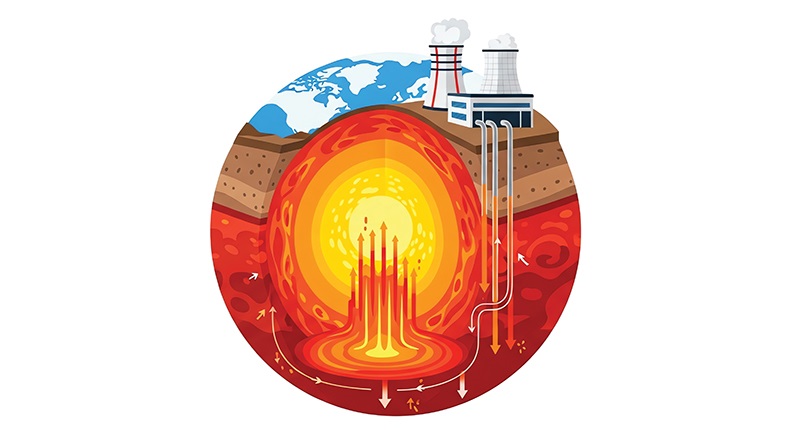
New enhanced geothermal systems (EGS) create their own reservoirs, drawing on methods first developed to pull oil and gas out from between layers of shale deep underground. Using horizontal drilling technologies to create boreholes that run at a diagonal from the Earth’s surface, they reach down 15,000 feet or more to hit areas of extremely hot rock, where temperatures reach 500°F or higher. By circulating water through those layers, developers create steam under intense pressure that’s driven back up production well pipes and used to power steam generators to produce electricity.
This is the technology Houston-based Fervo Energy is using in its development of a 400-MW plant in Beaver County, Utah. It’s expected to begin generating this year and reach full production in 2028. The company previously partnered with Google on a 3.5-MW project that’s helping support that company’s data center demand in Nevada.
Things are getting hotter
At Newberry Mountain, also known as Newberry Volcano, in central Oregon, developer Mazama Energy recently completed proof-of-concept drilling to temperatures reaching 629°F at a relatively shallow 10,200 feet. The company then created a trademarked lattice-like production field and was able to circulate water through that field that returned as steam through a nearby production well. This success demonstrated connectivity between the two wells and the ability to eventually generate electricity more efficiently than before, given the higher temperature of the steam they created. A 15-MW pilot generating plant is expected to be operating by the end of 2026 and is planned to be scaled up to 200 MW.
In a parallel effort, Mazama will attempt to take its technology to even hotter levels, to what’s called superhot rock, where temperatures exceed 750°F. At these temperatures, water becomes supercritical, meaning it’s no longer distinctly a liquid or a gas and gains greater heat-transfer capabilities. The company says this would allow for up to 10 times more power density using 75% less water and 80% fewer wells than current EGS approaches.
Pete Lumley, Mazama’s director of communications, is bullish on this technology’s ability to deliver clean, baseload generation across the globe.
“The majority of the world has access to the potential of superhot rock, where we create our own reservoir—there’s more energy available from the Earth’s heat than there are fossil fuel reserves in the world,” he said. “So, we get clean, carbon-free energy at numbers greater than what we see in fossil fuels. It’s going to provide energy security and raise people out of energy poverty.”
Moving off the volcano
Lumley concedes Newberry Mountain is a unique location. Though it’s been quiet for more than 1,300 years, it remains an active volcano, so superhot rock is much closer to the surface there. In general, though, Lumley said the western United States offers good opportunities for reaching high-temperature rock at accessible levels, but in “the eastern side of the United States, you’re looking at having to drill 10 kilometers [more than 6 miles] to get to 400°C.”
This situation could raise the same transmission quandary faced today, getting wind and solar energy from resource-rich Western states to load centers in the east.
“If there’s a lot of success, people might want to take the opportunity to drill these deeper, more expensive wells on the eastern seaboard, as well, or those that want to use this energy may have to be located in the West, which could free other resources in the East that could be satisfied with an energy mix,” Lumley said. “Because with superhot rock, energy is 24/7, it’s not intermittent like we have with solar and wind, so these three clean energies can work together.”
stock.adobe.com / Aksal
About The Author

ROSS has covered building and energy technologies and electric-utility business issues for more than 25 years. Contact him at [email protected].