The 2026 edition of the National Electrical Code saves its biggest structural moves for the back half of the book. The changes in chapters 5–8 include a new article for off-road electric vehicles, a ground-up reorganization of limited-energy wiring and the end of Chapter 8’s long-standing independence. Here is a look at the changes spanning articles 500 through 840 and what they mean on the job.
Article 550, Manufactured Homes
Section 550.13(B) now simply references 210.8, deleting the stand-alone list of locations requiring GFCI protection inside a mobile or manufactured home. After several cycles of divergent rules, GFCI scope in manufactured housing matches any other dwelling unit. New Section 550.51(E) requires a surge protective device complying with 230.67 when existing service equipment is reconnected to a replacement home.
Article 555, Marinas and Boatyards
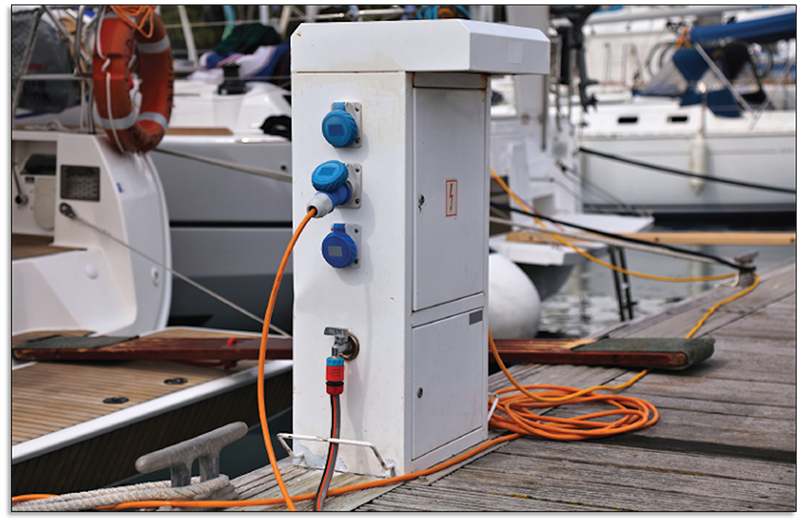
At marinas, Section 555.5 raised the maximum AC voltage from 250V to 600V phase-to-phase, recognizing the enhanced distribution systems needed to handle the larger loads showing up at docking facilities and piers. New Section 555.35(F) requires GFPE systems to be coordinated and performance tested by an approved method, with a written record made available to the authority having jurisdiction. Section 555.35(B) resolves the old fire pump conflict requiring ground-fault monitoring on fire pump monitoring alarms that include audible and visible warning when leakage currents exceed 100 milliamps.
New Article 624, Electric Self-Propelled Vehicle Power Transfer Systems (ESVSEs)
New Article 624 covers electric self-propelled vehicle power transfer systems—equipment that does not fit the Article 100 definition of “electric vehicle” because it was never built for road use. Think equipment such as electric forklifts, airport ground support equipment, tractors and construction equipment, golf carts, and boats and ferries. Three new Article 100 definitions support it: electric self-propelled vehicle, supply equipment and power export equipment.
Article 625, Electric Vehicle Power Transfer System
Section 625.43 was restructured, and the change buried in 625.43(A) is significant. A disconnecting means is now required for all electric vehicle service equipment (EVSE), not just EVSE rated 60A or more or over 150V to ground. Smaller chargers that needed no disconnect under the 2023 code need one now. Those thresholds did not disappear entirely—under 625.43(C), a cord-and-plug-connected unit not exceeding 60A or 150V to ground can still use the plug as its disconnecting means.
Section 625.43(D) adds an emergency shutoff for permanently connected equipment in other than one- and two-family dwellings. It must be readily accessible and visible, located not less than 20 feet and not more than 100 feet from the equipment, be a manual reset type and marked “EVSE EMERGENCY DISCONNECT” and “WARNING: ELECTRIC VEHICLE(S) WILL REMAIN ENERGIZED.”
New Section 625.5 requires permanent field marking of supply voltage, number of phases, frequency, full-load current and short-circuit current rating on the outside of the enclosure, and this marking should be visible after installation. New Section 625.4 requires qualified people for permanently installed equipment. And Section 625.42(A) renames the energy management system a power control system, redirecting users from Article 750 to Article 130, Part II.
Article 680, Swimming Pools
In Section 680.26(B)(2), the perimeter surface equipotential bonding requirement was increased from 2 feet to 3 feet below maximum water level. On raised or stepped decks, that changes the bonding envelope, which is not a correction anyone wants to write after the concrete is poured. The same section now recognizes 40% copper-clad steel conductors. Section 680.22(B) adds festoon lighting to the outdoor clearance requirements, so string lights over a pool deck must meet the 12-foot minimum height above maximum water level, extending 5 feet horizontally from the inside walls.
Chapter 7 was rebuilt: New articles 720, 721, 722, 723, 742 and 750
The most consequential change in the 2026 NEC is the reorganization of limited-energy wiring. Six new articles now hold requirements that were previously scattered across articles 300, 725, 726, 760, 770, 800, 805, 810, 820, 830 and 840 and repeated in each of them.
Article 720 carries the general wiring requirements, and Section 720.4(A) establishes that only the sections of Article 300 it names apply, with Table 720.4(A) identifying which limited-energy articles are covered. Article 721 consolidates power sources for Class 2 and 3 circuits, Class 4 fault-managed power systems, and premises-powered broadband communication systems. Article 722 holds the cables, divided into nine parts by cable type. Optical fiber lands in Part VII, power over ethernet bundle ampacities live in Table 722.140(B), and PLFA cable applications sit at 722.170. Article 723 covers raceways, cable routing assemblies and cable trays. Article 742 addresses overvoltage protection. Article 750 becomes the single home for grounding and bonding of limitedenergy systems, with the requirements largely unchanged from 2023.
A new Article 100 definition of “limited-energy cable,” alongside a revised definition of “limited-energy system,” ties the structure together, and sections 722.13 and 722.15 now state, one time, the rules for installing limited-energy circuits with each other and separating them from power circuits.
The practical consequence is that familiar section numbers are simply gone. Sections 725.136, 725.139, 726.136, 726.139, 760.136 and 760.139 were all deleted.
Concrete gets deeper: 695.7(A)(2), 700.10(D)(2) and 708.10(C)(2)
Fire pump feeders, emergency system feeders and COPS feeders share a revised encasement rule. The familiar 2 inches of concrete now requires a 2-hour fire rating documented by a qualified licensed professional engineer. Without that documentation, the encasement must be 5 inches. NFPA Research Foundation substantiation found that 2 inches of cover could allow compromise of the conductor insulation.
Chapter 8 is no longer an island: Section 800.1
For decades, Chapter 8 stood alone, independent from the rest of the code rules and applying only where other rules were specifically referenced in Chapter 8. Revisions to Section 90.3 end that. Chapter 8 is now subject to the general chapters, and the scope in 800.1 has been narrowed to communications wires and cables outside of and entering buildings. Everything inside the building moved to Chapter 7.
The ripple effects are everywhere. Section 800.24(A) was deleted, so workmanship on communications installations is judged by the “professional and skillful” language in 110.12. Antenna grounding and bonding moved from 810.20 and 810.21 into 750.66. Coaxial and broadband sheath grounding moved from 820.90, 820.93, 830.90 and 830.93 into 750.48. Article 830, Part IV moved to Article 722, Part IV.
Taken together, the 2026 changes to chapters 5–8 are about the NEC adapting and reorganization. Requirements repeated in 10 places now appear once. Chapter 8’s independence is gone. Off-road electric equipment finally has an article of its own. And if the reorganization feels disruptive, read Informative Annex L, which lays out the proposed structure for the 2029 NEC, where the chapter arrangement in place since 1937 gives way to something built for how the code is used today. The 2026 edition is the first step of that transition, and the contractors and inspectors who start navigating it now will spend a lot less time hunting for deleted sections later.
electrical training alliance / eaton corp. / cisco
About The Author

Kyle Krueger
Executive Director of Codes and StandardsKRUEGER is NECA’s executive director of codes and standards. He has worked in the electrical industry for over 25 years as an inside wireman, authority having jurisdiction and educator. Kyle currently represents NECA on the NEC Correlating Committee, Code-Making Panel 3, NFPA 72 Correlating Committee, NFPA’s Electrical Section Executive Board and the UL Electrical Council. Reach him at kkrueger@ necanet.org.