Jim Dollard has an extensive background in codes and standards. Send questions about the National Electrical Code (NEC) to Jim at [email protected]. Answers are based on the 2023 NEC.
Arc energy reduction
Does a 1,200A fusible disconnect with 1,000A fuses require a means of arc energy reduction?
No, see Section 240.67. This requirement is based on the installed fuse’s rating and does not address the size of the disconnect. Where fuses rated 1,200A or higher are installed and the fuse does not have a clearing time of 0.07 seconds or less at the available arcing current, a means of arc energy reduction in accordance with 240.67(B) is required.
Any grounding electrode?
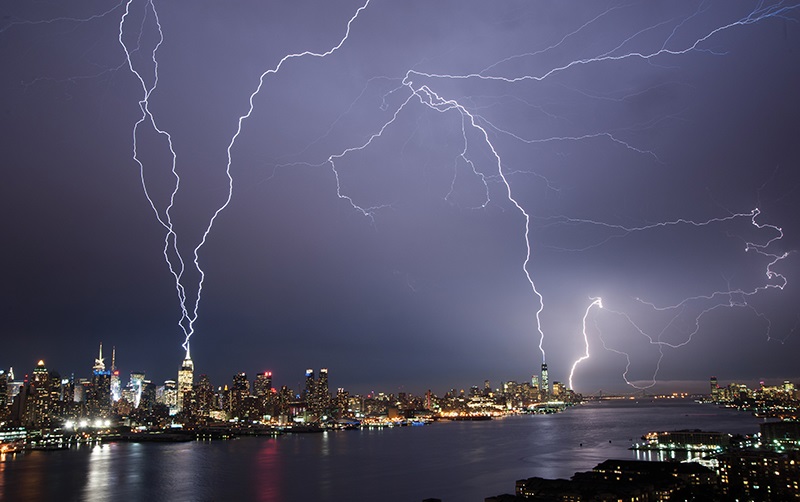
Where a lightning protection system is installed at a barn, are we permitted to tie our grounding electrode conductor to that grounding when taking a feeder to the barn?
No, see Section 250.60, which prohibits the use of conductors and driven pipes, rods or plate electrodes used for grounding strike termination devices instead of the grounding electrodes required for grounding wiring systems and equipment. It is important to note that this requirement recognizes that these grounding electrode systems must be bonded together.
Cybersecurity protections
What type of protection is provided for circuit breakers in a switchboard that can be monitored and operated over the internet? It would seem easy for someone to hack into the system and create havoc.
All electrical equipment must be approved by the authority having jurisdiction (AHJ). Typically, listed equipment will be judged to be satisfactory when installed in accordance with the product listing and labeling. See Section 110.3(A) list item (8), which requires network-connected life safety equipment to address its ability to withstand unauthorized updates and malicious attacks while continuing to perform its intended safety functionality. While this requirement is focused on life safety equipment, all network-connected devices should be evaluated.
Two informational notes send the code user to UL 5500, Standard for Remote Software Updates, and NEMA CY 70001, Cybersecurity Implementation Guidance for Connected Electrical Infrastructure, for more information.
Emergency shutdown of prime mover
Is an emergency stop button required for a 60-kilowatt (kW) generator installed in the basement of a commercial occupancy?
Yes, see Section 445.19. A remote shutdown device is required for generators with greater than 15-kW rating installed in other than one- and two-family dwelling units. The shutdown device is required to be located outside the equipment room in a readily accessible location and must be marked “Generator Emergency Shutdown.” Additionally, the shutdown device must be equipped with provisions to disable all prime mover start control circuits to render the prime mover incapable of starting and must initiate a shutdown mechanism that requires a mechanical reset.
Type IC required?
AAre small, recessed LED type lights required to be IC-rated? While they will contact insulation in some areas, they do not create heat like an incandescent lamp.
Yes, recessed LED luminaires that will be in contact with thermal insulation are required to be IC-rated. Thermal insulation is not permitted to be installed above a recessed lighting fixture (luminaire) or within 3 inches of the recessed luminaire’s enclosure, wiring compartment, ballast, transformer, LED driver or power supply unless the luminaire is identified as Type IC for insulation contact. See Section 410.116(B).
Listed Class 4 systems
When installing a Class 4 power system, is it permitted to mix and match components based on market availability?
Class 4 fault-managed power systems must meet the requirements of Article 726. Section 726.2 contains listing requirements. Terminals and connecting hardware used on Class 4 distribution systems must be listed, and Class 4 systems must have a power source listed as a Class 4 power transmitter or Class 4 power transmitter as part of a transmitter/receiver system. All the equipment and active components that are part of a Class 4 system must be listed as a Class 4 device. In some cases, the listing information will include listed compatible devices because the device may depend on specific system devices for interoperability, monitoring or control.
FS single device box support
Does the code permit an FS box with a single receptacle to be supported only by a short length of rigid metal conduit?
Yes, Section 314.23(F) provides requirements for enclosures that contain devices supported by entering raceways. The general rule is that the enclosure cannot exceed 100 cubic inches in size and must have threaded entries or identified hubs. The box must then be supported by two or more conduits threaded wrench-tight into the box, with each conduit secured within 18 inches of the box. See Exception No.1 following 314.23(F), which permits a single-gang FS device box to be supported by a single RMC or IMC.
Damaged wiring and equipment
Is there an NEC rule requiring conductors and a transformer exposed to high temperatures to be tested or replaced? We are replacing a significant amount of electrical equipment that was damaged by water in a fire. However, we know the electrical room saw extreme temperatures setting off the heat detectors, but the insurance company is pushing back.
Section 300.4(C) requires all conductors and wiring methods that are no longer suitable for use due to damage, such as overheating, fire damage, corrosive influences or water, to be replaced. Conductors can be visually inspected and tested if necessary to decide on suitability for continued use. While this section does not specifically address heat-damaged electrical equipment (it only addresses conductors and wiring methods), Informational Note No. 2 sends the code user to NEMA GD 2-2021, Evaluating Fire- and Heat-Damaged Electrical Equipment, for information on electrical equipment and wiring methods damaged by fire or heat. This document provides prescriptive guidance requiring dry type transformers be replaced where damaged by heat from a fire. It may be necessary to have a testing company test the transformer windings. See also Informational Note No. 1, which sends the code user to NEMA GD 1-2019, Evaluating Water-Damaged Electrical Equipment, for information on electrical equipment and wiring methods damaged by water.
On-site optional standby power source labeling
An inspector required us to have a permanent label on the outdoor service disconnect for a home to note that there was a generator on-site. Is that a code requirement or just a local thing?
Where an optional standby power system is installed for one- and two-family dwellings, Section 702.7(A)(1) requires signage in the form of permanent placards, labels or directories at the disconnecting means required in sections 225.41 and 230.70(A)(2) to indicate there is an optional standby power source and the location of the disconnect or means to shut down the prime mover. The AHJ can approve another readily visible location for the required signage.
stock.adobe.com/Zina Seletskaya
About The Author

DOLLARD is retired safety coordinator for IBEW Local 98 in Philadelphia. He is a past member of the UL Electrical Council, NEC Correlating Committee, NEC CMP-10, CMP-13, CMP-15, NFPA 90A/B and NFPA 855. Jim continues to serve on NFPA 70E as a Special Expert. Reach him at [email protected].