In the last 20 years, there has been some harmonization of the standards from the Institute for Electrical and Electronics Engineers (IEEE) and the International Electrotechnical Commission (IEC). The IEEE is most dominant in North America, though the standards are recognized worldwide, and the IEC developed the standards generally adopted by most of the rest of the world.
The flickermeter standard covered in IEEE 1453 is now based on IEC 61000-4-15, and is mainly concerned with limits in later revisions. The same is true with harmonics covered under IEEE 519, which is based on measurements from IEC 61000-4-7.
IEEE 1346-1998
Most of the IEEE standards that cover power quality are developed by working groups in the PQ Subcommittee under the Transmission and Distribution Committee of the Power and Energy Society of IEEE. I think one discontinued IEEE standard is key to understanding why we do what we do, or, why PQ is important: IEEE 1346-1998, IEEE Recommended Practice for Evaluating Electric Power System Compatibility With Electronic Process Equipment.
IEEE 1346 was developed by a group under the Industrial Application Society. It discussed in detail how to evaluate if an electrical power system is capable of providing the voltage, current and frequency that the load requires.
An easy way to think about it is to remember that people care about warm pizza and cold beer. Is the equipment or process running properly to produce the quality product needed, whether that’s welded car bodies or data transmissions keeping the financial world operating continuously? A voltage sag generally doesn’t matter if the process wasn’t disrupted. My electric toaster operates just fine with 10% harmonic voltage distortion.
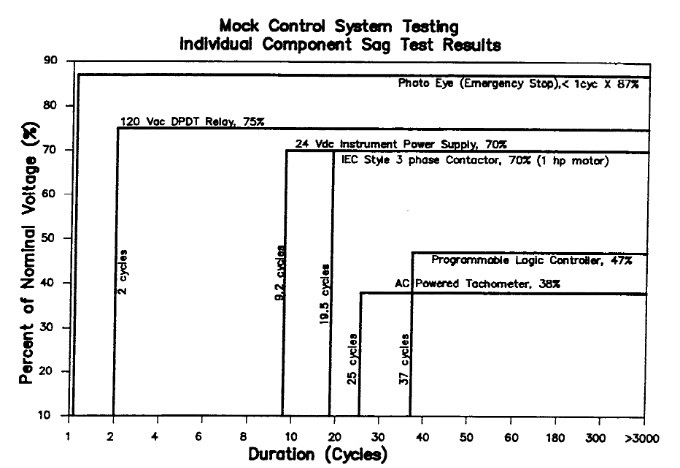
IEEE 1346 had a single graph that explained it all, though it did require a bit of explanation for first-time viewers. The graph above shows the level of residual voltage during a sag and the amount of time before a piece of equipment or device misoperates.
In the example used in the graph, an emergency stop photo cycle could trip offline with a sag to 88% of nominal voltage for just one cycle (16.6 milliseconds), whereas the programmable logic controller would ride through for up to 37 cycles at just 47% of nominal voltage. The graph got a bit more complex when a set of contour lines were added to represent the typical voltage sag magnitudes and durations that occurred at the site. With that data, a facility manager could determine how often a given production line would typically be disrupted due to voltage sags.
The graph also pointed out what equipment would benefit from some mitigation equipment such as an uninterruptible power supply. Add in the cost of downtime for that production line, and an economic justification for a PQ monitoring and mitigation solution could be presented to those in the company who sign off on such purchases.
Times change
You might note that the last revision to the standard is 1998. Since standards must be updated at least every 10 years, this standard fell by the wayside, due to a host of reasons, despite its importance to the providers and consumers of electrical power. IEEE 1346 was withdrawn.
At last, a new document addresses this concern: IEEE 2938-2023, IEEE Guide for Economic Loss Evaluation of Sensitive Industrial Customers Caused by Voltage Sags is similar to the defunct IEEE 1346. The guide provides a reliable method of evaluation for said sensitive industrial customers, which includes the costs of power quality monitoring and voltage sag mitigation projects.
It covers typical test results for equipment similar to what you see in the figure, adding personal computers, high-pressure sodium lights, metal halide lamps and others. Procedures detail how to go about collecting the data needed to make the case for those responsible for keeping thing running smoothly, such as facility managers.
It is also a valuable tool for electrical contractors to justify to customers the equipment and tests needed to monitor and mitigate power quality problems. As the old adage goes, what gets measured, gets managed.
Be sure to note that IEEE documents are not a common resource for electrical contractors, as compared to the National Electrical Code. The standards are developed primarily by engineers, especially those in the electrical utility industry. However, others across the power quality industry also contribute to these standards. IEEE 2938 has applications for the United States and China, since the data gathered was from both countries. Future articles will discuss how this new guide can be applied to help contractors make and save money.
IEEE 1346
About The Author

BINGHAM, a contributing editor for power quality, can be reached at 908.499.5321.