Thirty miles can seem daunting in a transmission line rebuild project, especially when there is no telling what you’ll find along the way. Now add the mind-numbing cold and intense Minnesota weather over the course of a nearly year-long project.
That’s what Hooper Corp., DeForest, Wis., faced in late 2024 as it began a rebuild of Xcel Energy’s 5300 161-kilovolt (kV) transmission line from the South Bend Substation in Rapidan, Minn., to the Huntley substation southward in Winnebago. The latter handles several voltages up to 345 kV.
The project was part of the Midcontinent Independent System Operator’s (MISO) 2022 Midwest Transmission Expansion Plan, or MTEP22, which covered 382 total projects and an estimated investment of more than $4 billion.
The project wasn’t easy, considering weather that was tough even for the Hooper crew of 30, a combination of local and Midwest labor, and the discovery of an artesian well that was discharging 80 gallons of water per minute.
But against these unlikely odds, the rebuild, designed to greatly increase load in that area, was finished a full two months early, thanks to astute coordination. That left everyone, especially Brad St. Germain, Hooper‘s senior project manager, extremely satisfied.
“It was a tremendous success,” St. Germain said. “Xcel was certainly thrilled with the outcome to finish ahead of schedule, especially with the artesian well issues. Overall, the main story for Hooper is it’s the first of many projects Xcel has had planned for the next couple of years.”
Hooper executed the South Bend-to-Huntley rebuild at a cost of $17 million after bidding the project in 2023, and it was one of the first to be completed under the MTEP22 plan. Hooper will soon be working on another major project under the plan—a more than 100-mile, 345-kV effort from Mankato to Rochester, Minn.
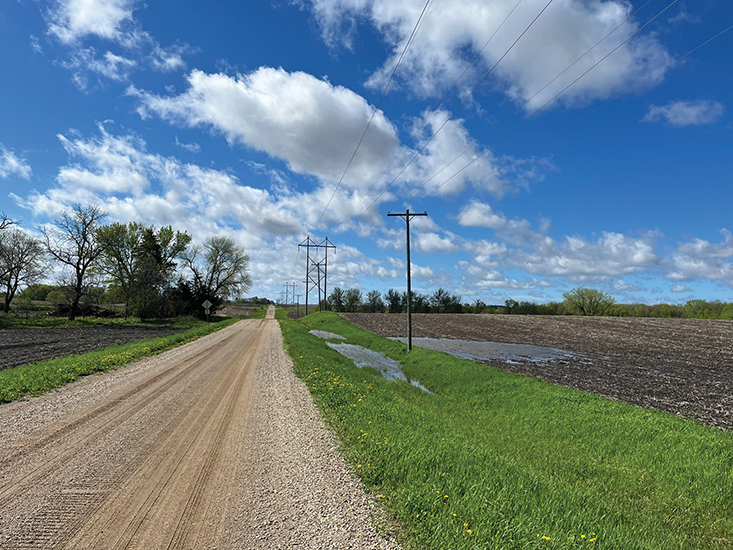
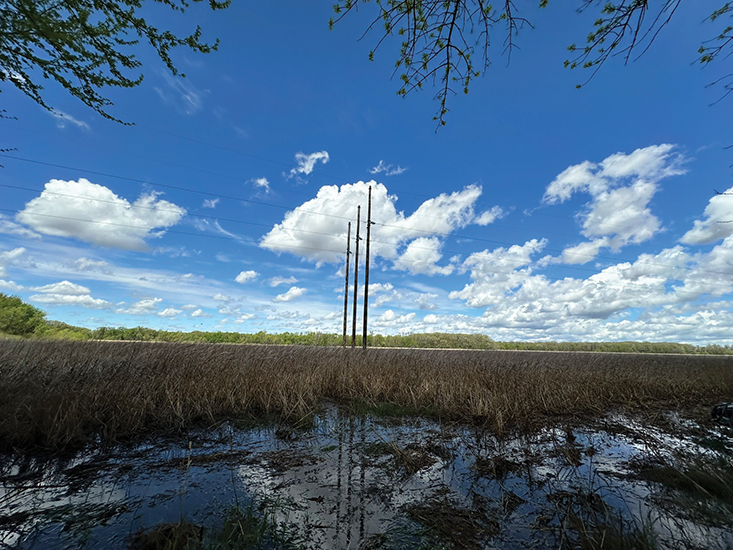
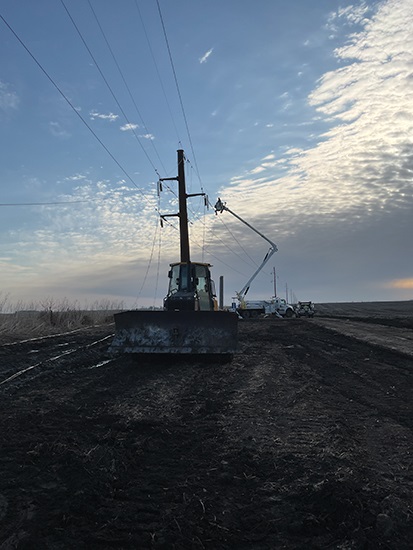
A high water table, with standing water in some locations, created challenges for site access.
A high water table was a concerning issue
There were complications on the South Bend-to-Huntley project even before the rebuild started in November 2024. Rapidan Substation, the local counterpart to South Bend Substation, was washed away that June, affecting 600 customers. The Blue Earth River overflowed and swept the equipment that made up the 69-kV substation down the river. St. Germain said Xcel Energy installed a temporary mobile substation at the 161-kV South Bend Substation to cover the distribution load.
Though that problem was fixed by November, it belied a potentially concerning issue for the South Bend-to-Huntley project team, including St. Germain.
“They have a high water table, so that added to the access challenges,” he said. “The weather impacted how we approached the project. There was a lot of standing water out there, so we were looking for a way to reduce the access area.”
That meant working in the cold weather to mitigate the water and access concerns. As many as 4,500 timber access mats were used during the winter of 2024–25 for material transportation. Use tapered off as the weather improved, St. Germain said. Access mats measure 4 feet wide and 16 feet long.
“The most matting was in the winter, and we reduced matting as we went,” St. Germain said, adding that the matting “went to the worst areas in the winter.”
Drill rig plays pivotal role
All this was necessary to replace the 220 wooden H-frame structures along the 161-kV transmission line from Rapidan to Winnebago. These H-frames likely dated back 70 or so years, according to St. Germain.
“They were at the end of their useful life,” he said. “Typically, these wood-pole lines are designed for 50 years. Once you get over that, it’s time for replacement.”
Removing the ancient H-frame structures was one challenge. Quite another was replacing them with 192 direct-embedded steel monopoles and 28 foundation steel structures.
-j.jpeg?sfvrsn=53e4a7c5_1)
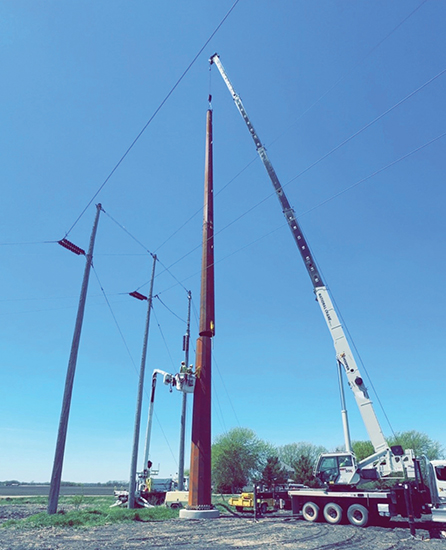
New steel monopoles were installed, including 192 direct-embedded poles and 28 foundation steel structures.
New technology was the catalyst for success. Hooper used its new TR60 drill rig from Bay Shore Systems Inc., Rathdrum, Idaho, for direct-embed drilling. Featuring a 100% hydraulic Kelly winch, the TR60 features 65,000 foot-pounds of rotary torque that can drive holes with a maximum depth of 80 feet and a diameter of 108 inches.
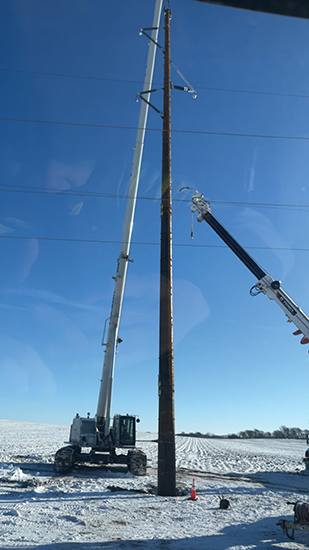
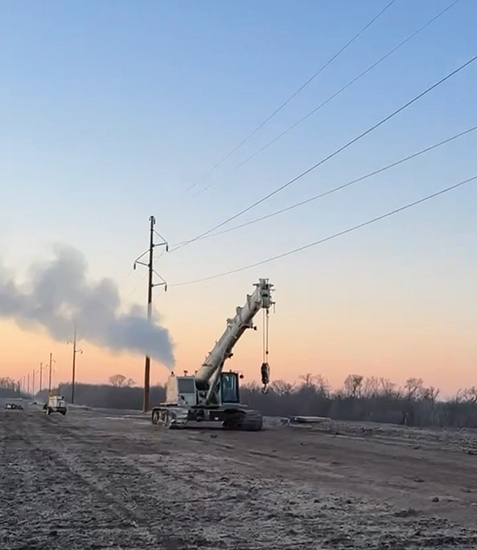
Hooper used the TR60 to install corrugated metal pipes, then placed the steel monopoles using a telescoping boom crane.
There was a logical reason to use the TR60, St. Germain said, and it wasn’t just its capacity to spin the auger into the ground. The equipment’s total mast height was less than 20 feet, so Hooper didn’t have to move any of the overhead transmission lines.
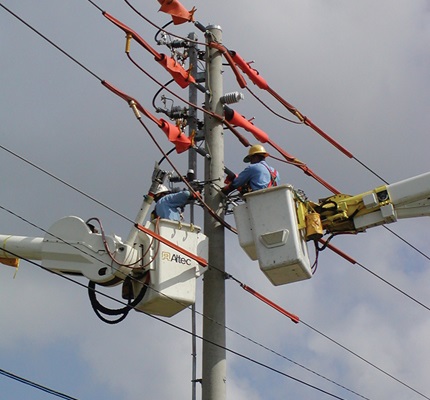
“We left the existing line intact,” he said. “We set the new poles, then transferred the conductors to the new poles before removing the H-frame.”
St. Germain added that his team was able to do up to seven of these changeovers a day, each averaging about two hours.
That’s not all. For the remaining 28 foundations for the steel structures, subcontractor Tri-State Drilling, Plymouth, Minn., used drilled-concrete pier foundations. Once again, there was simple rationale for using that method for some poles, but not all.
“When you have a mixture of direct-embed versus drilled-concrete pier, it’s a cost reduction effort,” St. Germain said, adding Xcel Energy coordinated engineering for the entire project through Ulteig.
In between the new monopoles, the transmission line was upgraded with bundled 636 ACSR Grosbeak/VRC conductor, or a twisted-pair conductor type, which provides advantages beyond one single wire per phase, St. Germain said.
“It’s self-dampening wire that helps reduce vibration and helps to shed ice, if you get ice on the conductors,” he said.
Another advance was the 48-fiber optical ground wire, which acts as a shield wire for the conductors, and also operates as the backbone for a private telecommunications network between the South Bend and Huntley substations.
It wasn’t long before water once again proved to be problematic, however.
Roughly halfway through the project, near Amboy, Minn., the Hooper work crew discovered an artesian well discharging about 80 gallons of water per minute—not an insignificant amount. It took Xcel Energy about five weeks to cap the well, St. Germain said, causing Hooper to reroute its work.
“We had to find a workaround,” St. Germain said. “We were able to reroute resources. We were able to move crews around so we didn’t experience delays in the project.”
Local communities play a big role
Many local support services were needed in the magnitude of the South Bend-to-Huntley project, which is where the local communities excelled.
“One thing that was very impactful is there was a lot of really good cooperation with the local communities, especially Winnebago,” St. Germain said.
 |  |  |
That included independent contractors in Rapidan and Winnebago that helped with acquisition and transfer of materials and renting space for laydown yards.
“The local community really welcomed us in our efforts,” St. Germain said. “We didn’t have any negative interactions with landowners and farmers in the area.”
He did note that, once in a while, a landowner would visit his work crew to get a sense of what was happening on their land. The project was easement-based, meaning those landowners signed an agreement for Xcel Energy to upgrade the lines as needed.
“That is typical,” he said. “You’ll find a couple of landowners that take quite an interest. The utility only comes through every 30 or 40 years.”
An Xcel Energy spokesperson noted, “As a transmission owner and member of MISO, we submitted the project to MISO and it was approved to be included in its annual (Midwest) Transmission Expansion Plan. This was the first project in a series of projects as part of that plan. Since we own the infrastructure, we covered the project cost.
“We worked with many stakeholders throughout this project, including neighboring utilities, municipalities and landowners to meet community needs and ensure smooth operations,” the spokesperson added. “Much of the project’s construction occurred through commercial agricultural farming operations, and engaging with the owners early was essential to its success.”
In the end, Xcel Energy and Hooper weren’t the only ones satisfied with the outcome. So was BENCO Electric Cooperative, which serves 20,200 customers in south-central Minnesota.
“Anytime they redo a transmission line, it benefits our customers,” said Chelsea Germo, BENCO’s marketing manager. “We are not a transmission company, we don’t have our hands in the operational side, but the people that are affected are our members.”
Germo said the results are readily apparent, with greater reliability with a load that is constantly shifting.
“At the end of the day, big picture, it’s a better grid,” she said.
Hooper Corp.
About The Author

VOSS is a freelance writer based in the Chicago area and has worked extensively in the low- and high-voltage areas of the electrical industry. Contact him at [email protected].