This month, my column in the magazine begins a series of articles on the technology behind fiber optic communications. In this article, I will delve deeper into the technology. I know that some of this tech stuff looks like magic. In fact, I often start lectures about it with a slide of this quote by Arthur C. Clarke, author of “2001 A Space Odyssey”: “Any sufficiently advanced technology is indistinguishable from magic.”
I’ll make this “magic” understandable and explain how it works. Let’s start with how signals are transmitted in telecommunications.
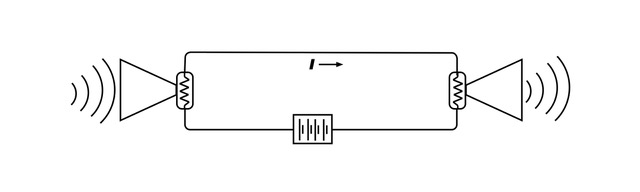
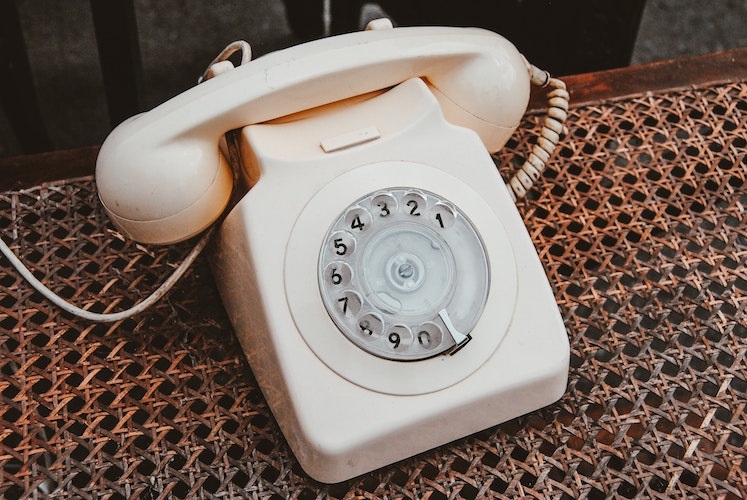
POTS—plain old telephone service—worked on a simple current loop.
For the first century, phones worked essentially the same way. A microphone converted sound into an electrical signal by varying resistance in a current loop and a speaker converted the current back into sound. The limitation of that system of analog transmission was the limit on long-distance transmission caused by electrical noise and, of course, a current loop could only support a single user at a time.
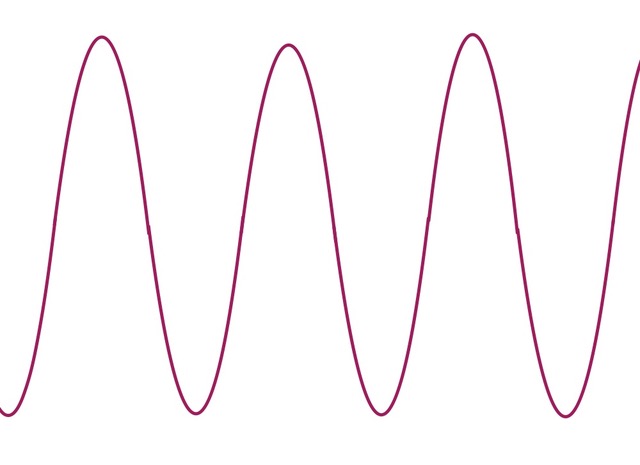
Analog signal – a sine wave
Consider a simple analog signal—a sine wave. Think of a perfect musical note and how it sounds.
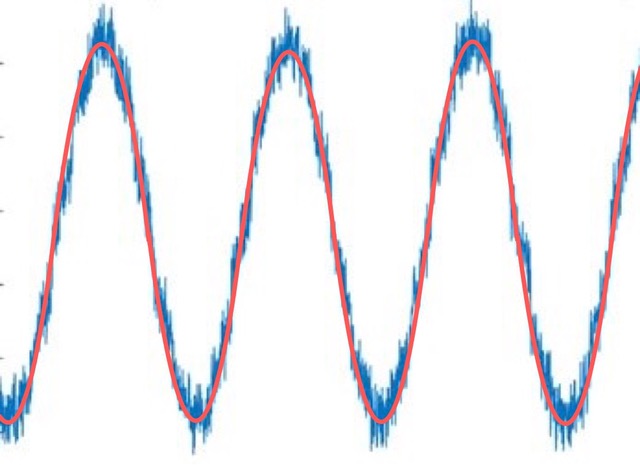
Analog signal (sine wave) with noise
The problem with analog signals is noise, which you can hear with AM radio, for example. Electronic systems always have noise, some created by the circuits themselves and some created by external sources. The problem with noise is it can make communications hard to understand, especially when long transmission lines attenuate the signal and pick up more noise.
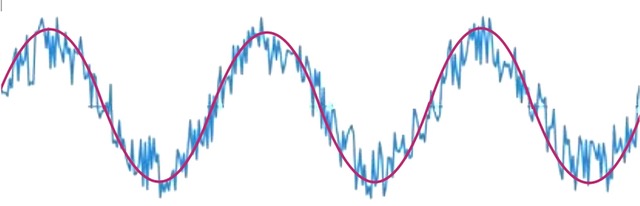
Noise in the sine wave is now much greater in proportion to the signal.
In 1948, Bell Labs mathematician Claude Shannon published a paper called “A Mathematical Theory of Communications.” Shannon’s paper said that the solution to transmitting information farther and faster was to digitize the information, converting the analog electrical signal to digital using a series of “1s” and “0s”—binary data like is used in computers.
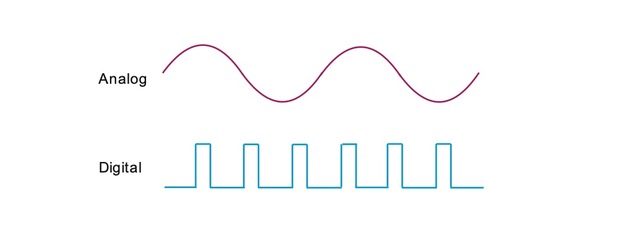
Analog (sine wave) signal vs. digital signal (1s and 0s)
Converting analog signals to digital requires special electronics to sample the analog signal at sequential times and convert the signal to binary digits. The sampling must be done at exact periods and at relatively high speeds. To digitize the analog voice signal on the phone, which is in the frequency range of 0–4,000 hertz (cycles per second), requires sampling the signal 8,000 times per second.
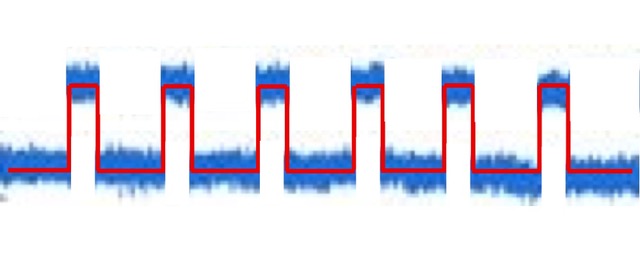
Digital signal with noise showing how 1s and 0s are easy to distinguish even with noise.
Digital signals were practically immune to noise, so greater distances and higher speeds were achievable. Digital signals also allowed multiple signals on a single channel—another advantage over analog transmission.
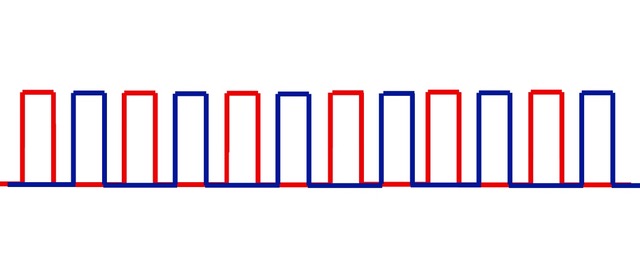
Multiplexing two signals (blue and red) on one circuit by sending pulses at different times
Implementing Shannon’s principles in the phone system could not be done overnight. Many technologies needed to be developed before it could become practical. Digitization of the phone system had to wait until the development of semiconductors and integrated circuits in the 1960s and 1970s.
The conversion of the phone networks to digital was occurring at the same time as the conversion from copper wires, radio waves and satellites to fiber optics.
More to come.
All illustrations by Jim Hayes
About The Author

HAYES is a VDV writer and educator and the president of the Fiber Optic Association. Find him at www.JimHayes.com.