I was recently interviewed for a new book about the history of fiber optic communications as it spread around the world. During our conversation, I pointed out some of what I thought were the most important technological advances in fiber optics during its relatively short 50 year history.
Those technological developments were, in chronological order:
- Optical fiber usable for communications—the idea won Charles Kao a Nobel Prize, while Corning made it practical
- Solid-state lasers for fiber optic sources
- Single-mode fiber expanded fiber distance and bandwidth
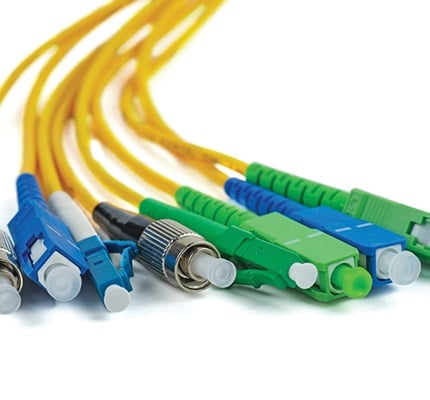
- Ceramic ferrules for connectors made connections better and more reliable
- Wavelength division multiplexing (WDM) allowed multiple channels on a single fiber
- Distributed feedback lasers enabled WDM and hybrid fiber coaxial CATV networks
- Passive optical networks made fiber to the home cost effective
- Coherent transmission allowed major speed and distance advances
- Bend-insensitive fibers enabled smaller cables and more fibers in cables
The second tier of developments include loose-tube cable, optical power ground wire (OPGW) for utility transmission lines and ribbon cables (including the newer flexible ribbons, microcables and high-fiber-count cables. Perhaps we should also include physical contact connectors, miniature connectors and fusion splice-on connector termination. But these are really low-tech developments compared to the above.
Communications technology
This list only covers fiber optic technology. We could also look at communications technology, where we would add digital communications, ethernet and the internet, which has been driving communications growth for the last 30 years. New hardware should also be noted, including computers—from mainframes to PCs, smartphones and tablets—along with the applications they spawned for personal and commercial use, which have led to the need for data centers to manage the massive amount of information created every millisecond.
What was first and what comes next?
There is a bit of “Which came first, the chicken or the egg?” in these technological developments. Did fiber advances in speed and distance facilitate the development of technologies that use more bandwidth, or did technology evolve to require faster communications? The answer, as usual, is both, and we exist in a never-ending cycle of technological development—and catch-up.
I often wonder what the next big thing in fiber optics will be. Researchers are looking at how to get more bandwidth and distance from fiber. Proposed solutions include quantum theory, entangled particles and other ideas that seem more like magic, until they become practical.
More realistic solutions include simply adding more cores to a single fiber. Multicore fibers with two or four cores are already used in submarine cables. More cores could be possible but would require solutions to break out each core to an individual fiber to connect to communications equipment.
Another new technology is hollow-core fiber, which offers lower link latency—how long it takes a signal to get from one end of the fiber to another. In regular fiber, light traveling in the glass core travels at about two-thirds the speed of light in air or a vacuum. In hollow-core fiber, the light travels in air, and the speed is about 50% higher than in glass. This reduces latency, a big factor for some users of fiber such as high-speed stock traders. Some private links are already using hollow-core fiber.
It is interesting to note that all the technologies in my list above are still in use every day, a confirmation of their importance to fiber optic technology. But there are other technologies that probably should be obsolete. Top of this list is multimode fiber. When I was introduced to fiber optics at Bell Labs in 1977, they were already preparing for the move to single-mode fiber. Multimode fiber had higher attenuation, lower bandwidth and problems with modal noise, making it unsuitable for telco use.
Single-mode fiber dominated telco applications as soon as it was available. Multimode fiber persisted for use in premises cabling because it could use cheaper LED sources and, as speeds increased to 1 gigabit/second, cheaper VCSEL sources. Multimode fiber, however, is bandwidth-limited, a problem for gigabit networks. Today, it is more expensive to make multimode fiber, and lasers for single-mode fiber are cheap, making a single-mode link a much more sensible choice. How much longer can multimode fiber hang on?
What will stick around, and what is the next big thing in fiber optics? Good question. I guess we’ll just wait and see!
stock.adobe.com / Nattapol_Sritongcom
About The Author

HAYES is a VDV writer and educator and the president of the Fiber Optic Association. Find him at www.JimHayes.com.