Last month, I gave my selection of the most important developments in fiber optics from its beginnings to today, and highlighted a few that might be the next big thing. It occurred to me that it would be interesting to delve into the development of the technology a bit deeper, looking not just at the technology itself, but at some of the individuals who helped develop it.
I know some of this tech stuff looks like magic. I often start lectures about it with a slide of an observation by Arthur C. Clarke, author of “2001: A Space Odyssey.” According to Clarke, “Any sufficiently advanced technology is indistinguishable from magic.”
How can we send signals containing billions of bits per second down hair-thin strands of glass for thousands of kilometers? We could even take a step or two back—how does the internet work, or telecommunications, or even the original phone system that developed fiber optics as part of its technical progress?
First, a little background
For the first century, phones worked essentially the same way. A microphone converted sound into an electrical signal by varying resistance in a current loop, and a speaker converted the current back into sound. On that system of analog transmission, there was the limit on long-distance transmission caused by electrical noise and, of course, a current loop could only support a single user at a time.
All that began to change in 1948 when Bell Labs mathematician Claude Shannon published a paper called “A Mathematical Theory of Communication.”
Shannon had an undergraduate degree in electrical engineering and mathematics from Michigan and a Ph.D. from MIT in mathematics. While working at Bell Labs on cryptography during World War II and with Vannevar Bush at MIT on early computers, he worked with many pioneers of information theory and computers.
Shannon’s paper said that the solution to transmitting information farther and faster was to digitize the information by converting the analog electrical signal to digital—a series of “1s” and “0s,” binary data like what is used in computers. Digital signals were practically immune to noise, so greater distances and higher speeds were achievable. Digital signals also allowed multiple signals on a single channel, which offered another advantage over analog transmission.
There was a lot more in Shannon’s paper than just the solution to expanding the capacity of the phone system; the paper is often credited with creating the background technology of the information age. It also introduced a concept now known as the “Shannon Limit,” a universal way to show the theoretical limit of the information carrying capacity of a network.
Implementing Shannon’s principles in the phone system could not be done overnight. Many technologies needed developing before it could become practical. Technology to convert analog signals to digital had existed in the 1920s to improve the speed of telegraphs, but it used vacuum tube amplifiers, which were too slow, expensive, power-consuming and unreliable for the phone system. Digitization of the phone system had to wait until the development of semiconductors and integrated circuits in the 1960s and 1970s.
My front row seat
I personally had a front row seat to the implementation of the digital phone system, working for two pioneering semiconductor companies with the analog/digital and digital/analog converters needed for this transition. During this time, I traveled the world teaching telcos and their suppliers about digital telephone networks and the new integrated circuits becoming available to convert analog plain old telephone service lines to digital signals.
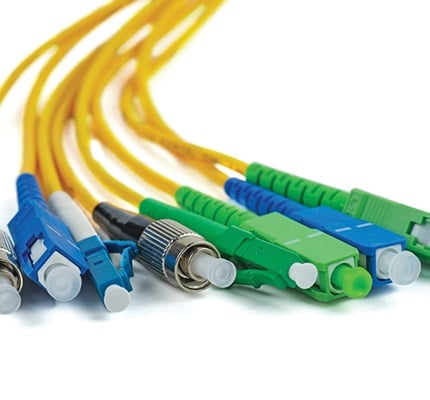
The shift of the phone networks to digital was occurring at the same time as the conversion from copper wires, radio waves and satellites to fiber optics. I was introduced to fiber optics at Bell Labs by the researchers inventing a lot of the technology needed to convert the phone network into fiber optics. While the optical fiber manufacturing technology was being developed at Corning Glass, Bell Labs was developing the practical equipment to digitize phone lines—lasers needed for transmitters and various components for the cable plant such as cables, splices and connectors.
I was invited to see and evaluate the need for manufacturing and test equipment. After my visits to Bell Labs, I became convinced the two technologies would revolutionize the phone system, but the company I worked for was not interested. I held on to the idea, and in 1980 became an entrepreneur in this new technology. That led to my direct involvement in much of the development of fiber optics. The progression of this technology has been swift. More to come.
stock.adobe.com / nerthuz
About The Author

HAYES is a VDV writer and educator and the president of the Fiber Optic Association. Find him at www.JimHayes.com.