In this month’s magazine column, I described my recent experience touring a modern data center and that it occurred to me how the general design of a data center is a good model for any smart building. Let’s look into the design of a smart building in more depth.
“Smart” may be getting worn out from overuse¾what does it mean for a building to be smart? In most cases, what smart really means is designing or upgrading buildings to modern standards of technology, especially communications.
Smart buildings are modern buildings that use technology to make them more secure (video surveillance, security systems, etc.), efficient (HVAC, electrical, lighting, environmental controls, etc.) and offer modern communications services (internet, wireless, etc.) to support the needs of the building’s occupants, including locations for computing and communications networks. These basic needs are common to most modern buildings, whether the building is an office tower, retail store, manufacturing plant or even a data center.
One consideration in designing or updating a building is whether it is occupied by one organization or several. Single-occupant buildings are easier to build; once you add multiple occupants, you have to duplicate some services and consider additional security within the building also.
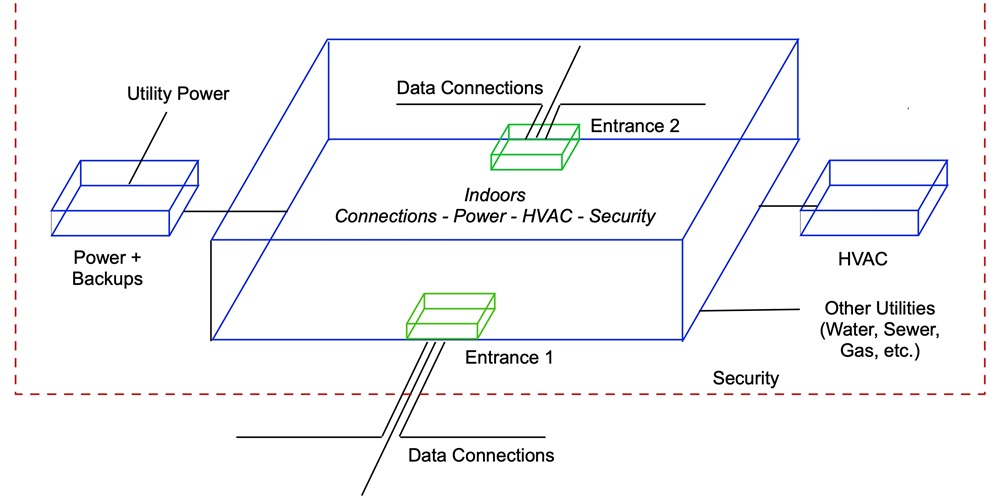
Let’s start with the entrance facility. Organizations depend on reliable high-speed internet services for their business. Most want more than one internet service provider (ISP) for backup and additional capacity during times of high usage. Every building needs a secure room for their communications connections and hardware.
It’s the hardware that can vary a lot. Some companies today have large data needs but rely on cloud computing services, so they need less hardware but more bandwidth. Some companies have small “data centers,” the term that now has replaced the computer equipment room, even if their data and computing needs are small.
Then you have power users. Co-location companies that host internet data centers for multiple clients are probably the biggest of the power users. Companies doing computer graphics, animation and games are heavy users of computing power and data. High-speed stock traders are another power user, and they need connections to private fibers that offer low-latency communications to computers at stock exchanges.
The entrance facility needs to be able to accommodate users that want fiber directly to their locations in the building, so the entrance would be mainly patch or splice racks. But some services may require electronics to convert outside services to data interfaces appropriate for users. If the entrance facility must include electronics, you need power, data quality power and backup.
In the data center I visited, they had three levels of backup. It was on the same block as a substation, but power in the building was conditioned. There were lithium-ion batteries for instantaneous backup while diesel generators were started, then fuel cells being tested to replace the diesel generators. The backup was designed to work indefinitely to ensure nonstop operations.
Speaking of backup, the incoming cables to the entrance facility should have backup, too. The building should have two entrance facilities in different sides of the building, insurance for when some contractor starts digging up the street without checking for the location of all those fiber optic cables coming into the building.
And, of course, the entrance needs high-level security. Access needs to be limited to the proper personnel, whether this is a single-occupant or multitenant building.
From the entrance facility, provision must be made to run cables to all areas of the building. Structures such as cable trays or conduits must be designed and installed to carry enough cables and support them if vertical runs are needed. Security needs consideration here too. Airports, for example, often require fiber optic cables be run in metal conduit for security.
Another consideration is Wi-Fi or cellular phone connectivity. Wi-Fi has a limited range, and cellular signals often do not penetrate buildings well. Depending on the occupants, or on local codes for access by fire and life safety personnel, there may be multiple systems in a building, all operating from a central facility or local to a specific occupant.
Any place where communications or computing equipment are located in the building require equal consideration¾security, power and don’t forget HVAC. Mostly air conditioning (AC), because all those electronics generate heat. The rule of thumb I’ve heard is that AC needs as much power as the electronics. Some computing equipment now requires both air and water cooling, complicating the building further. The data center we visited had giant outside AC units that looked like they belonged to a power plant.
By now, you are probably getting the idea that a smart building is an integrated system, a lot more than running a few fiber optic cables to locations in the building. Besides provisions for cables, you must consider security, power and HVAC—and we haven’t even mentioned problems caused by weather or earthquakes.
Not every building needs the same services as a data center. Warehouses are mostly empty space with Wi-Fi talking to robots or a few workers. Office buildings must have lots of connection flexibility, including wireless, to satisfy various combinations of occupants. Data centers are concentrations of all these requirements.
Every building, like every fiber optic project, is different. The considerations are generally the same: space, connections, communications, power, HVAC and security. Start from there and you should be able to figure it out.
About The Author

HAYES is a VDV writer and educator and the president of the Fiber Optic Association. Find him at www.JimHayes.com.