The 2026 edition of the National Electrical Code continues a broader modernization effort aimed at improving usability, aligning with evolving technologies and better addressing medium- and high-voltage electrical systems. Several key revisions affect articles 242, 245, 250 and a new grouping of articles covering systems operating at voltages above 1,000V AC/1,500V DC. These changes reflect an intentional restructuring of the code to clarify requirements, align with industry practices and accommodate emerging electrical infrastructure such as renewable generation, data centers and high-power electric vehicle charging systems. This article summarizes the most significant changes.
Article 242, Overvoltage Protection Requirements
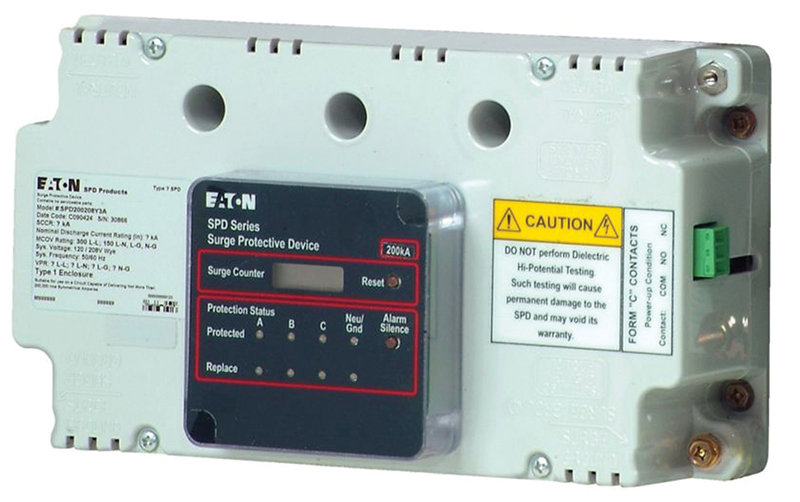
Article 242 addresses overvoltage protection and continues to refine requirements for surge protective devices (SPDs) and surge arresters. Part II of Article 242 covers permanently installed SPDs not over 1,000V AC/1,500V DC. Part III of Article 242 covers permanently installed surge arresters over 1,000V nominal. Section 242.2 now requires listing for SPDs not over 1,000V AC/1,500V DC.
Clarifications were made to Section 242.14 regarding Type 2 SPDs. The language now specifies that these devices must be installed in accordance with one of three applicable installation conditions:
- 242.14(A): Covers service-supplied buildings
- 242.14(B): Covers feeder-supplied buildings
- 242.14(C): Covers separately derived systems
Previous wording implied that all conditions had to be met simultaneously, which created confusion. The revision clarifies the intent and aligns installation requirements with real-world applications.
Article 245, Overcurrent Protection for Systems Above 1,000V AC/1,500V DC
Article 245 establishes requirements for overcurrent protection in electrical systems exceeding 1,000V AC/1,500V DC. As electrical infrastructure expands to include higher voltage distribution within facilities, these provisions become increasingly important.
O ne significant change introduces mandatory listing requirements in a new Section 245.2 for overcurrent protective devices used in high-voltage systems. Devices rated up to 15,000V AC/V DC must be listed beginning Jan. 1, 2029, while devices rated above 15,000V AC/V DC and not over 52,000V, must be listed beginning Jan. 1, 2032.
These phased implementation dates recognize the complexity of high-voltage equipment while giving manufacturers and the industry time to transition to listing requirements.
New Section 245.6 addresses adjustable relays and trip units. When operating settings can be adjusted on protective devices, documentation must be available to personnel responsible for design, installation, operation or inspection. This information must also be accessible to the authority having jurisdiction upon request.
This requirement supports transparency and ensures that protection settings remain consistent with the design and coordination of the electrical system.
Article 250, Grounding and Bonding for Systems Not Over 1,000V AC/1,500V DC
Article 250 has long been one of the most heavily referenced sections of the NEC, and the 2026 revisions focus largely on improving clarity and usability while maintaining existing safety principles.
One example involves effective ground-fault current paths in Section 250.4(A)(5). The technical requirements remain unchanged, but the text has been reorganized into a list format consistent with the NEC Style Manual. This approach improves readability and makes the requirements easier to apply in the field.
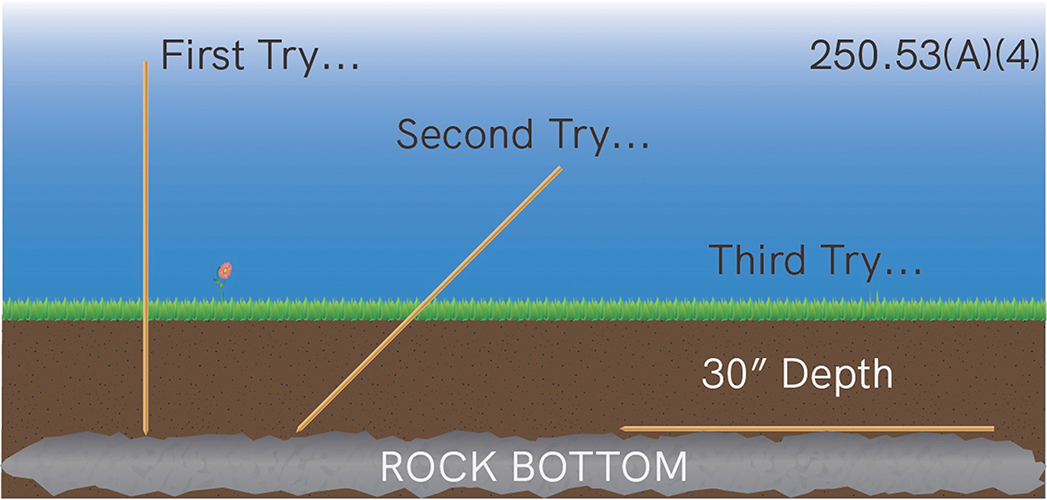
Section 250.53(A)(4) was revised to clarify the specific installation requirements for rod or pipe electrodes. Section 250.53(A)(4)(a) requires all rod or pipe electrodes to be installed so that at least 8 feet of length is in contact with the soil, and 250.53(A)(4)(b) requires that rod or pipe electrodes initially be driven vertically to a depth of 8 feet.
However, this revision also includes two exceptions that establish a hierarchy for alternative installation methods when there is bedrock. The first exception permits the rod or pipe electrode to be driven at up to a 45-degree angle, while the second exception permits the rod or pipe electrode to be buried horizontally in a trench at least 30 inches deep, but only if the rock bottom is encountered on a 45-degree angle.
Finally, Section 250.64(C) now allows grounding electrode conductors to be spliced using listed grounding and bonding equipment at accessible locations. Previously, this requirement limited the allowable splice methods to irreversible connections or exothermic welding only. This change improves flexibility while maintaining reliability.
Evolving Requirements for Systems Over 1,000V AC/1,500V DC
Perhaps the most significant structural change in this group of articles involves the reorganization of requirements for systems exceeding 1,000V.
In the 2023 NEC, Article 235 was created to consolidate medium-voltage requirements previously scattered across multiple articles. The 2026 NEC continues this effort by relocating portions of Article 235 into several new dedicated articles, including:
- Article 265 for branch circuits over 1,000V AC/1,500V DC, nominal
- Article 266 for feeders over 1,000V AC/1,500V DC, nominal
- Article 267 for outside branch circuits and feeders over 1,000V AC/1,500V DC, nominal
- Article 268 for services over 1,000V AC/1,500V DC, nominal
- Article 270 for grounding and bonding of systems over 1,000V AC/1,500V DC, nominal
A recurring theme across articles 265 through 270 is the introduction of provisions recognizing supervised installations. This concept allows a system design to be developed by qualified people under engineering supervision. To qualify as a supervised installation, these criteria must be met:
- The design must be developed under engineering supervision.
- Qualified personnel must perform installation and maintenance.
- Personnel must have documented training and experience with systems above 1,000V.
- Ongoing monitoring and servicing must be performed by qualified individuals.
This concept reflects long-standing practices in large industrial environments, where specialized engineering oversight is common. By formally recognizing supervised installations, the NEC acknowledges a level of necessary expertise, while still maintaining its key safety objectives for the following installations over 1,000V AC/1,500V DC:
- 265.19(B), Branch Circuit Conductor Sizing and Ampacity
- 266.4(C), Feeder Conductor Sizing and Ampacity
- 267.39(C), Outside Branch Circuit and Feeder Rating of Disconnect
- 268.23(C), Overhead Service Conductor Sizing and Ampacity
- 268.31, Underground Service Conductor Sizing and Ampacity
- 268.42(C), Service Entrance Conductor Sizing and Ampacity
- 270.5, Grounding and Bonding
Article 265, Branch Circuits Over 1,000V AC/1,500V DC
Article 265 addresses branch circuits above 1,000V AC/1,500V DC. Several revisions align the article closer to real-world installations.
A revision to Section 265.20(A) reflects a fundamental difference between low-voltage and medium-voltage equipment. Medium-voltage equipment is designed to operate at 100% of its rated capacity, whereas low-voltage equipment often follows an 80% rule for continuous loads. As a result, load calculations now use the concept of simultaneous loads rather than the traditional continuous/noncontinuous load distinction.
Article 270, Grounding and Bonding of Systems Over 1,000V AC/1,500V DC
Article 270 introduces a dedicated location for grounding and bonding requirements for systems over 1,000V. These provisions were previously located in Part X of Article 250.
Section 270.122(B) brings three new tables for determining the minimum size of equipment grounding conductors (EGCs) for medium-voltage cables and conductor types. These tables recognize common medium-voltage cable constructions and provide clearer guidance for designers and installers.
- Table 270.122(B)(1), Smallest Acceptable EGC in Multiple Conductor Cables, or with Two or More Insulated Conductors Such as Duplex, Triplex and Quadruplex Type, 1,001V to 2,000V
- Table 270.122(B)(2), Smallest Acceptable Equipment Grounding Conductor in Multiconductor Cables, or With Two or More Type MV-90 Insulated Conductors, 2,001V to 35,000V
- Table 270.122(B)(3), Smallest Acceptable Equipment Grounding Conductor in Multiconductor Cables, or With Two or More Type MV-105 Insulated Conductors, 2,001V to 35,000V
Looking Ahead
The changes summarized here demonstrate the NEC’s continued evolution as electrical systems grow more complex and technologically advanced. The restructuring of medium- and high-voltage requirements, combined with refinements to grounding, bonding and overvoltage protection provisions, improves clarity and aligns the code with modern electrical infrastructure.
As industries continue to adopt large-scale renewable energy systems, electrified transportation infrastructure and high-capacity digital facilities, these changes ensure that the NEC remains a practical and effective framework for electrical safety in the future.
iaei | electrical training alliance | eaton
About The Author

Kyle Krueger
Executive Director of Codes and StandardsKRUEGER is NECA’s executive director of codes and standards. He has worked in the electrical industry for over 25 years as an inside wireman, authority having jurisdiction and educator. Kyle currently represents NECA on the NEC Correlating Committee, Code-Making Panel 3, NFPA 72 Correlating Committee, NFPA’s Electrical Section Executive Board and the UL Electrical Council. Reach him at kkrueger@ necanet.org.