You're reading an older article from ELECTRICAL CONTRACTOR. Some content, such as code-related information, may be outdated. Visit our homepage to view the most up-to-date articles.
At the University of Nebraska—Lincoln (UNL), scientists have created conductive concrete that can ensure roadways and bridges stay clear during snowstorms.
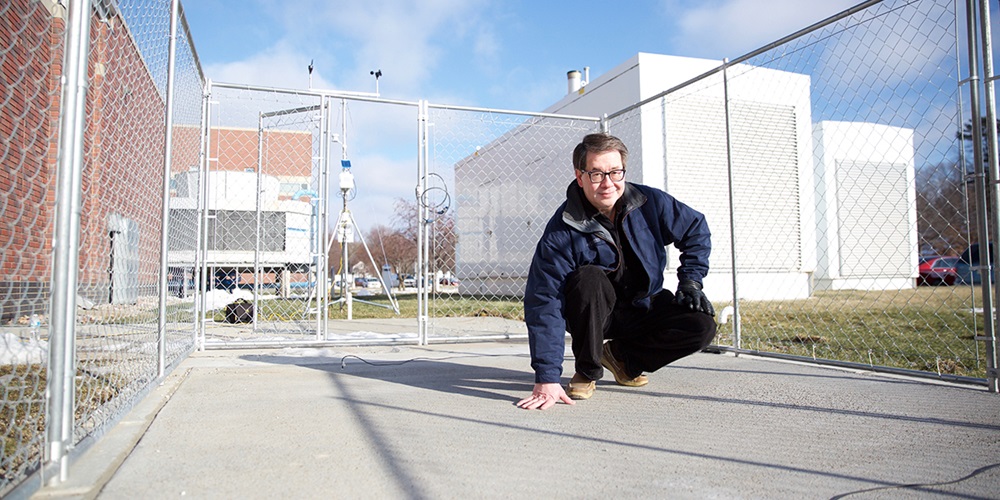
The secret to this new technology is in the recipe. Chris Tuan, UNL professor of civil engineering, added just the right pinch and dash of steel shavings and carbon particles to a concrete mixture to strike a balance. The concrete can be electrified to conduct heat, but it is safe to touch.
If that sounds unbelievable, Tuan's research team is currently showing off their technology to the Federal Aviation Administration (FAA). They are involved in a demonstration that will last through the end of this month. According to UNL, if the FAA is satisfied with the results, it will consider testing the technology in the real world by integrating it into a major U.S. airport's tarmac.
(Caption: Four hours of time-lapse footage show conductive concrete melting fresh snow from its surface during a winter storm that hit Omaha in late December 2015. Source: UNL)
Tuan was surprised, however, when the FAA told him they don't want to use the technology for runways. Instead, it would prove useful in clearing gated areas where baggage carts load and unload.
"They said that, if we can heat that kind of tarmac, then there would be [far fewer] weather-related delays," Tuan said in a press release.
Tuan's team has ambitions beyond airport runways, however, and they have been working on this project for over a decade. In 2002, Tuan and the Nebraska Department of Roads installed conductive concrete in a 150-foot bridge, and it has been successfully deicing the bridge's roadway surface since that time, testifying to the mixture's longevity.
"Bridges always freeze up first, because they're exposed to the elements on top and bottom," Tuan said. "It's not cost-effective to build entire roadways using conductive concrete, but you can use it at certain locations where you always get ice or have potholes."
According the UNL, since salt and de-icing chemicals create potholes, it may prove to be financially feasible to incorporate conductive concrete in certain areas to reduce long-term maintenance and repair costs.
Tuan also said his concrete could prove feasible in high-traffic intersections, exit ramps, driveways, and sidewalks.
The FAA is currently funding the team's research, and it doesn't look like it will make it to roadways anytime soon. However, after further testing and development, electrical contractors could find themselves delivering power to the ground.
About three years ago, Mid-Atlantic Transportation Center posted this video on YouTube. Check it out for more information.
About The Author

JOHNSON is a writer and editor living outside Washington, D.C. He has worked in magazine, web and journal publishing since 2006, and was formerly the digital editor for ELECTRICAL CONTRACTOR magazine. Learn more at www.tjfreelance.com.