You're reading an older article from ELECTRICAL CONTRACTOR. Some content, such as code-related information, may be outdated. Visit our homepage to view the most up-to-date articles.
Where are the growth areas? That’s a question many electrical contractors (ECs) ask themselves. This recent low-voltage project reflects current trends, such as increased demand for connectivity and for energy savings, and could well provide ECs across the country the motivation to pursue these opportunities.
Imagine an ordinary day at Stonestown Galleria Mall, an 862,000-square-foot shopping mall in San Francisco. Consumers mill about, perhaps stopping at any of the 160 stores on either of the two levels. Most have phones or other devices in hand and are staring at screens, texting or chatting. They will not be happy if the connection is iffy. That’s why Stonestown’s owners opted for installation of a distributed antenna system (DAS) during a 2013 renovation.
“Increasingly, users demand their wireless-connected devices work effectively both indoors and outdoors,” said David Cate, project manager, Connectivity Wireless Solutions, Duluth, Ga. “Owners of shopping malls feel they are quickly losing money if people don’t have connectivity. Use of an in-building DAS allows property owners to have one wireless infrastructure that can support multiple service providers. Its use is spreading quickly in public spaces and in hospitals or jails where emergency or public safety calls don’t go through if the wireless signal coverage drops.”
American Tower Corp. (ATC), a multinational company headquartered in Boston, designed the DAS in conjunction with Connectivity and provided the wireless towers. Connectivity also partnered with Paganini Communications Inc. (PCI), a low-voltage cabling contractor out of San Francisco to install the system. Paganini Electric Corp. started PCI in 1998 due to the growing demand from their customers for low-voltage services.
“Our customers wanted a one-stop-shop for their wiring needs,” said Larry Andrini, vice president, PCI. “Cellular phones work off of large antennas out in the public, and when you have a facility like the Stonestown Galleria or a high-rise that is made up of high-density concrete and metal, the structure doesn’t allow cellular signals to penetrate. There is a lot of dropped coverage and, in some cases, no coverage.”
A DAS is effective because a line-of-sight channel is present more frequently, meaning delay spread is reduced.
“Cellular antennas have been around for several years,” Andrini said. “All of our mobile phones operate off of them, but a DAS inside a building or facility is new. What’s also new to the market is the idea of a company like ATC installing a system and allowing service providers, e.g., AT&T, Verizon, T-Mobile, to pay to use that system.”
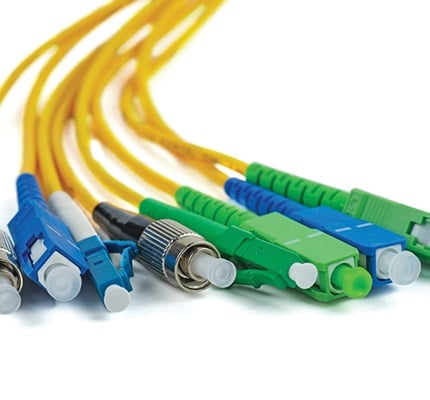
As one of the first steps on the Stonestown project, ATC conducted a survey to determine where to strategically place remote antenna units (RAU) throughout the shopping mall to split the transmitted power among several low-power antennas as opposed to a single, high-power antenna. PCI installed the RAU and ran a fiber optic cabling backbone from the main head-in equipment in the basement to a fiber aggregation point (FAP), essentially the antenna system’s hub for the entire mall. From the FAP cabinet, Paganini ran fiber optic cables to the RAU and then ran ½-inch coaxial cable out to the low-power antennas.
Since the system was installed, the head-end equipment has been able to communicate with the carrier base station and convert the radio frequency (RF) signals to digital pulse signals, which are distributed through fiber cabling to the network of fiber remote units and antenna access points that are located throughout the building. The antennas receive and radiate the RF signals.
“There is a learning curve in understanding and assembling the parts and pieces due to the number of components that it takes to build a complete DAS and to establish pathways in the mall,” Andrini said. “Most of the ceiling access was in what is called a hard-lid ceiling—a fully closed Sheetrock ceiling. There wasn’t easy access into those ceilings, which we had to open up in many locations to have access.
“The biggest challenge we ran into and were aware of was the temperament of the actual product we installed. There couldn’t be any flaws in the fiber or the copper cable. Performance had to operate at 100 percent. After we did the installation, it had to be exactly on the mark, or it needed to be redone. The testing parameters were stringent. If our technicians bent one of the fiber cables around a turn too tightly without having a big enough sweep on the cable or bang a cable, it could have altered the performance,” he said.
PCI also faced challenges on the project related to working within a functional shopping mall.
“All work had to be done by our four to six technicians at night,” said Tom Casey, project manager, PCI. “We had to be cleaned up and off-site prior to the mall opening the following morning and also had to coordinate with store owners for access into their suites after hours, since we had to run cabling through individual stores in order to get to the antenna locations. Then we had to get information from them to our technicians who arrived at night.”
After the DAS was installed and test results were successful, PCI turned the project over to Connectivity, which then programmed the equipment and brought the facility online.
“While low-voltage is not a new market, it is a constantly changing one, and keeping up with it is the key to success,” Andrini said.
About The Author

CASEY, author of “Women Heroes of the American Revolution,” “Kids Inventing!” and “Women Invent!” can be reached at [email protected] and www.susancaseybooks.com.