You're reading an older article from ELECTRICAL CONTRACTOR. Some content, such as code-related information, may be outdated. Visit our homepage to view the most up-to-date articles.
I magine a laboratory where you could envision, develop and confirm your building design before or during construction. Investigate building system performance by staging an office facsimile. Make final specifications on sustainability measures prior to occupancy. No need to imagine it: It’s called FLEXLAB, a $15.7-million research complex at the Lawrence Berkeley National Laboratory in Berkeley, Calif.
FLEXLAB stands for “Facility for Low-Energy Experiments in Buildings.” It comprises seven customized labs, each designed to reduce energy load through research and development (R&D), demonstration, and verification. Analyzing design complexity and integration are key capabilities of the new facility.
“We all know lighting and HVAC impact energy use in a space, but so do added sensors and controls,” said Stephen Selkowitz, who is leading Berkeley’s FLEXLAB research and development program. “For example, say you’ve calculated the savings you might achieve with LED lighting, but you are also going to use motorized shading and a daylighting control system. Savings become less clear as these controls interact. The shading certainly lowers your cooling load, but it has its own draw, and now you’ll use more artificial lighting. So, what are your savings? These kinds of scenarios can be played out in one of our test beds and reconfigured before an install or final design.”
A testing landscape
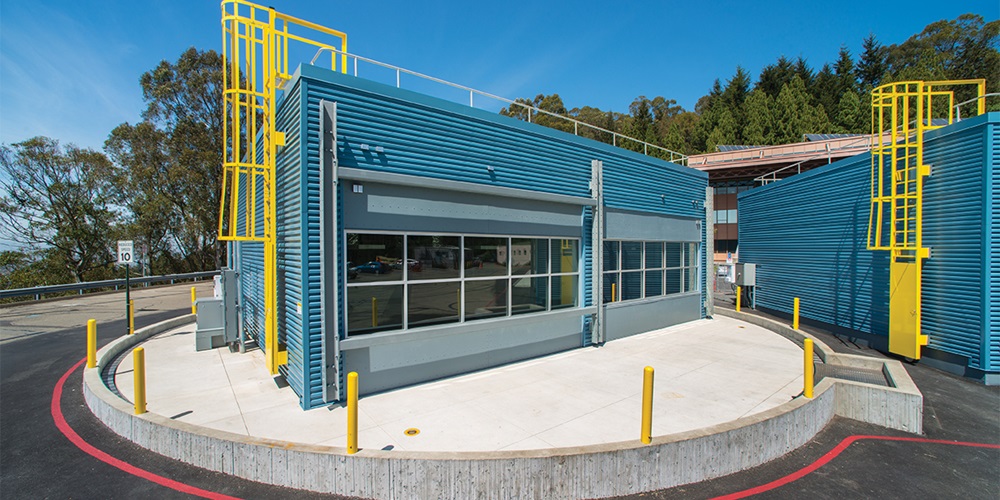
Four individual test beds have been built outside the Berkeley lab’s main science office building. Each test bed can be reconfigured when investigating everything, from code-compliant design to net-zero aspirations, checking out any combination of building envelope, lighting and HVAC systems. One test bed sits on a 64-foot-diameter turntable, an industry first, allowing customers to explore options in building orientation, best-case daylighting and control, solar panel placement and angle, and other concerns. The lab can rotate 270 degrees to actively track the sun or test a building design in any fixed orientation (southeast to northeast).
A second test bed is equipped to meet the leading energy-performance standards of California’s Title 24. Another lab resembles a building circa 1970–80 to allow for retrofit strategies. The fourth test bed is two stories high (24 feet) to accommodate designs from high-bay warehouses to atrium and other lobby spaces. It features reconfigurable skylights and clerestories. Finally, test beds for controls hardware, lighting controls and plug loads, and virtual design are located within the main science office building.
FLEXLAB allows its clients to modify and optimize system performance as dictated by the space in which they will eventually reside. That’s different.
“Through client-informed room mockups, we can monitor the energy usage of a lighting system and vary the setups; record how much lighting loads go up and down; discover light levels at the back of the room,” Selkowitz said. “Our building simulation test beds are a rare opportunity for early R&D product development, too. Clients can try and push the envelope as a way of seeing what’s achievable.”
Selkowitz added that FLEXLAB does not ignore the value of virtual design, rather it emphasizes its importance as part of integrated design. In its virtual design testbed, various members of a building team can sit at a computer station, working on their portion of a project design. Work is displayed on a smartboard for everyone to see. Team members can discuss and analyze the effects of design decisions on their own work and make collaborative design decisions. The test bed can accommodate building information modeling (BIM) and other virtual design platforms.
The complete FLEXLAB operation features almost a thousand sensors used for data collection, with room for more than twice that amount. Cameras are equipped to record internal sun patterns for daylighting studies and meters measure power, thermal loads, airflow, lighting and glare. FLEXLAB’s $1 million data-acquisition (DAQ) system reports measurements instantaneously in real time. To ensure proprietary information, single-test performance data from different participating vendors is not shared.
Bringing the building community together
FLEXLAB brings together manufacturers and the building community to collaborate with research staff in the development, simulation and validation of efficient building technologies. Clients may use the facility at different stages of their project development, be it conceptual or more developed design.
FLEXLAB’s first major project is underway. San Francisco-based Webcor Builders has been commissioned to design/build a 200,000-square-foot office building in that city for Genentech, a major biotech company. This newest addition to the Genentech campus is currently under construction. Both parties want to confirm the design and configuration of the building—a “precommissioning,” so to speak.
At press time, Webcor was in the early weeks of a three-month lab test that will explore its planned use of lighting controls; automated shading; HVAC control sequences; phase-change materials for a low-profile access floor; and glare avoidance tactics through furniture and its placement.
Phil Williams, vice president for Webcor, leads the company’s Sustainability and Technical Systems group, which includes electrical. “This is all about the client deciding to invest in testing systems, operations and training their facilities staff well in advance of occupancy,” Williams said. “We are working to help deliver the facilities that they bought, paid for and expect. “
For Williams, this unique testing will give owners, architects, designers, installers, operators and users more, and better, information earlier in the process.
“It is not a panacea, but it does take away significant variables, allowing us to deliver a better space with less risk to the owner before occupancy,” he said. “We will also discover how to leverage what we’re learning on this project with future work.”
Raising questions and discovering options
Selkowitz said Berkeley and Webcor created a representative office space on the rotating test bed, equipped with building controls either approved or being considered for the Genentech building. By fall, both parties will have made the ultimate decisions as they work toward a building opening by summer 2015.
“On balance, we will learn how to optimize some systems,” Williams said. This is a challenging project, as many of the occupants will forgo fixed office spaces. Mobility will reign. New questions then arise regarding design and infrastructure as unexpected details emerge within the building mockup. To help reveal operational performance differences between the north and south sides of the office building, the rotating test bed will effectively simulate the different exposures of the building.
“Some architecture decisions were made prior to FLEXLAB, so we’re exploring how those decisions impact energy performance,” Selkowitz said. “For example, as automated shading is being used, we are investigating when to raise or lower shades in different parts of the building and by how much. There’s even a question of what fabric density will work best. Then there are questions of occupancy sensor operation. When should they be used to dim or turn lights on or off? What ballast considerations need to be worked through? Whether its shading, daylighting and other lighting controls, we’re working to capture the best energy savings.”
After the critical testing is done, Genentech is going to bring in two different groups. One group will consist of operations’ managers, who will learn to use the building’s control systems. Another group will be brought in to confirm the look and feel of the lighting.
“All of this is being done so, when you put people in the actual building, it works,” Williams said.
Other FLEXLAB capabilities
“Flexibility is in the name,” Selkowitz said. “We don’t want to constrain a team. We’ve also given a lot of thought to running the facility as efficiently and cheaply as possible for our research partners. For instance, in our lighting and plug load test bed, we can hang different fixtures into metered sockets for easy plug-and-play change out. Plugs are metered every 2–5 seconds. We can make performance comparisons between lighting sources, such as LED and high-performance fluorescents.”
This 4,000-square-foot lighting and plug load test bed features 17 interior office cubicles and 10 perimeter offices. Twenty-five ceiling-mounted photo sensors can measure the illumination distribution throughout the space. A power metering system measures as accurately as 2 percent for loads greater than 25 watts (W) and 0.5 percent for most loads less than 25W. Clients can test different control algorithms for dimming electric lighting to balance the space daylight as well as control automated fenestration systems. Different controls strategies can also be employed for plug loads.
Many of the FLEXLAB test beds can be split in half to conduct simulations that make “A” and “B” comparisons. Test bed ceilings can be raised to explore deeper natural lighting possibilities.
Commercialization and deployment are two other uses for FLEXLAB. The lab facility becomes a third-party verifier, sometimes in unexpected ways. For example, utilities are turning to the facility as they incentivize better technology such as LED. To do that, they would like to discover how the technology truly performs. The facility is also inviting in code officials. In this instance, FLEXLAB becomes a place to educate, not just develop, and test. Perhaps it will help drive standards where they are lacking.
Through FLEXLAB’s Industry Partnership Program, the building community, manufacturers, code officials and others can follow the facility’s efforts, provide input on research projects through periodic workshops, and attend an annual open house.
“FLEXLAB is an opportunity for pursuing true integrated design, performance-based testing and its prove-out from the owner’s point of view, the contractor’s, and the entire design team,” Selkowitz said. “That’s work worth following.”
About The Author

GAVIN, Gavo Communications, is a LEED Green Associate providing marketing services for the energy, construction and urban planning industries. He can be reached at [email protected].