You're reading an older article from ELECTRICAL CONTRACTOR. Some content, such as code-related information, may be outdated. Visit our homepage to view the most up-to-date articles.
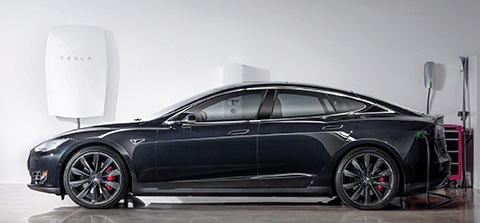
On April 30, 2015, Tesla Motors announced that it is releasing a new line of stationary rechargeable lithium-ion batteries for homes and commercial buildings. They are designed to store energy for use when it is otherwise unavailable (such as with a grid power outage) or when it's less expensive (such as with solar-panel energy-storage applications).
The Powerwall battery will cost approximately $3,500 for a 10-kilowatt-hour (kWh) unit, which is an optimal size for serving a home if the power grid goes down. A 7-kWh version, priced at $3,000, is designed for managing the fluctuations in power to houses served by solar panels. The price does not include installation nor the required direct-current-to-alternating-current inverter.
On its website, Tesla specifies that the battery “requires installation by a trained electrician.” The company plans to create a network of certified installers.
A homeowner or commercial building owner can purchase and install up to nine 10-kWh Powerwalls (to achieve a 90-kWh output), or nine 7-kWh Powerwalls (to achieve 63-kWh output).
Each unit weighs about 220 pounds. Since they can be mounted on either interior or exterior walls, the units have thermal management systems that allow them to provide power in hot (up to 110°F) and cold (down to –4°F) conditions.
Each unit (available in a multitude of colors for those interested in indoor color coordination) is only about 7 inches thick. However, it does take up some real estate—a unit is about 3 feet wide and 4 feet tall.
Each battery comes with a 10-year guarantee (renewable for another 10 years), as well as some integrated software that provides thermal regulation, safety checks and energy optimization.
“It will be connected to the Internet, so we can create smart microgrids,” said Elon Musk, CEO and co-founder of Tesla Motors, Palo Alto, Calif.
According to JB Straubel, Tesla’s chief technology officer, the 400-volt battery “doesn’t use heavy-gauge wire, so that makes the installation easier.”
Musk and Straubel estimated that installation would take 60–90 minutes.
Units are available for preorder, and shipments will begin in late summer.
“Our goal here is to fundamentally change the way the world uses energy at the terawatt scale,” Musk said. “The goal is complete transformation of the entire energy infrastructure of the world.”
About The Author

ATKINSON has been a full-time business magazine writer since 1976. Contact him at [email protected].