You're reading an older article from ELECTRICAL CONTRACTOR. Some content, such as code-related information, may be outdated. Visit our homepage to view the most up-to-date articles.
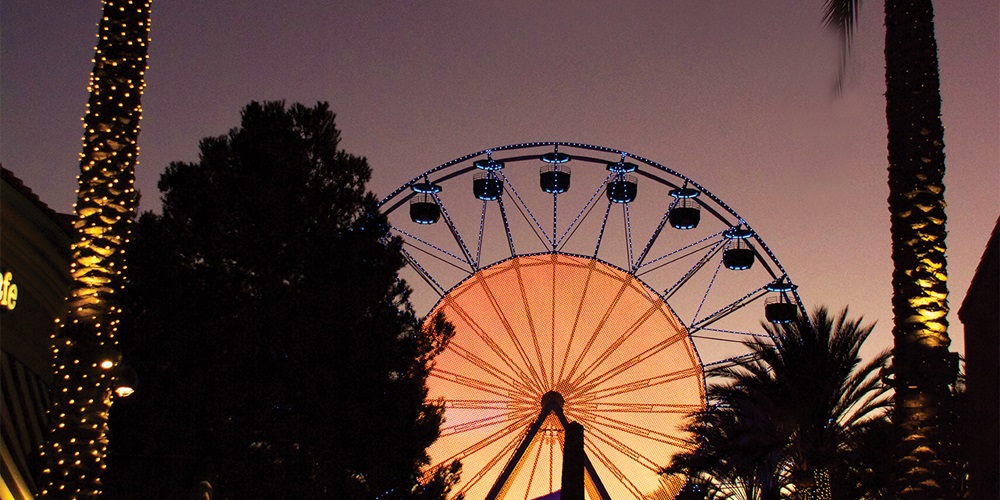
Lighting an iconic Ferris wheel is not an electrical contractor’s usual task. However, Briggs Electric Inc. of Tustin, Calif., faced such a challenge when the company took on the unusual project of the Giant Wheel at Irvine Spectrum Center.
Each year, more than 17 million people visit Irvine Spectrum Center, which features public fountains, trains for children, a carousel, movie theaters, restaurants, clubs and other attractions that create a festive atmosphere. The Giant Wheel, which debuted in 2002, is the most recognized landmark and main attraction of this entertainment and lifestyle destination.
The 108-foot Giant Wheel, with its octagonal, Andalusian-inspired gondolas, was built in Italy more than a decade ago, and some updates were desired to create showstopping displays on the wheel.
Work began in spring 2015 on the wheel's energy-efficiency and glamour upgrade that concluded with a custom lighting installation in June to mark the center's 20th anniversary.
Birth of the design
First Circle Design Inc., of Costa Mesa, Calif., in collaboration with The Irvine Company Retail and Marketing Division, generated the concept of a grid configuration of light-emitting diodes (LEDs) in an array.
“The LED grid provided us with the ability to animate a variety of images at the center wheel,” said Matt Levesque, founding principal designer, First Circle Design. “It enabled us to give the wheel personality using First Circle’s design creativity for seasons, holidays and special events.”
The wheel displays seasonal animations, light-changing sequences and gradations and intensities of color.
Briggs Electric, founded by S.E. Briggs in the garage of his Newport Beach home in 1946, began the $300,000, five-week project for general contractor Wesling & Associates, Costa Mesa, by demolishing 12,500 standard lamps and replacing them with more than 52,000 energy-efficient LED lights capable of 16 million different color schemes. Briggs Electric worked from drawings by Linwood Engineering Associates, Irvine.
The result was a 45 percent increase in energy savings. In the wheel’s inner circle, the lights create a round, 60-foot, TV-like screen created by panels of LEDs that each can be independently controlled. Images of faces or different effects can be cast. During lighting shows, as the outer circle of the wheel spins, gondolas bobbing in the process, the images in the center can stay constant or shift around.
The process
Briggs Electric’s crew worked in tandem with RGB Lights, Chicago, which was brought in to realize the vision of First Circle Design and The Irvine Company.
“Working with RGB Lights, we used standard products utilized in the industry for a decade but never on a moving wheel,” Levesque said.
RGB’s patented product, a flexible LED mesh video solution called FlexiFlex, facilitates large-format video.
“We had a project using strands of LED where we wanted to deploy it in sheets, so I designed a surface that allows you to snap in the lights so they all face in the same direction,” said Brett Gardener, founder of RGB Lights. “The wind can flow through it, and it can be configurable and customized down to the resolution, the color of the surface and the type of LED.”
The surface mesh consists of an aircraft-cable grid that is assembled in panels. One panel can be added to another in an assembly to create grids of the desired size. On the grid are node clips spaced 100 millimeters (mm) apart in some areas and 300 mm apart in others. The LEDs are snapped into the clips. When energized, the lights create animations.
“Everything is custom: brackets, clips and all the lighting,” said Todd Lorenz, director of construction development, Briggs Electric. “We redesigned the fuse boxes to make them more accessible and designed closure plates that hide a lot of the wiring. Extrusion pieces had to be custom-made to hold the mesh network boxes, which link all the controllers together to create the effects.”
While the original approach in construction was to have the crew work off of lifts, Briggs Electric proposed that the crew use scaffolding instead.
“We believe that was part of the reason we got the job,” said Jeff Perry, president, Briggs Electric. “Everyone else was looking at it differently, but we believed that, by working off of scaffolding, we could get more people up on the wheel and be more productive because we were working off a stable platform. The owner, The Irvine Company, agreed that was the best approach for the project.”
Orange County Scaffold, Orange, Calif., developed a custom design for a free-standing, outrigger-support-system scaffold that enabled Briggs Electric to staff both sides of the wheel on multiple levels at the same time.
“We weren’t going to be able to train our crew how to build, erect or disassemble the scaffolding but to just make them aware of the construction of it,” said Brad Weaver, field operations superintendent, Briggs Electric.
Training topics included how scaffolding was built, that it held 25 pounds per square foot, and the overlap planking method.
“I introduced the crew to tubular scaffolding … so that they were aware of how it looked,” Weaver said. “If anything looked off-kilter, they could bring it to the attention of their supervisor.”
It wasn’t required, but Briggs Electric made all crew members use a “yo-yo,” a safety harness application, tied off to two points of connection. Guardrails were also provided.
The crew accessed the multiple levels of scaffolding using a ladder that extended from the ground to beyond the scaffolding, a bit more than halfway up the wheel.
“We created a protocol so that, when the wheel needed to be turned, our foreman would announce over the loud speaker, ‘Hands free, tools free,’” Weaver said. “He’d sound the bell and make sure everyone had their tools and equipment away from the wheel. At that point, the wheel could be totally rotated to another position so the crew could continue to work on it.”
Work began with the wiring of the metal spokes, which extended from the hub to the outer wheel. To access the spokes in the center, Briggs used painters' expandable pick aluminum planking that went through the wheel from scaffolding to scaffolding so that the workers were able to mount the power supplies for the lights.
Crews first installed a linear run of Rigiflex, a strip that the light nodes clip onto.
“There were 64 lights on a strand that plugged into multiple breakout cables, which were able to accept eight or 16 sets of the 64 light strands each,” said Steve Southern, general foreman, Briggs Electric.
Off the breakout cables, each strand had to be situated in a precise location, per the RGB Lights drawings.
“Their crew was on the ground directing us during installation,” Southern said.
Briggs Electric’s crew then had to attach the mesh surface from the hub to the inner circle, the center area of the wheel that can now maintain a horizontal image. Since the mesh surface is only available in panels of a certain size, Briggs added one panel to another, making adjustments to the surface so that it covered the space of the circle. In all, 20 panels were used on each side.
“We started from the center and dropped the panels down, tied them off, then spun the wheel to do the other ones,” Southern said.
While installing the mesh, Briggs Electric had one crewmember on each level of scaffolding.
“As we dropped the mesh, the guy on the upper level of scaffolding would clip the mesh onto the spokes with a stainless-steel band, then pass the mesh to the guy on the level below,” Southern said. “That guy would do the same and so on until we finished a section, [creating] a waterfall effect. We used the same process when installing the light strands.”
For Briggs Electric’s crew, snapping the lights in place wasn’t as simple as it might sound.
“RGB had a schematic, and we installed the lights per RGB mapping,” Southern said. “The lights didn’t go in a straight line but in a serpentine one. RGB told us where we were starting and where to turn. Some went up 20 [nodes] and then over one and up 20. Others would go up for 64 nodes.”
As a result, images are created on the screen by the panels of stainless steel mesh that have light nodes every 4 inches per 64-node strand.
Turning on the lights
The computer systems that control the lights are located in a building near the wheel.
“The wireless signal from that goes up to antennas to send information to a master control mounted on the hub of the wheel that takes all the information in and puts it out on a network throughout the wheel,” Lorenz said.
RGB designed the control system and provided computer controls, while ShowPro, Los Angeles, provided technical installation support. On the wheel, Briggs Electric mounted wireless receivers as well as 7.5 and 24V boxes for power and network data that were linked together through Category 5 cables on the wheel's inner circle.
Basically, a data hub takes in power and Ethernet data and distributes it to the strands of lights that are attached to the FlexiFlex mesh panels.
“Each strand of light is on individual connection into the power-data supply and can be individually controlled,” Gardener said.
Information goes from the video source to the individually addressed lights, which reduced the number of power and data connections. RGB originally thought that 800 control boxes would be necessary to manage the power and data but the company redesigned the system so that only 100 boxes would need to be installed, simplifying the process for Briggs Electric.
“It was a team effort, starting from the owner on down to the apprentice out doing the work,” Weaver said.
Light show displays on the wheel now delight the community every night with varying color schemes and animations drawn from a choice of 16 million colors. It’s a one-of-a kind light show on one Giant Wheel.
About The Author

CASEY, author of “Women Heroes of the American Revolution,” “Kids Inventing!” and “Women Invent!” can be reached at [email protected] and www.susancaseybooks.com.