You're reading an older article from ELECTRICAL CONTRACTOR. Some content, such as code-related information, may be outdated. Visit our homepage to view the most up-to-date articles.
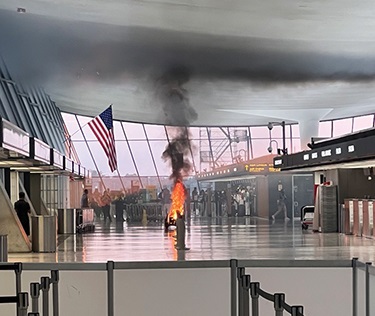
On the afternoon of April 7, 2015, a large portion of the Washington, D.C., area and surrounding suburbs was hit by a sudden power outage. The event affected several prominent buildings, such as the White House, the Capitol, various museums, transit stations and the University of Maryland in College Park, Md.
However, unlike most widespread power outages (see story below), weather conditions were not to blame. The skies were clear and the temperatures were comfortably in the 70s. Instead, this outage began when a transmission conductor “broke free from its support structure and fell to the ground” in Mechanicsville, Md., according to the Southern Maryland Electric Cooperative (SMECO), causing a small brush fire. Mechanicsville is more than 40 miles away from the nation’s capital.
In a statement released a few hours after the event, Pepco, the utility serving greater Washington, D.C., described the incident as a “dip in voltage.”
“There was never a loss of permanent supply of electricity to customers,” the statement read. “The dip in voltage caused equipment at some customer facilities to transfer to their backup systems. The momentary outage occurred because of customer equipment responding to a dip in voltage.”
Because the affected area included many prominent government buildings, some wondered if foul play or terrorism could have been involved. However, the Department of Homeland Security quickly determined that this was not the case.
The outage affected an estimated 8,000 customers in Washington, D.C., and 20,000 customers in the Maryland suburbs. The University of Maryland closed at 2 p.m. due to the impact.
Despite some early estimates that all power might not be fully restored for another day or so, nearly all electricity was back up and running within hours.
About The Author

Matthew Kraus was formerly the director of communications at NECA and senior editor of ELECTRICAL CONTRACTOR for five years. He can be reached at [email protected].