You're reading an older article from ELECTRICAL CONTRACTOR. Some content, such as code-related information, may be outdated. Visit our homepage to view the most up-to-date articles.
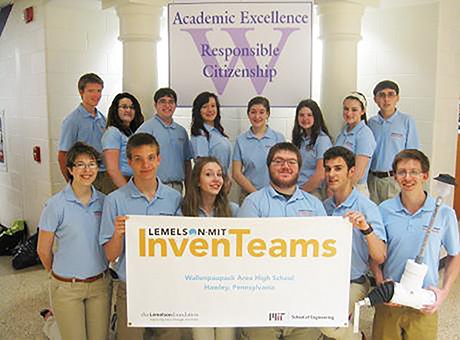
Fourteen students from Wallenpaupack Area High School in Hawley, Pa., invented a low-voltage generator that harnesses the movement of a boat dock to produce electricity. They came up with the idea to solve a local problem. Alternating current (AC) electricity is prohibited by lake regulations along the shore and on the docks of local Lake Wallenpaupack, the third-largest lake in the state with 52 miles of shoreline. The result is about 2,500 poorly lit docks.
The device consists of modified servo gear motors, which work off of rotational motion and act as generators that provide direct current (DC) power. The motors are attached to an arm that reciprocates when waves cause the dock to rise and fall.
The energy produced by the wave motion is stored in a battery that powers an LED lantern on the dock. The device uses safer low-voltage energy, which is allowed on the lake.
The device mounts directly onto the dock, instead of floating as a buoy, like most other wave-powered generators. As such, it can be easily adapted for use on other lakes with floating docks.
The generator produces enough power to maintain 4.8 volts at 700 milliampere-hours. The lantern can be powered for eight hours with an output of 30 lumens when fully charged. The first prototype cost just $300 to fabricate.
The Wallenpaupack students are part of the Lemelson-MIT InvenTeam Program. The program, through the Massachusetts Institute of Technology’s (MIT) Energy Initiative, is designed to inspire young people to pursue creative lives and careers through invention. InvenTeams receive grants up to $10,000 each to conceptualize, design and build technological solutions to real-world problems. Teams are invited to showcase their prototypes at MIT each spring.
Two representatives from the Wallenpaupack team were among more than 100 students from 25 states who were honored to showcase their projects at the White House Science Fair in March 2015. Besides being presented at the White House, the generator earned first place in the Pennsylvania Entrepreneurship Challenge, sponsored by EconomicsPA. The students also recently presented their device to a national meeting of shoreline managers for hydroelectric facilities, sponsored by the Federal Energy Regulatory Commission.
About The Author

ATKINSON has been a full-time business magazine writer since 1976. Contact him at [email protected].