You're reading an older article from ELECTRICAL CONTRACTOR. Some content, such as code-related information, may be outdated. Visit our homepage to view the most up-to-date articles.
Productivity loss, equipment damage, facility downtime and increased energy use are only some of the problems that poor power quality (PQ) can create. Among the most common PQ issues are voltage variations, brief power interruptions, startup loads of equipment with large motors and faulty insulation. While they have remained the same over the years, their effect on today’s electrical and electronic equipment can be more serious than in the past.
Voltage spikes can result in equipment failure or damage, especially when electronic or microprocessor components are involved. Data centers can be shut down, bringing work to a halt and losing critical data.
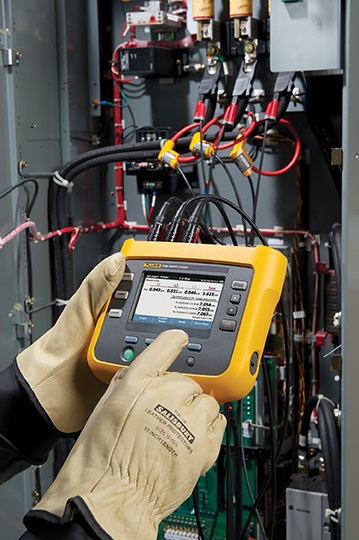
PQ testing equipment has changed with the times to provide effective PQ troubleshooting, logging, recording and energy analysis.
Frank Healy, power quality marketing manager, Fluke Corp., said today’s highly lean facilities are more sensitive to downtime and power disruptions; interruptions that were shrugged off 10 years ago are now viewed very seriously.
“The two most common PQ issues are interruptions to the power supply (dips, harmonics and unbalance) that affect equipment performance and excessive power consumption caused by power quality distortion; inefficient usage of power causes excessive consumption,” he said. “Most new equipment installs now include electronic controls that increase loads creating two issues: the generation of harmonic ‘pollution,’ which winds up back in the power supply, and not all electrical distribution setups are equipped with the necessary filtering to manage that input. Second, electronic loads are more sensitive to harmonic and other types of power quality distortion and may go offline if power quality isn’t high enough.”
Another change is sustained interest in power-consumption efficiency. Building operators consider energy as a cost within their control. Any decrease in energy consumption positively affects their bottom line. The first step in assessing the opportunity for reducing power consumption is to conduct an energy study using a power logger.
“Power quality testers and loggers have evolved to support these changes,” Healy said. “Power quality testing is now conducted by a broader range of people for a greater variety of reasons. The tools have evolved on both the high end as well as generalist spectrum. High-end tools perform a greater variety of tests with more memory, longer battery life and better software. Entry-level tools are completely new and enable a generalist electrician who doesn’t do power studies every day to easily and correctly set up an energy or power study. These new tools are small with highly intuitive user interfaces and similar improvements in memory, battery and software.”
Test probes have also improved tremendously. New types of current probes are much more flexible and longer-length with a small cross section so they can get into tight spaces and around large bus bars.
Fluke has introduced a patented method of calculating power consumption that more accurately reflects the power consumption of electronic loads. Fluke also has a new series of energy and power loggers designed for engineers and nonengineers alike.
John Olobri, AEMC director of sales and marketing, said that, in the past, low- voltage sags caused most of the damage to motors and transformers.
“Now, transients and harmonics cause more damage to ubiquitous sensitive electronic equipment,” Olobri said. “Due to more powerful but less costly electronic components, today’s testers have greater capabilities and functionality than older models for the same competitive prices. Today, we typically see instruments with 25 or more simultaneous function/calculation capabilities. Instruments use manual-connection lead wires with alligator clips for voltage inputs and Rogowski coils for current inputs and Hall effect current clamps for DC input. Sample rates generally have leveled off at 256 samples per cycle.
“Today’s PQ testers offer improved resident memory with removable SD cards for memory storage and to facilitate off-site download of data recordings. With the lowering price of SD, we see memory increasing to 2 gigabytes [GB] internal and up to FAT [file allocation tables] 32 GB or more with SD high capacity removable memory cards. This greatly supports faster storage intervals and/or longer recording periods. The issue, therefore, evolves to optimal protracted download times. Testers with remote monitoring and recording downloads via Bluetooth to PCs, and devices using smartphone apps, help offset the cumbersome flame-resistant safety requirements,” Olobri said.
With energy costs increasing, Olobri said the industry is seeing new power quantity testers for recording power consumption over time, rather than power quality.
“Although they appear to be similar in input requirements, their charter is from an economic perspective, measuring the ultimate energy cost and efficiencies,” Olobri said.
Charles Argenziano, Hioki director of technical support, said that, initially, PQ concerns were about voltage sags, surges and transients.
“That’s what we knew, and that’s what test products of the day showed,” he said. “We grew in this field and learned that there were many more anomalies to concern ourselves with—harmonics, voltage, current, power, unbalanced loads, power factor, consumed energy, frequency shifts, flicker, and more. Today’s instruments can detect and validate this data.”
Major manufacturers are providing equipment to meet these needs, Argenziano said.
“Basic PQ analyzers need to display voltage and current sags, surges, interrupts, transients, harmonics, power factor and watts,” he said. “The key word is ‘basic.’ These are basic measurements for basic tests. These models must meet the international standard for power quality and IEC 61000-4-30 Edition 2 Class A. Anyone evaluating analyzers to purchase should confirm how instruments were tested and that they are certified.”
Today’s PQ testers have greatly expanded data storage and transfer capabilities.
“Many of the newer units use SD cards with 2 to 32 GB capacity,” Argenziano said. “Plus they use a compression binary program that allows the unit to store years of data on one card. The transfer of data can be as simple as removing the card and doing a copy and paste or if the PQ application is equipment using the USB or LAN connection, upload the data to a PC running a software program for analyzing the data and preparing of customized reports.
“With memory recording capability, a power quality application should be an optional feature. Many times, electrical studies need to show longer running time once an anomaly is captured. Along with the standard volts and current that a memory recorder can capture, power factor, watts, kilowatt-hours and harmonics also are required. Today’s power quality units capture short bursts of data, but many users need to see longer recording times,” he said.
According to Argenziano, the standard connection is voltage with direct connection and current connections using a current transformer (CT) in the utility market and world of 60 hertz (Hz). For alternative energy, direct connection for current becomes more popular for lower currents to about 50 amperes (A), then CT above that.
“I believe they are, with the CAT ratings, newer, safer voltage leads, and [with] connection and CT connection, the safety aspect has greatly increased,” he said.
Dave Kadonoff, Ideal Industries field sales engineer, said PQ issues are most commonly thought of as disturbances to the purely sinusoidal waveform of 60 Hz and related amplitude for the appropriate rms voltage. However, any deviation from the pristine waveform of sufficient magnitude (up or down) and sufficient duration can impact reliable function of the load or shorten its expected lifetime.
“Any equipment that is under the control of logic circuits can be impacted by loss of control signals if PQ to the control unit is compromised,” Kadonoff said. “The most serious problems caused are those that impact personnel safety, but that can be very indirect, such as an elevator shutting down, trapping people inside it for a prolonged period of time.
“Causes of fires are investigated, but often we do not initially relate them to power quality issues, but they may well have been the cause.”
To find and categorize PQ distortions and the slightest of deviations from a pure sine wave, many overlook the integrity of the wiring and connections of the electrical-distribution systems, Kadonoff said.
“To look further—all the way back to the panel—a receptacle/polarity checker is needed,” he said. “For such tests, our instrument plugs into a standard three-prong outlet for any 120 volts, 15A or less loads. Existing voltage is measured, and a 15A load is applied for slightly less than one cycle to not disturb any sensitive electronics or trip any breakers, even if there are already loads on the circuit. Then voltage is measured in the loaded state, and the percentage of drop is calculated with a drop of less than 3 to 5 percent recommended by code. This test provides an immediate sense of the condition of integrity of the branch-circuit wiring from the panel to that point and whether it can support loads totaling design limits without causing excessive voltage drop.”
About The Author

GRIFFIN, a construction journalist from Oklahoma City, can be reached at [email protected].