You're reading an older article from ELECTRICAL CONTRACTOR. Some content, such as code-related information, may be outdated. Visit our homepage to view the most up-to-date articles.
Sometimes, electricians and electrical contractors must work in areas where no electrical service is available. In those circumstances, portable power is the answer.
Portable power devices generate electricity for temporary lighting and operate tools and equipment when conventional power is not available. Following storms and other disasters that cause outages, service restoration cannot begin without portable power sources.
Today’s selection of portable generators offers a solution for almost every temporary power need, ranging from compact and lightweight, 2-kilowatt (kW) gasoline models to large, single-unit, 2,000-kW models. In addition, generator packages can provide temporary power needs for hospitals and other large facilities.
Well-known names serving the portable power market include DeWalt (www.dewalt.com), Generac (www.generac.com), Honda, Kohler and MultiQuip (www.multiquip.com).
Tom Pernice, senior marketing strategist, Honda Power Equipment, said: “There has been an impressive evolution of portable generators over the last few years. Generators are becoming smaller, lighter, more fuel-efficient and quieter. Changing regulations dictated by the National Electrical Code [NEC] and the Occupational and Safety Health Administration [OSHA] regarding generators used on work sites also are important, for example, ground-fault circuit interrupter [GFCI] receptacles. The reduction of sound levels also is an important feature on sites near residential areas.
“Automatic voltage regulation [AVR] or inverter technology can safely power computers and other sensitive equipment that require what is referred to as stable ‘sine waves.’ These generators produce regulated, stable power that can operate the most sensitive electronics without fear of interruption.”
Elaborating on these two features, Pernice said that generators equipped with AVR constantly monitor load changes and adjust output to produce a clean sine wave. AVR continually shifts the fields and loads to maintain the revolutions per minute (rpm) of the generator at 60 cycles, which is reasonable quality power for most applications.
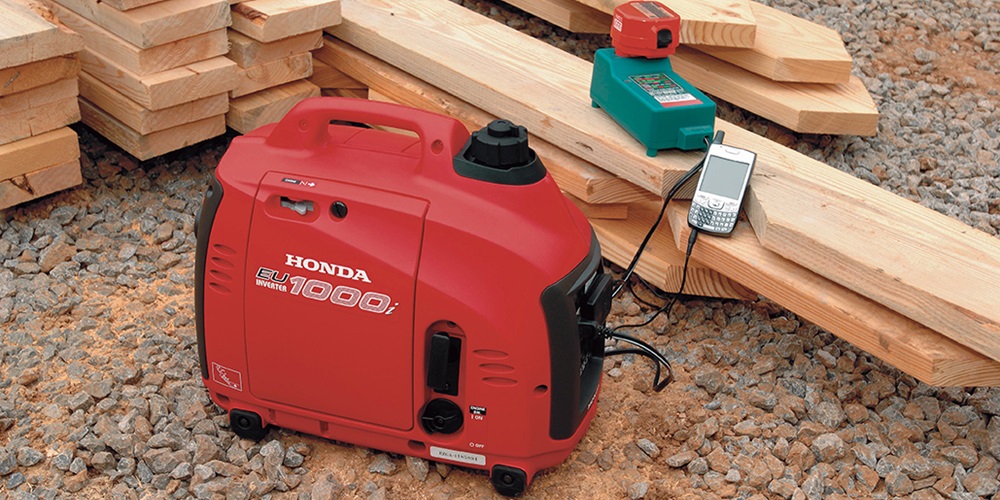
“While AVR-regulated generators provide good quality power, inverter generators produce the best quality power,” Pernice said. “Inverter technology processes the raw power produced by the generator and passes it through a special microprocessor to produce the most stable power. This means sensitive equipment can operate from a remote location with a reduced possibility of interrupted service or damage to the equipment. [This is] particularly important on job sites where more and more contractors rely on sophisticated equipment that must be charged and recharged.”
In addition to the advancements of portable generator products, Pernice said there are changes in the ways generators are used.
“While some construction company owners still use two or three conventional generators to offer power at construction sites, the trend now is to have workers use individual power sources, which offers greater flexibility,” Pernice said. “The benefits of lighter weight units in smaller package sizes is driving a real transformation on construction job sites. These smaller, lighter, inverter generators are easier to transport, can be located closer to the user, and can be connected in parallel to double the output when needed. The ability for contractors to generate the power needed without sacrificing portability is a major shift in how generators are being used on job sites.”
Understanding overall power needs and the equipment that is to be powered are important factors in choosing the correct generator. This is where generators that feature AVR or inverter technology play an important role.
“Many low-cost generators do not offer the features that produce good quality power for sensitive equipment,” Pernice said. “As consumers become increasingly aware of the differences in performance between quality generators versus low-cost alternatives, they are choosing to invest in models that feature new innovative technologies that have been introduced to the market.”
Manny Rumao, marketing manager, Kohler Power Equipment, cited three significant innovations in generators: inverter technology, customization and fuel-efficiency.
“Inverter technology allows the generator to be quiet, compact and light in weight,” he said. “Customization means contractors now can get a generator that’s customized for their specific jobs. A wide variety of accessories—including wheels, legs, handles, lifting kits and more—can be added faster and easier than ever.”
The engine is the generator’s heart.
“Electrical contractors should consider the engine powering the generator,” Rumao said. “Is it from a respected brand with a heritage of delivering top-quality products? And new engine features available include the electronic fuel injection, which improves overall performance and helps users save money by optimizing fuel consumption, auto-idle, maintenance minders, and angled fuel inlets; all can help save considerable time and money. These user-friendly features make every job a little easier and enhance the overall value of the equipment over the long term.”
Which improvement is the most significant?
“We believe that whatever the contractor thinks is significant is more important than what we, as manufacturers, perceive as being important,” Rumao said. “That’s why we initiated detailed job-site observations and performed numerous follow-up interviews with professionals before developing our new generator line.”
Not all generators are suitable for powering sensitive equipment, such as computers.
“THD [total harmonic distortion] is the key,” Rumao said. “THD is a measure of impurity in the quality of electric output. That means the lower the THD, the better the output. The industry standard—the utility power that we use every day—is around 5 percent THD. Using a generator with 5 percent or less THD should be fine for operating sensitive equipment.
“The second important factor is voltage regulation. Output voltage should be smooth and consistent at 110 volts [V], 220V, etc. Spikes where the voltage jumps to 150V, for example, should be avoided.
“Quality-brand portable generators are designed with these two safety features integrated to ensure the quality of power. They typically cost a little more, but the price premium doesn’t exceed the value of the computers or other equipment that’s put at risk when using an inferior generator,” Rumao said.
About The Author

GRIFFIN, a construction journalist from Oklahoma City, can be reached at [email protected].