You're reading an older article from ELECTRICAL CONTRACTOR. Some content, such as code-related information, may be outdated. Visit our homepage to view the most up-to-date articles.
Tools evolve, and even the most basic tools used by electricians—screwdrivers, pliers, measuring devices, etc.—are significantly better than they were 20 years ago. Add hole saws to that list.
New materials, designs and manufacturing processes enable today’s hole saws to cut cleaner holes faster with improved durability.
Here, six hole saw manufacturers discuss their latest products. (Note that this category does not include adjustable hole openers primarily used to make holes for luminaires.)
“Productivity is a key requirement for power tool users, so Bosch has developed solutions that provide speed, longer life and optimization for specific applications,” said Jared Schmidt, channel product manager, accessories at Bosch, Mt. Prospect, Ill. “There also have been changes in job-site materials and expanded applications. To meet the changing needs of the market, Bosch has introduced solutions such as the Daredevil carbide hole saw, which provides long life, gives up to 10 times faster performance versus a standard hole saw and provides an extra-deep cup for thicker materials.
“Another new product development is hole saws for impact drivers. With the growing importance of impact drivers in fastening applications, these tools are perfect for drilling into sheet metal, such as an electrical box. Impact Tough hole saws are designed for demanding applications and feature automatic plug ejection.
“Popular sizes are 7/8-inch and 11/8 and 13/8 inches, but a variety of other sizes are used. Electricians drill in all materials, but sheet metal remains the primary application.
“Because productivity continues to be of key importance, we recommend a hole saw be optimized for the specific application. Choosing a product that’s been designed to provide the longest life and speed are key to making the job easier,” Schmidt said.
Tom Hart, product manager at DeWalt, Baltimore, discussed the evolution of hole saws.
“Over the last few years, hole-saw manufacturers have started using more durable grades of steel for increased wear resistance,” he said. “Carbide hole saws have helped increase tool life, especially in thicker gauge metals. Manufacturers have also experimented with different ways to improve hole ejection through features such as staggered and angled slot designs and springs.
“More and more, users are relying on their impact drivers where they previously would have used a drill, so companies have launched more accessories for this tool. For hole saws, a one-piece design is ideal to withstand an impact driver’s torque. Raised shoulder designs have been launched to prevent breakthrough, which is especially beneficial when drilling into something that already has existing wiring.
“Extensive end-user research has shown that life and speed are the two most important factors when considering which hole saw to buy. Metal can be pretty hard on hole saws. Users can step-up to carbide hole saws to significantly increase life. Additionally, time is money, so no one wants to spend any more time than necessary to drill a hole.
“Electricians primarily are cutting through metal. The most common sizes for commercial construction are 11/8 and 13/8 inches to drill holes for [electrical metallic tubing]. Residential electricians may also be cutting through wood studs and joists. The most common sizes are ⅞ inch and, 11/₈, 13/8, 2 and 2½ inches,” Hart said.
DeWalt offers a full range of carbide hole saws designed to cut metal ranging in size from 9/16-inch to 4 inches. There is a full range of impact-ready hole saws designed to cut metal in sizes from 3/4-inch to 11/2 inches. Bimetal hole saws are designed to cut metal and come in sizes from 9/16-inch to 6 inches. The 2X Long Life saws are designed to maximize life. Sets with multiple sizes are available.
Rob Bentley, product manager, hole making at Greenlee, Rockford, Ill., discussed the choices contractors have to make when researching hole saws.
“The application and material should determine which features are most important to a user and, therefore, which hole saw is best for the job,” he said. “Ultimately, users are looking for the lowest cost per hole. They want to make clean, accurate holes quickly, safely and easily. They also want their tools to last. Most common materials cut by hole saws are wood, mild steel, stainless steel, aluminum, fiberglass and plastic.
“Greenlee carbide hole cutters—available in 22 sizes from 5/8-inch to 3 inches—are the most dependable power-tool accessory solution for cutting fast, accurate and burr-free holes. Precision-engineered carbide teeth minimize torque and friction while cutting, generating less heat, cutting more quickly and extending the life of the tool.
“In addition to stainless steel, carbide hole cutters also work great in mild steel, tin, aluminum, copper, brass, fiberglass and plastic.
“Greenlee also offers Ultra Cutters in seven sizes from 7/8-inch to 21/2 inches. They are designed to cut mild steel, tin, aluminum, copper, brass, fiberglass and plastic.
“Greenlee’s bimetal hole saws—available in 52 sizes from 9/16-inch to 6 inches—are used in wood, mild steel, tin, aluminum, copper, brass, laminates, fiberglass and plastic.
“Greenlee’s Carbide Grit hole saws are available in nine sizes from 7/8-inch to 41/2 inches. They are identical to a bimetal hole saw, except the cutting edge is coated with tungsten-carbide grains, which is ideal for cutting more abrasive materials such as ceramic tile, cement board, lath and plaster, brick, cast iron and cinder block,” Bentley said.
Matthew Lacroix, director of brand marketing at Lenox, East Longmeadow, Mass., discussed his company’s approach to hole saws.
“Electricians use hole saws to cut wood and metal,” he said. “For wood, they cut holes in framing lumber to run wires or PVC piping. Thin metal is cut for electrical panel installations. Hole saws also are used to cut through masonry siding to run wires through the side of a building into a basement where the circuit breakers are contained. They can cut through drywall or lumber to install overhead lighting.
“The top attributes for a quality hole saw are life [number of cuts], durability [robustness, resistance to tooth loss], speed of cut, cleanliness of cut and plug removal. Changes in hole saws include high-speed steel-edge wire used for the tooth edge in bimetal saws and growth in diamond grit edge hole saws for tiles, countertops and more.
“Tooth design—tooth shape, set pattern, gullet depth—plays a key role in how the saw performs. There are improvements in life and cutting speed in wood and metal-cutting applications, and major advancements in plug removal. Bimetal hole saws provide longer life and increased durability from bimetal saws. Other major improvements include diamond hole saws, wet and dry cutting, and quick-change arbors,” Lacroix said.
Lenox offers bimetal hole saws from 9/16- to 6 inches in diameter and carbide hole cutters from ¾- to 3 inches in diameter.
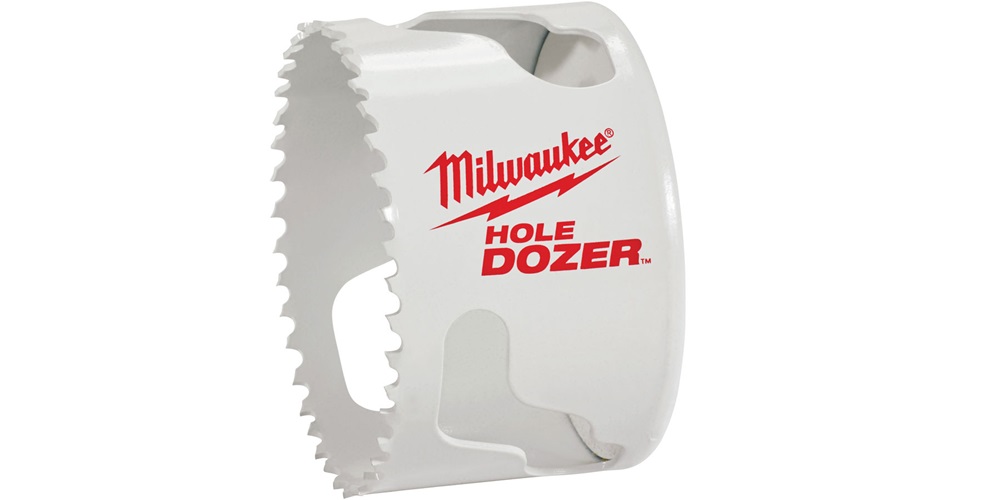
Ryan Rudzinski, product manager for Milwaukee Tool, said not all hole saws are as similar as they appear.
“On the surface, hole saws may look alike, but when closely viewed, differences begin to emerge,” he said. “Metallurgic and manufacturing technology continues to advance in the power-tool accessory arena. Durability is key for users and critical to get through a range of both soft and hard materials that come in a variety of thicknesses and accommodate different applications. Teeth need to stay on a hole saw while cutting in any of these materials, allowing the user to complete each job.
“Impact drivers continue to grow in popularity among electricians. Impact hole saws are designed for the speed and torque of an impact driver, while also being versatile enough to use in a regular drill. Milwaukee’s Shockwave impact hole saws feature an 8-TPI design for quick, burr-free cuts, a stop shoulder to prevent overdrilling and an ejection spring to immediately remove the plug of material cut.
“It is important that arbors create secure connections that result in quality holes with minimal cleanup. Many manufacturers promote [that] their arbors are faster to change between sizes. But because most users typically have a few hole saw sizes during daily work, that doesn’t really have an impact. More important is how secure the arbor connection is. The quality of the holes cut is more important than how quickly the saw can be changed out.
“Milwaukee offers a full range of hole saws for the electrical market. Bimetal hole saws are always a great choice because they can cut through a complete range of materials, basically anything an electrician would need to cut into on a job,” he said.
Tayler Brinson, product specialist at Southwire Tools, Carrollton, Ga., stressed the importance of reliability and longevity.
“Reliability and tool life are the most important considerations for hole saws,” he said.
Recent advancements in hole saws include quick-connect mandrels.
“The primary sizes of hole saws used by electricians are in the 2- to 7-inch range depending on applications,” Brinson said. “Larger sizes usually are for installing recessed can lights, and sizes like the 2-inch saws are used for feeders. Southwire Tools offers bimetal hole saws, carbide-tipped hole saws and an adjustable hole saw. Bimetal holes saws cut steel, aluminum, brass, wood and plastic. Carbide-tipped hole cutters cut metals and stainless steel.”
About The Author

GRIFFIN, a construction journalist from Oklahoma City, can be reached at [email protected].