You're reading an older article from ELECTRICAL CONTRACTOR. Some content, such as code-related information, may be outdated. Visit our homepage to view the most up-to-date articles.
In recent years, there has been a trend to increase functionality of many tools and testers that electricians use. The idea is that, if one tool can do multiple tasks, electricians will need fewer tools, which can mean a lighter tool belt or box. However, users have discovered additional functions may limit the effectiveness of a tool to complete its primary task and that secondary features may not perform as well as a single-purpose product.
The multimeter is a multipurpose tester that has been around a long time. Although analog multimeters still are sold and used, most multimeters now are digital. For electricians, it is an essential tool.
“The digital multimeter [DMM] is still the first, go-to, always-on-my-tool-belt instrument for the electrical contractor,” said Chris Gloger, digital multimeter business unit manager, Fluke Corp.
Mike Fox, general manager, Flir/Extech test and measurement products, said the multimeter remains the primary, most comprehensive, and most essential test tool for electrical contractors.
“As other tools introduce more functions, the multimeter soldiers on with an unbeatable combination of more breadth of measurement modes, coupled with the best accuracy available among portable test instruments,” Fox said.
The latest DMM models have expanded capabilities and wireless functionality, and options are diverse. A single tester can meet varying needs.
“The ability to measure electrical phenomenon has followed the trend in computing where more capability is available than ever before,” Gloger said. “The key is for multimeter manufacturers to implement this power in ways that benefit DMM users. A DMM can measure almost any electrical parameter. Most users do not need to measure everything; they need to measure specific things extremely well.”
Electrical contractors might be more interested in rapid go/no-go (noncontact) testing for voltage presence, and low-impedance modes for preventing false readings caused by ghost voltage, while a heating, ventilating and air conditioning (HVAC) contractor probably needs built-in microampere current measurements for testing pilot light sensors and temperature measurement.
“Rather than looking for a digital multimeter that has 20 or 30 dial positions to cover every possible measurement, users should look for a DMM with measurement functions that fit their common tasks,” Gloger said. “Many manufacturers now include wireless communications capability in their digital multimeters. It takes a single, momentary measurement and makes it recordable and storable in a database. This is a trend that is going to continue.”
“Today’s multimeters are expanding their versatility beyond the scope of standard multiple measurement modes,” Fox said. “For example, a low-pass filter can ensure precision readings even when signals are noisy. This is useful for working on variable frequency drives [VFDs]. Low Z mode ensures that so-called ‘ghost voltage’ doesn’t affect readings. Point-and-shoot infrared surface temperature measurement remains a popular must-have on multimeters.
“The availability of richer, higher quality color displays has dramatically improved the usability of multimeters. High-contrast, dot-matrix LCDs are easier to read and take the multimeter display beyond numerical values and labels and also include more sophisticated graphical reading displays for better testing insights.
“The ability to store readings also can prove helpful when performing a series of readings that must all be logged. Taking that a step further, very-advanced DMMs offer Bluetooth capabilities to stream readings to a mobile device with an app that displays readings remotely. Remote viewing on a smartphone or tablet can help improve safety and also make it easier to operate switchgear that’s not immediately adjacent to the point of measurement.
“An extension of the mobility theme is connectivity in a sort of ‘diagnostic ecosystem’ with other tools like infrared cameras. A multimeter can relay electrical readings to an infrared camera, which imprints those readings on related thermal images for more coordinated testing and documentation.
[SB]“In terms of accuracy, the increased availability of multimeters with low Z and VFD modes has helped to improve accuracy across the board. Additionally, basic accuracy as low as +/– 0.05 percent can now be found on durable, drop-proof meters, not just bench-duty instruments,” Fox said.
Manny Fernandes, national sales manager, Hioki USA, said: “In today’s world AC [alternating current] and DC [direct current] voltages are essential in DMMs for continuity, peak and average measurements. They also have filter functions for noise and harmonic distortion, including temperature measurement, capacitance and diode measurements. Over the years, DMMs have become user-friendly. They now have a terminal shutter preventing accidents to the operator and no damage to the instrument. CAT IV, 600 volts, True rms [Trms] is the most important.”
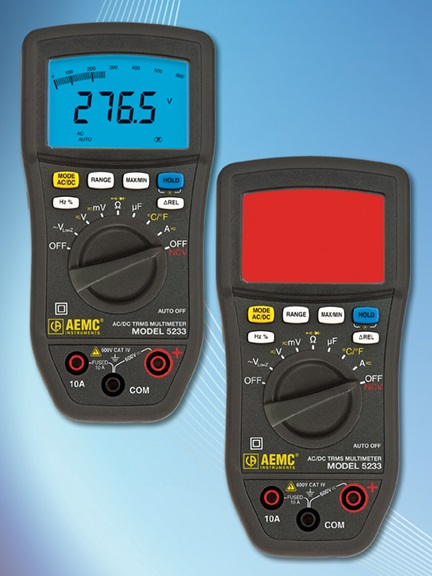
John P. Olobri, director of sales and marketing, AEMC Instruments, said: “Over the past two years, changes in multimeters improved functionality with low Z to eliminate phantom voltages, noncontact voltage detection and duty-cycle capabilities.
“Large backlit displays with bar graphs provide quick reference. High-impact boots and IP54 rating improve durability. For safety, models are CAT IV rated. High-end test equipment is getting less expensive and more available. More multimeters are being sold but at a decreasing rate due to the influx of multi-function clamp-on meters,” Olobri said.
Chris Forthaus, senior test and measurement product manager, Ideal Industries, said: “Buyers of later generation multimeters expect to find typical functions that include voltage and current, resistance, capacitance, diode testing, and also lead sets that meet the latest standards incorporating removable probe tip covers for CAT II, III or IV compliance.
“Digital multimeters have evolved over time to offer more and more functions, features and specialization. However, the majority of electrical contractors mostly still use multimeters for the measurements just mentioned—voltage, current and resistance—with the occasional need to measure capacitance or temperature or to check the function of diodes and other semiconductors. Adding capabilities for other specific testing may reduce the effectiveness of other needed tests and may add complexity to using the meter.
“The great news today is that there is a choice of meters available that are targeted to the specific needs of electricians who don’t have to settle for a general-purpose meter cluttered with functions that they will never use.
“Regarding accuracy, most meters provide far more accuracy and resolution than is typically required or necessary for most electricians and service technicians. Accuracy to a volt or two is often more than sufficient, even though any modern meter will be far more accurate. At some point, accuracies of 0.05 percent versus 0.025 percent become meaningless.
“There have been some exciting developments recently in the area of connectivity, enabling measurements to be wirelessly monitored at a safe distance and shared via smart devices.
“Manufacturers have a continuing challenge to offer meters that meet the demands of electricians, providing them with quick, easy and trusted access to the readings they need to complete a task. New innovations are introduced on an ongoing basis, providing electricians with a wide range of choices in functionality and cost.
“The choice of equipment available at affordable prices has never been wider, and the main problem facing users these days is deciding what functions are going to be truly useful on an everyday basis,” Forthaus said.
Jeffrey R. Jowett, senior application engineer, Megger, said: “Multimeters still have a solid foothold in the market, as they retain the accuracy and safety that alternative test meters cannot always meet. Multimeters remain, in many cases, the best value for the money, the easiest to use and most practical tool.
Multifunction testers are a double-edged sword; they can be cumbersome to operate and aren’t always the best choice where time is money. Many functions may go unused, making them less than economical for the application.
“Multimeters now are split into two separate types: instruments with high display count and accuracy for electronics engineers and instruments that have high CAT safety ratings (IEC 61010) with acceptable functions for the electrical engineer or field technician. If rugged use is anticipated, drop test specifications should be checked.
“True rms measurement capability is critical for work in nonsinusoidal electrical environments. A bar graph function can be invaluable in identifying noise and sources of electrical disturbance. Useful convenience factors include backlighted screen and digit sizes that make work easier in poorly lit environments,” Jowett said.
About The Author

GRIFFIN, a construction journalist from Oklahoma City, can be reached at [email protected].