You're reading an older article from ELECTRICAL CONTRACTOR. Some content, such as code-related information, may be outdated. Visit our homepage to view the most up-to-date articles.
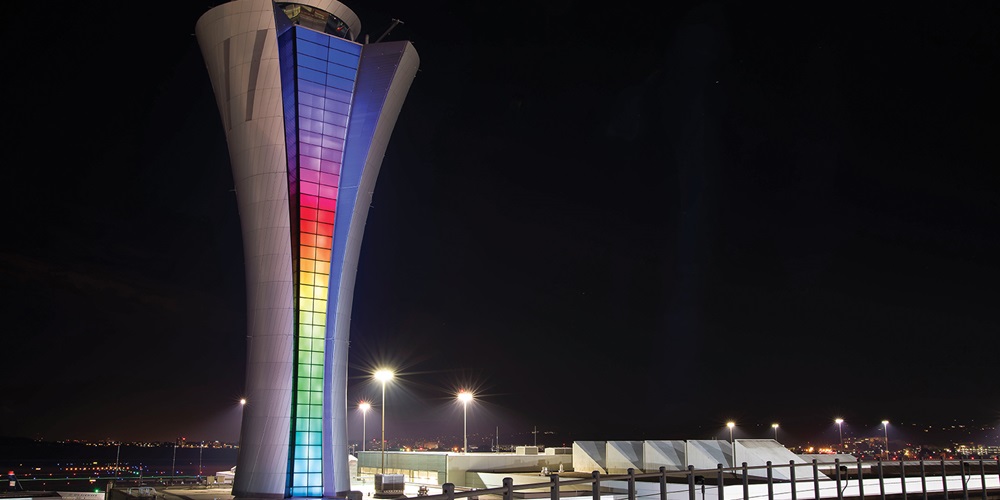
San Francisco Airport’s new air traffic control tower (ATCT) is not only a functional facility, but it’s also a 221-foot-tall work of art and a new landmark for the Bay Area.
“The form of the building is meant to resemble a torch that hearkens back to a time in San Francisco history when torches were used to drag ships into dock,” said Curtis Fentress, president and principal-in-charge of design, Fentress Architects. “It is a dynamic form, and everything had to be closely coordinated to fit within and on the building.”
A vertical element on one side of the tower creates the “wow” factor. Its multiple glass-fronted panels, illuminated by color-changing and programmable light-emitting diodes (LEDs), will treat the approximately 50 million domestic and international travelers to the airport to a light show to celebrate holidays and events.
“The tower has a small footprint yet a huge presence,” said Mark Keys, division manager/partner, Redwood Electric Group (REG), an electrical contractor with offices in Sacramento, San Francisco, Santa Clara and Vacaville, Calif. REG competitively bid the ATCT project to Hensel Phelps Construction Co. and was awarded the project at just over $12 million.
“We held a plan and spec contract with a distinct design/assist approach,” Keys said.
Getting off the ground
Construction of the ATCT began in summer 2012 and is scheduled for completion in early fall 2015. The project presented REG with unusual and unique challenges. The torch-shaped structure was built in between operating terminals with passenger traffic nearby. One side of the project was considered to be on the operational side of the airport.
“Getting material in and out of the project with the small footprint meant limited storage and lay-down for day-to-day construction activities,” said Tony Maisano, project executive, REG. “It was an enormous challenge. We had to make sure to get the right material to the field at the right time so we could remain productive. Some out-of-the-box thinking helped as we developed strategies to mitigate the downtime.”
Since both San Francisco Airport (SFO) and the Federal Aviation Administration (FAA) will occupy the ATCT, REG had to satisfy inspectors from the City of San Francisco Department of Building Inspection and the FAA.
“One of the bigger challenges was coming to commonality with the different authorities having jurisdiction [AHJ],” Keys said. “For example, the same identical type of pumps that were in the same room had to be wired with different means and methods as some were to support SFO space and others to support the FAA space. Understanding the rationale for that took some getting used to. You can imagine that the testing and commissioning is above and beyond normal because it’s such a critical facility.”
Since San Francisco is no stranger to seismic activity, the tower had to be built to withstand earthquakes.
“It’s a post-tension concrete structure with two tuned mass dampers at the top, so it’s a very a complex structural system built to withstand a very strong earthquake, one measuring up to 8 on the Richter scale,” Fentress said.
An exterior skin of aluminum insulated panels covers the concrete construction. The REG crew worked from swing stages to install the lightning protection on the exterior skin.
“Redwood Electric did a great job of integrating it with the design,” said Emily Finch, project architect, Fentress Architects. “In a normal building, they would likely take the lightning protection straight down to the ground. That’s not the case with a dynamic building like ours. The conductors and equalization rings have to curve along the contours of the building, along the reveals, so that the system doesn’t interfere with the beauty of the tower.”
Reveals are minor spaces between the panels that allow movement.
“The system had to line up with the grid pattern of the exterior skin of the tower,” Finch said. “That’s one element. On the inside of the building, we had very limited and tight space, and there was a lot of very close coordination on the interior of the building with REG, electrical designers, Fentress Architects and the FAA. Everybody was involved, and it was truly a team effort.”
The vertical post-tensioned tendons—structural cables running inside the concrete core that hold up the building— further complicated the process.
Another challenge for REG involved tying in airfield lighting and positioners for the FAA.
“We put in a few miles of fiber optic cable under the runway,” Maisano said. “We had small windows in which to work and had to be very careful. You can’t be on a live runway. It was an extremely tough scheduling process.”
Special attention was also paid to making the tower a comfortable place for the air traffic controllers. For example, the height of the new ATCT adds to the visibility so that controllers will be able to see all runways from one end to the other. An outdoor garden and patio will provide a pleasant break environment.
“I have done airport traffic control towers in the past and can say this one is truly unique,” Maisano said. “The importance of the aesthetics and the level of comfort for the operators, controllers, users and general public is second only to the actual performance and security of the tower. What we have built will benefit those in the community for decades to come.”
Directing trade traffic
Coordinating the team effort included a reliance on technology.
“Having hundreds of miles of wire in such a small space required the strict use of building information modeling [BIM] and layering of the installations to make it all fit,” Keys said. “There is layer upon layer of different trade work represented in the model.”
BIM was especially crucial in determining placement of the penetrations (openings for conduit runs) that go through the concrete core.
“There was an amazing amount of coordination with the electrical, and we had to know about the conduits ahead of time before pouring the concrete,” Finch said. “There was a significant coordination effort for each day’s concrete placement.”
Coordination on the project was enhanced by the efforts of Sue Dyer, president of OrgMetrics and CEO of the International Partnering Institute, who created a structural collaborative-partnering process that works to develop teamwork among the different parties on a project. Dyer has worked on SFO projects for many years, and, on this ATCT project, she arranged and facilitated monthly partnering meetings involving every key individual on the team.
“Electrical work on most projects is instrumentally important, more of a backbone, whether high- or low-voltage, for the buildings being wired now,” Dyer said. “As technology grows and the complexity of electronics grows, it’s more and more important to create a congruent team.”
That congruency affected the project in terms of efficiency and budget.
“The meetings created a buy-in from every key individual on the project from the beginning to the end,” Keys said. “In a partnering session, you’re forced to get to know the other people in the room on a personal level. You become familiar with who’s in the room and are more able to speak freely, share thoughts and ideas even if they don’t pertain exactly to your scope of work. We worked together and weren’t just looking at our own wallets. We looked at what was good for the project. Everyone was communicating, and we tended to get our work done in a more efficient manner. We also used what we learned in partnering meetings and implemented them in project team meetings.”
A soft landing
While construction will be substantially complete by fall 2015, the new control tower will run in conjunction for a year with the existing control tower that was completed in 1954.
“With the intricacies and safety involved with air flight, [the FAA has] to make sure all the systems are running concurrently with the existing systems,” Keys said.
Keeping the airport running is the most vital thing.
“The control tower is a very important key component of the airport, and, if it’s down, the airport is closed,” Fentress said. “The electrical is what makes it work.”
The project goal for the new ATCT facility is to be certified LEED Gold, which would make it one of the first ATCTs in the United States to achieve such a designation.
“The tower project is significant for SFO,” said Doug Yakel, public information officer, communications & marketing, San Francisco International Airport. “It’s the first time the FAA has placed the building of one of their towers in the hands of an airport, which speaks to the relationship we have with them. We had a vested interest in creating a structure that not only met the FAA’s functional requirements but in a design that complemented the existing architecture around SFO, with the goal of becoming an iconic landmark for years to come.”
“I feel we ended up with the right team on this one,” said Mark Costanzo, project manager, ATCT Project for SFO. “The combination of SFO, Hensel Phelps, and Redwood Electric Group made this difficult project happen. They were key players in the success of the project.”
About The Author
CASEY, author of “Women Heroes of the American Revolution,” “Kids Inventing!” and “Women Invent!” can be reached at [email protected] and www.susancaseybooks.com.