Personal protective equipment (PPE) brings up a mix of opinions. We all know and understand that PPE is a requirement when performing work that puts us at risk of injury. On top of that, most electrical safety training spends much of the session on how to select and inspect PPE. Yet, time and again when I speak to folks in the electrical industry, there is still a gap in understanding in how PPE protects us from injury. Essentially, what exists is an attitude that we know we need to wear PPE, but we don’t understand exactly how or why the PPE offers protection.
Before we venture too far down the PPE rabbit hole, we need to understand something very important: in the hierarchy of risk control methods, it is listed as the least effective method.
But this doesn’t mean PPE is not necessary. The PPE industry has invested countless hours of research and development to create effective and comfortable PPE.
Rubber insulating gloves
Focusing on electric shock first, the most common type of protective equipment is rubber insulating gloves. Severity of injury from electric shock depends on how much electrical current flows through the body and the path that current takes. Currents as low as 75–100 milliamps (mA) across the heart can cause ventricular fibrillation in healthy adults. Ohm’s law states that current is directly proportional to voltage and inversely proportional to resistance.
Rubber insulating gloves are effective because they drastically increase the resistance in the circuit when contact is made with hands. If the body’s resistance from hand to hand is around 1,000 ohms without gloves, this results in roughly 0.5A at 480V. But, if we increase the resistance to 1 million ohms by wearing rubber gloves, the current is reduced to a negligible level and the worker is protected from injury.
However, rubber gloves only protect if contact is made with the hands. If a worker accidentally contacts energized parts with an elbow or shoulder, they can still be shocked, which is why an electrically safe work condition will always be a better option.
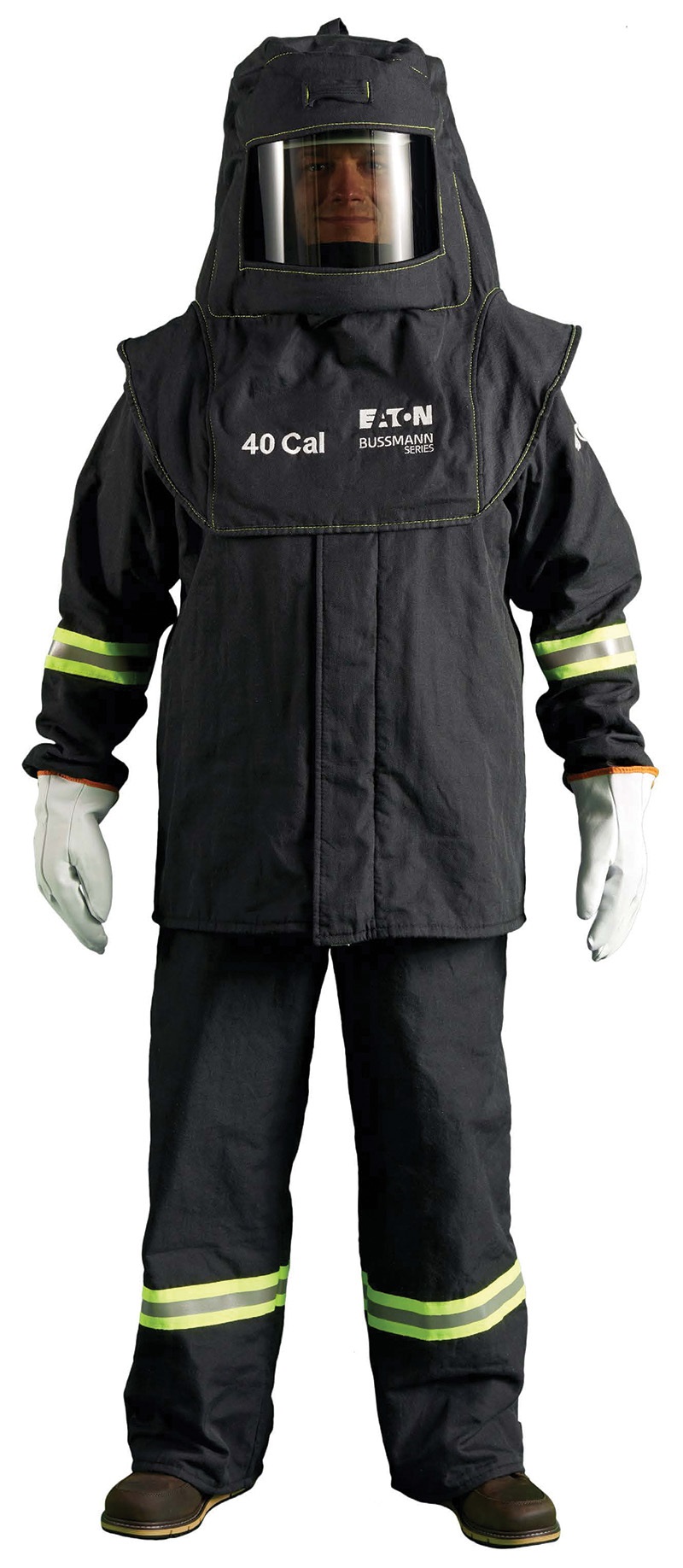
AR clothing
What about arc-rated PPE? How does it protect us from arc flash? Basically, if you want to minimize injury from an arc flash, you need to do two things: limit the amount of heat transferred to your body and reduce the likelihood of being on fire after the arc flash is over. The key here is to not wear fuel for the arc flash to burn. But, if all there is to it is not being on fire after the arc flash is over, can’t that be done with flame-resistant (FR) clothing?
Unfortunately, it is not that simple. FR clothing tests focus on self-extinguishment of the clothing after it catches fire. Arc-rated (AR) clothing is tested for flame resistance, but goes above and beyond this by also being tested for response to an arc flash.
This testing is accomplished by measuring two critical factors: how much heat transfers to the wearer, or arc thermal performance value (ATPV), and how much energy it takes to break open the fabric. Typically, the testing process seeks to determine at what incident energy level the garment will allow 1.2 cal/cm2 of thermal energy to reach the wearer, but if the garment breaks open before that point is reached, it will be rated for its break-open threshold instead of the ATPV.
But what about the blast created by the arc flash? The important thing to remember about AR clothing is that it is there to minimize the severity of injury from the thermal energy. Arc blast is difficult to determine for a given task since each situation will be different. Although PPE will not fully protect you against the effects of an arc blast, work practices such as body positioning and greater distance are effective in protecting from them.
It’s simple: if you don’t want to be blown up by an arc flash, don’t be standing in front of the arc flash when it happens. But, if you don’t want to be on fire after it is over, wear AR clothing.
PPE reduces the severity of injuries by taking aim at minimizing the factors that lead to injury: current for electric shock and thermal energy and residual clothing fire for arc flash. When we understand these reasons, we can see where PPE fits into the overall protection strategy. To effectively protect employees from electrical hazards, PPE is important, but there are still limitations. PPE is not a substitute for an electrically safe work condition. Always create one as the first option.
Until next time, stay safe and always remember to test before you touch!
About The Author

Vigstol is an electrical safety consultant for E-Hazard, a provider of electrical safety consulting and training services. He is also the co-host of E-Hazard’s electrical safety podcast “Plugged Into Safety.” For more information, check out www.e-hazard.com.