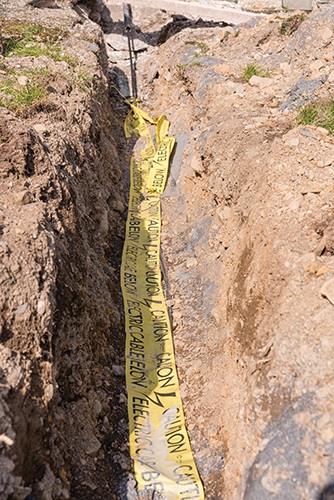
Trenching and excavation are dangerous. In recent years there has been a spike in fatalities, including 11 so far this year, according to Occupational Safety & Health magazine. As a result, OSHA has updated and revamped the National Emphasis Program (NEP) for trenching and excavation.
According to OSHA, “NEPs are temporary programs that focus OSHA’s resources on particular hazards and high-hazard industries. Existing and potential new emphasis programs are evaluated using inspection data, injury and illness data, National Institute for Occupational Safety and Health (NIOSH) reports, peer-reviewed literature, analysis of inspection findings, and other available information sources.”
The NEP for trenching and excavation is intended to reduce or eliminate hazardous conditions and help ensure compliance with pertinent OSHA regulations.
Excavations are often necessary to complete underground line work. They are man-made trenches, cuts, cavities or depressions in the ground formed by earth removal. This unique work environment poses some serious dangers and potentially hazardous scenarios, including cave-ins and confined space hazards, and underground pipes and wiring.
Important guidance to know
Prior to excavation work, the ground must be properly marked. Most municipalities require a minimum of 24–48 hours to clear and mark an area before work can be done. Workers should be familiar with the following colors utilities typically use as markings for identification:
- White—proposed excavation
- Pink—temporary survey markings
- Red—electric lines and lighting cables
- Yellow—gas, oil, petroleum and
steam lines - Orange—communication lines,
cables or alarm signals - Blue—water
- Purple—reclaimed water or irrigation lines
- Green—sewer and drain lines
Workers should establish a safety checklist before digging. Additionally, they should check for the proximity of utilities, buildings and vibration sources; contact the owners of affected utilities; arrange for shutdown or relocation of facilities, if necessary; provide daily job site excavation permission; and check the adequacy and availability of all equipment including PPE, shoring materials, signs, barricades and machinery. All of this must occur prior to the commencement of work. A copy of 29 CFR 1926—Subpart P should also be available on the job site.
When working in a trench or excavation, safe means of entry and exit must be in place. This means, when necessary, the appropriate benching, sloping, shoring and shielding has been established.
Benching is a method of protecting workers from cave-ins by excavating the sides to form one or a series of horizontal levels or steps, usually with vertical or near vertical surfaces between levels. Sloping involves cutting back the trench wall at an angle inclined away from the excavation. Shoring requires installing aluminum hydraulic or other types of support to prevent soil movement and cave-ins. Shielding protects workers by using trench boxes or other types of supports to prevent soil cave-ins.
Soil types
When implementing these protective measures, it is critical to be familiar with the different types of soil. This will ensure the correct safety mechanisms are deployed under the right conditions. Different soil types include stable rock and types A through C.
Stable rock is natural solid mineral matter that can be excavated with vertical sides and remains intact while exposed. Examples include granite or sandstone.
Type A soils are cohesive with an unconfined compressive strength of 1.5 tons per square foot (tsf) (144 kPa) or greater. They include clay, silty clay, sandy clay, clay loam and, in some cases, silty clay loam and sandy clay loam.
Type B soils are cohesive with an unconfined compressive strength greater than 0.5 tsf (48 kPa) but less than 1.5 tsf (144 kPa). Type B soils include angular gravel, silt and silt loam.
Type C soils are cohesive with an unconfined compressive strength of 0.5 tsf (48 kPa) or less and include gravel, sand, loamy sand, submerged soil, soil from which water is freely seeping and unstable submerged rock.
It is imperative to follow all federal, state, local and company safety rules and regulations pertaining to trenching, excavations and confined space safety when applicable. Employers must ensure all workers are properly and adequately trained on the hazards they might encounter while on the job.
stock.adobe.com / Stephen
About The Author

O’CONNOR is safety and regulatory affairs manager for Intec, a safety consulting, training and publishing firm. Reach him at [email protected].