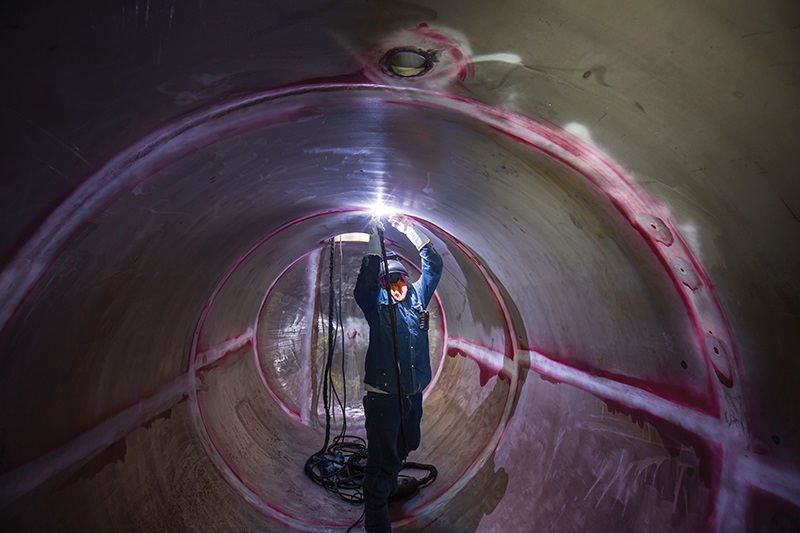
Done in confined spaces, hazards from welding and cutting activities can multiply. It is imperative for employers and workers to understand all the risks, safety protocols and requirements necessary to prevent an incident from occurring. Electrical contractors sometimes do welding during installation, repair or maintenance on metal electrical enclosures, conduits, supports or grounding structures. When done in environments such as manholes, vaults, tunnels, crawl spaces, tanks, utility vaults, basements or service shafts, extra caution must be taken.
First things first
As a refresher, OSHA defines a confined space as one large enough for an employee to enter and perform work but has limited or restricted means for entry or exit and is not designed for continuous employee occupancy. A permit-required confined space, however, is one that meets any of the following criteria: has a hazardous atmosphere, contains material that can engulf an entrant, has walls that converge inward or other physical hazards.
Making sure air quality is good in environments where welding is occurring is paramount and is especially true in confined spaces. Improper or bad ventilation can result in a lack of breathable air. Poisonous fumes, vapors and gases generated from welding need to be controlled. Additionally, welders need constant access to an oxygen-rich, clean air supply. Oxygen levels should never dip below 19.5% or suffocation can occur.
Other hazards
Air quality is not the only hazard at play. If there isn’t proper ventilation, the steam and flammable dust that accumulate in the atmosphere can rapidly build up and cause fires or explosions.
Confined spaces can trap heat and create extremely hot work conditions. Electrical hazards are heightened due to the increased risk of contact with voltage from tools, lighting or equipment.
When working in tight, uncomfortable quarters with restricted movement, even the simplest tasks can cause overexertion and physical strain.
To ensure employee safety, special consideration must be given to the precautions needed. Work must be limited to properly trained individuals using appropriate, approved equipment. The air quality must be tested prior to entry and as needed. Ventilation should be used to expel welding fumes and maintain oxygen. If general, if local or mechanical exhaust systems are not sufficient to provide breathable air, respirators are needed. The type of respirators will depend on the percent of oxygen available and levels of toxins in the air. Where oxygen levels cannot be maintained or toxins can’t be filtered out, an air line or self-contained breathing apparatus may be needed.
Other PPE to consider include eye, face, body and head protection. Match protection to exposure and the type of welding performed. For example, the filter level of lenses used will depend on whether gas or arc welding is being used and factors such as electrode size and plate thickness.
In spaces with limited working area, smaller, compact, portable welding equipment and wire feeders will enhance maneuverability. Often, these tools have remote controls that allow users to adjust the settings without exiting the confined space.
Further considerations
Communication and rescue equipment are critical. Workers in the space must be in constant contact with an attendant outside. Devices used must offer clear transmission. Rescue equipment and procedures must also be in place. Those performing the rescue must have the appropriate equipment and know how to use it.
Finally, consider possible hazards that may remain even after completing welding or cutting work. Metal that has been worked on may be hot for some time. Warn others of the possible danger. If gas welding or cutting was done, make sure to turn off and bleed the system. An oxyacetylene system that leaks oxygen, acetylene or both will create an explosive atmosphere.
From a regulatory perspective, there are several OSHA standards that address welding and cutting. One of the most notable for the construction industry is CFR 1926 Subpart J and CFR 1910 Subpart Q for general industry. However, it is also addressed in the agency’s confined space regulation. OSHA indicated in a 2019 clarification letter: “Although the welding standard has a section designed to address the hazards of welding in a confined space, [OSHA] is applying the provisions of the confined-spaces standard to all other hazards associated with confined-spaces work to the extent these provisions of the confined-spaces standard do not conflict with employee protections. OSHA designed the welding standard to protect employees solely from the hazards of welding, which include metal fume, gases, and smoke hazards associated with the welding process, physical hazards from the welding device or contact with the hot welding surface, potential explosion of the gas tanks, and hazards from working with specific materials.”
stock.adobe.com / chitsanupong
About The Author

O’CONNOR is safety and regulatory affairs manager for Intec, a safety consulting, training and publishing firm. Reach him at [email protected].