Circular and reciprocating saws are massively important parts of the electrician’s arsenal. But without understanding proper selection, use and care for blades, saws aren’t nearly as effective or efficient as they could be. This article will discuss the different types of saw blades, how to use bladed tools effectively and safely, and how to make blades last through high-quality care and maintenance.
General considerations
The first thing to consider when selecting the proper saw blade is the material that must be cut.
- Standard wood blades are the most common and are general-purpose only. They typically range from 24–60 teeth (fewer teeth yield rougher but quicker cuts, and more teeth yield finer but slower cuts). Standard blades also work well for cutting PVC, as the blade design is rather aggressive, and PVC is not overly hard.
- Plywood and fine-finish blades are used for finer finished work. They have a higher tooth count (60–100) that reduces splintering.
- Carbide-tipped blades are designed for greater durability and wear resistance. The carbide tips can be resharpened more often and will stand up to much more abuse than a standard bimetal blade.
- Metal-cutting blades are designed to cut metal in lieu of wood and come in two general categories: abrasive (to grind the metal away) or carbide-tipped (thicker and specially shaped tooth geometries stand up to the abuse of cutting metal).
- Masonry blades are abrasive and rely on grinding (as opposed to cutting) through concrete, stone, brick or tile. They are often devoid of teeth, and the cutting surface is typically made from silicon carbide or diamond grit.
There are a few other items and terms to keep in mind when selecting saw blades:
- Kerf refers to the width of the cut in the material. As a rule, a thinner kerf is better—less material being removed generates less heat and does not work the tool as hard.
- Gullets are the spaces between the blades of each tooth and play a key role in carrying away the waste material (sawdust, for example) and preventing the blade from clogging up. Generally, the larger the gullet, the better the feed rate of the blade.
- Expansion slots are small slots laser-cut into some higher-end blades. These slots are designed to disperse the heat generated during the cutting process in an effort to prevent the blade from becoming warped due to heat or friction.
- Tooth quantity (or TPI, teeth per inch) is important to take into account. The higher the TPI, the slower and smoother the cut. The lower the TPI, the faster and rougher it is.
- Diameter of the saw blade will be driven by the saw itself. Always match up the saw size to the blade size.
- Arbor size is also based on which saw is being used and will be marked on it. Some circular saw blades come with different bushings that allow them to be installed on a variety of saws with different arbor sizes.
- Price is a factor for many when choosing tools—especially ones that are consumable. However, more expensive blades are usually manufactured with higher-quality materials that produce cleaner cuts and last longer than their less-expensive counterparts.
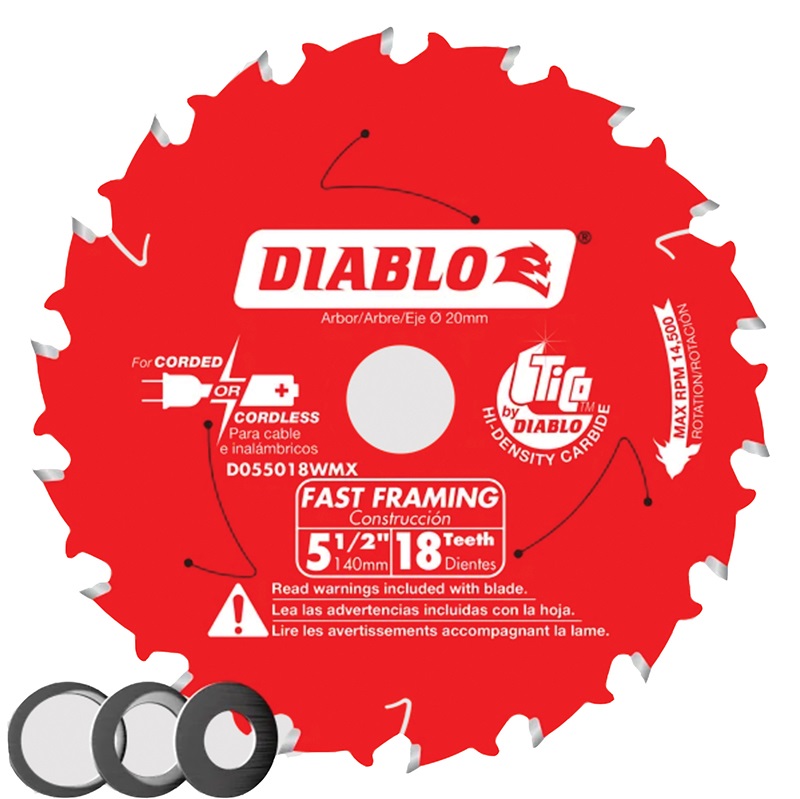
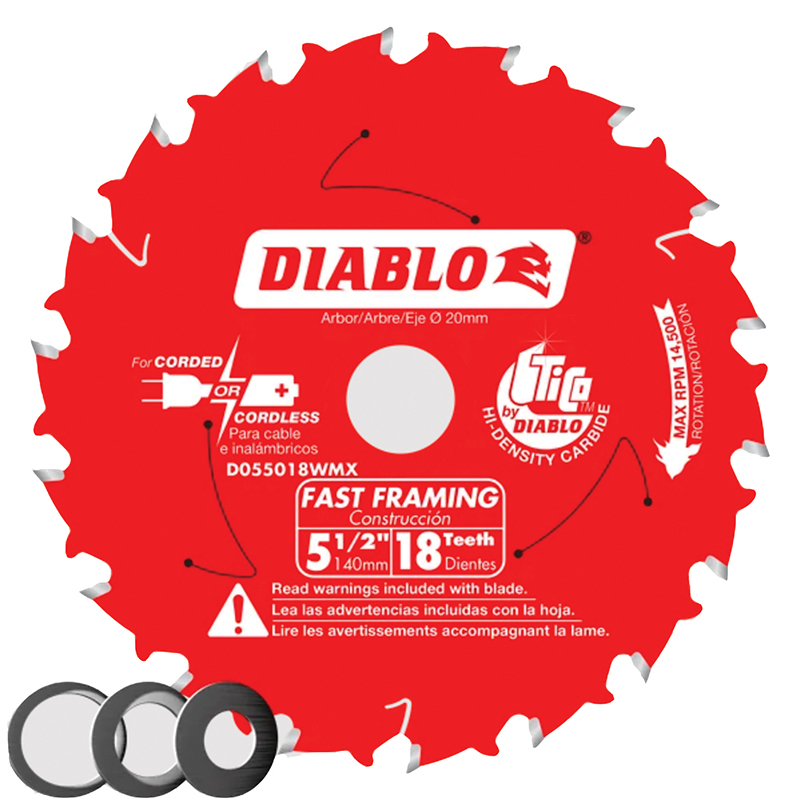 | 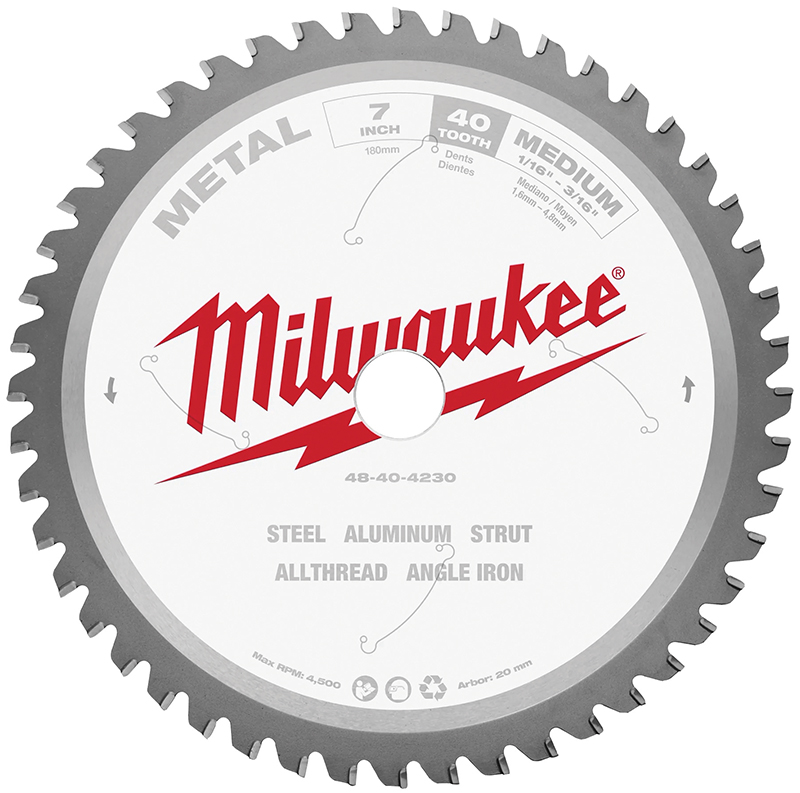 | |
Diablo Tools’ 5.5 inch, 18-tooth Fast | Milwaukee Tool’s 7 inch, 400-tooth metal-cutting circular saw blade |
Circular saw blades
For most of us electricians, a general-use or framing-type circular saw blade is suitable for cutting wood to install a box or notch a stud for conduit installation. High Point, N.C.-based Diablo Tools’ Fast Framing saw blade is an excellent choice for quick and efficient wood cutting. The blade features high-density carbide tips designed to maximize blade life, performance and durability. The blade’s thin kerf allows it to move through material quickly with less effort, and the expansion slots reduce vibration by keeping the blade cool and reducing warp. Another notable feature is the nonstick coating that reduces gumming, rusting and corrosion. Several blade diameters are available to accommodate virtually all corded and cordless saws on the market.
Milwaukee Tool, Brookfield, Wis., offers a line of metal-cutting circular saw blades for those who use a circular saw to cut conduit (or anything metal). The tips are made of cobalt-infused tungsten carbide designed to extend the cutting life and maintain sharpness, all without needing any lubricant.
The tips also have an alternate top bevel grind that produces cuts that are burr-free and cool to the touch—a definite bonus that allows for immediate handling after the cut is complete, without having to wait for the saw blade to cool down.
Rounding out the features of this blade are the laser-cut expansion slots that reduce wobble and warping. The blades are available in a multitude of diameters and tooth count to accommodate a variety of saw sizes.
Reciprocating saw blades
Reciprocating saws are also quite popular due to their versatility. Milwaukee Tool offers a carbide demolition wood- and metal-cutting reciprocating saw blade set that covers nearly any situation we would encounter. Whether cutting through wood, PVC or metal, these will do it all.
Every one of the blades within the set are carbide-tipped, allowing for considerably longer life. The blades are 1 inch tall and stand up to repeated use. The set includes two 9-inch AX blades for cutting through nail-embedded wood, as well as three TORCH blades (two 9-inch and one 6-inch blade) designed to cut metal thicker than 3/16 inch. While not the cheapest set of blades on the market, their longevity and durability make them worth it.
Diablo Tools offers a six-piece set of bimetal, non-carbide-tipped reciprocating blades for wood and metal demolition. Even without carbide tips, these blades are still extremely durable, lasting up to five times longer than standard blades. The set features one 6-inch blade for thick metal (3/16 inch to 9/16 inch), three blades (two 6-inch and one 9-inch blade) for cutting through nail-embedded wood and two 6-inch blades for medium-thickness metal (1/16 inch to 5/16 inch). All the blades are 1 inch tall, providing straighter cuts with less vibration, and all feature a unique tip design that enables faster and easier plunge cuts. Overall, this is a great, economical set that covers all the bases: wood, PVC, metal and demolition.
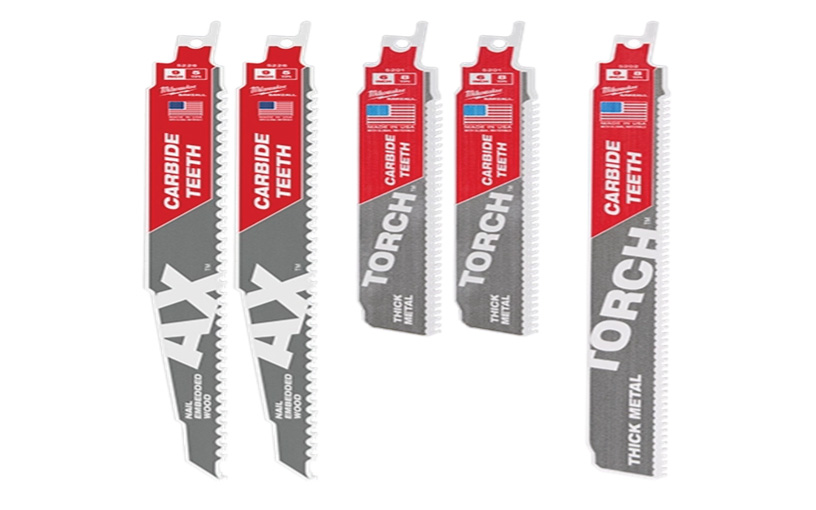
Milwaukee Tool’s Sawzall blades
Blade use and care
Keep in mind all blades are rated for specific rotations per minute (RPMs). Never use a blade rated for lower RPMs in a high-speed tool, as this can cause the blade to come apart or warp.
From a safety perspective, using the right feed pressure is imperative. Forcing the blade through the material runs the risk of the saw stalling, or even worse, kickback—where the saw forcibly comes back at you. In other words, let the blade do the cutting and do not force it through the material. Proper feed pressure also lessens the heat generated by cutting, extending blade life and reducing potential damage to the blade.
Proper mounting and direction are also important. Circular saw blades should be installed with the teeth facing forward, in the direction of rotation (this should be marked on the saw and the blade). For reciprocating saws, blade orientation may depend on the job (upward versus downward cutting), but most have universal fittings and bidirectional teeth.
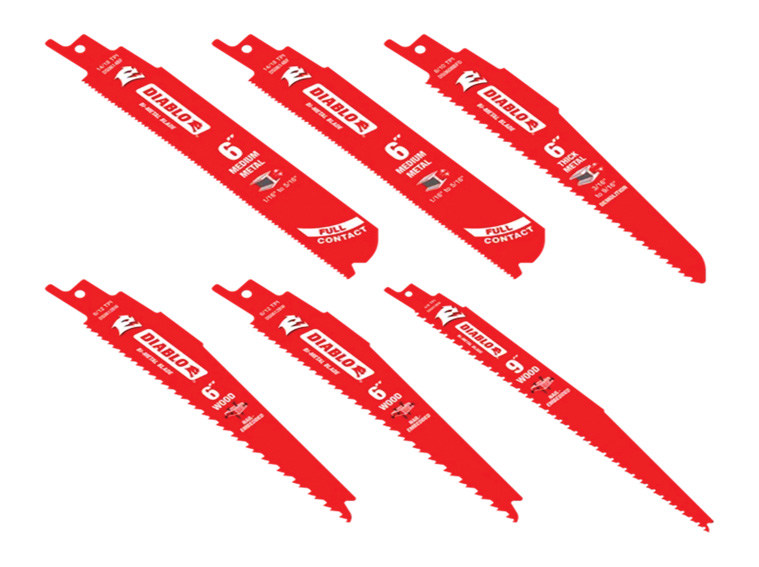
Diablo Tools’ six-piece bimetal reciprocating saw blade
set for wood and metal demolition
Proper care ensures longevity and cutting performance. Over time, blades can accumulate resin, pitch and debris that reduce cutting efficiency. They should be cleaned regularly using a commercial blade cleaner. The blades can also be soaked in warm, soapy water and scrubbed with a soft brush—just make sure to dry them thoroughly so they don’t rust.
Blades should be properly stored—either laid completely flat or hung vertically to prevent warping. Consider blade cases or sleeves to keep them protected and all in one place.
Blades should also be kept sharp. A dull blade cuts poorly and is dangerous. It causes the motor to work harder and increases the chance of kickback or binding since you have to apply more force to move it through the material. If you see signs of burn marks on the wood, smoking or binding, excessive chipping or tearing, or a slowdown of cutting speed, it is time to replace the blade. Circular saw blades can often be professionally sharpened, especially carbide-tipped ones. Reciprocating saw blades are typically a consumable item, although carbide-tipped ones can be sharpened.
Safety Tips for Portable and Stationary Saws
By Wes Wheeler
Always use a sharp blade appropriate for the material being cut. A dull blade will lead to using excess force, and the blade could break, bind, kickback or damage the material being cut by chipping or creating excessive heat.
When working with and changing saw blades, always remove the power to the tool. Unplug portable and stationary tools to prevent incidental energization that could create a hazard, and remove the battery when changing blades on battery-operated saws.
Remember that anytime you are cutting, sawing or drilling, personal protective equipment must be worn. That includes proper eye protection meeting the latest ANSI/ISEA Z87.1-2020 consensus standard and cut-resistant gloves meeting the ANSI/ISEA 105 standard. Secondary protection in the form of face shields can provide additional safety, but it must be used with the primary eye protection meeting the latest ANSI/ISEA Z87.1-2020 consensus standard.
Remember, you only have two eyes and two hands. It is important to wear the proper protection for both.
Conclusion
Saw blades are much more than just spinning pieces of metal—they are valuable extensions of the tools on which they are mounted. No matter what you are cutting, your choice of blade (and how well you maintain it) directly affects the safety, quality and speed of the work. Investing in the right blades, treating them with respect and using them with care makes your cuts cleaner and your whole operation sharper.
Diablo tools | milwaukee tool