You're reading an older article from ELECTRICAL CONTRACTOR. Some content, such as code-related information, may be outdated. Visit our homepage to view the most up-to-date articles.
Whether new construction or repair and maintenance work, integrated systems contractors sometimes require temporary, portable power sources. Today’s portable generators are more compact, more powerful, quieter and easier to use than ever before. When portable power needs to do more than run tools and operate temporary lighting, some models can safely supply computers and other sensitive equipment.
“There has been a significant amount of innovation in portable generators in recent years,” said Jake Thomas, director of product management, Generac Power Systems. “From increases in kilowatt [kW] output to improved customer interaction, multiple manufacturers have been working hard to bring additional value to the portable generator category.”
Thomas said some noticeable improvements include making units easier or more intuitive to start.
“Power on both sides of the generator spectrum also have been stretched lately,” he said.
Generac offers compact models for light commercial and residential use, ranging from 2 to 150 kW. On the high end, models are rated from 800 to 17,500 kW, more than three times higher than the previous industry norm.
“Additional advances bring more options than gasoline as a sole fuel source for compact models, and there are a number of aftermarket kits available to convert gasoline units to [liquefied petroleum], which can void the manufacturers EPA certification for the unit.
“Generators that are going to run computers, flat-screen monitors and TVs, and other sensitive electronics require a model that has very clean power. The typical measure of clean power is called total harmonic distortion [THD]. The IEEE [utility standard] is less than 5 percent for generators with the cleanest power, so users should verify the model meets that standard,” he said.
Contractors should keep many factors in mind when shopping for generators.
“In selecting a compact generator, users should be sure the unit has enough power for the job,” Thomas said. “Not just the overall kilowatt output but also the unit’s surge capability, which is the generator’s ability to provide a higher-than-rated output for a few seconds to accommodate electric motor starting loads like a circular saw. Other things to consider are portability and outlet configuration.”
Tom Pernice, senior marketing strategist for Honda Power Equipment, stressed the importance of finding the right match.
“It is important to match power needs with high-quality generator output that can protect sensitive equipment, offer portability, durability and reliability to provide the most value to the owner,” he said. “Generators are becoming smaller, lighter, more fuel efficient and quieter; many also are being designed to fit smaller, tighter spaces. Understanding overall power needs and what equipment is to be powered are important factors in choosing the right generator.
“Generators with inverter technology process raw power produced by the generator and pass it through a special microprocessor to produce the most stable power. This means sensitive equipment can operate from a remote location with a reduced possibility of interrupted service or damage to the equipment—particularly important on job sites where more and more contractors rely on sophisticated equipment that must be charged and recharged.
“Changing regulations as dictated by the [National Electrical Code (NEC)] and the Occupational and Safety Health Administration [OSHA] with regard to generators on job sites also are important for consideration, such as ground-fault circuit interrupter [GFCI] receptacles.
“The noise level of any generator is a major factor in determining the right model. Most generators are labeled with a decibel [dB] rating. For every increase in 10 dB, the noise level is 10 times more powerful. A generator that runs at 70 dB is 10 times as loud as a generator that runs at 60 dB. Superior technology and quality construction and materials help to keep noise levels low,” he said.
Spending a little extra money may be worth it, Pernice said.
“Low-cost generators are available, but many do not offer the features that produce good quality power for sensitive equipment; in fact, many low-cost generators also are not voltage regulated,” he said. “While many tools now include electronic units to regulate and monitor use and performance, contractors using low-cost generators may not realize the damage is occurring to their tools until the damage is done.
“Honda Power Equipment markets a complete line of generators for commercial and consumer applications. Lightweight, compact Honda generators produce between 1,000 and 10,000 watts of power, providing smooth, dependable power for recreation, construction, rental and home emergency use,” Pernice said.
Manny Rumao, portable products marketing manager for Kohler, said reliability is crucial.
“It has to start every time,” he said. “It doesn’t matter how quiet the unit is, or how long it can run on one tank, or how many outlets it has, if it doesn’t start. The job of a generator is to provide power when it’s needed, which equals peace of mind, and there’s no price tag for that.
“There are two categories of portable generators: one designed with price in mind and the other with durability. In the last five years, many players have entered the market, mostly on the lower end of the price spectrum, many with power ratings rounded up.
“Industrial-grade products are different. They usually are two to three times more expensive for the same power output, and ratings are not stretched. Technological advances like EFI [electronic fuel injection] have made the units even more expensive but have added value for professional users. Overall, the power range available hasn’t changed dramatically, but the price range has broadened at both ends of the spectrum,” Rumao said.
“Generated power can be measured many different ways, but the two that matter most are voltage regulation and THD.
“Voltage regulation ensures that a 120-volt generator is not producing correct voltage, which could damage expensive equipment. Some products boast AVR [automatic voltage regulation], but this feature could be automatically regulating voltage between unsafe limits. Good AVRs cost a little more but typically less than the equipment being plugged into the generator.
“THD measures the impurity in the power output. Even the power received from utilities is not 100 percent clean. It has about 5 percent THD, which electrical and electronic equipment is designed to handle. The higher the THD, the higher the probability of damaging equipment.
“More and more generator buyers are discovering safety features like manual transfer switches that reduce the need to run multiple extension cords. Other changes are being driven by stricter exhaust regulations, which usually add cost to the product for everyone.
“One trend we have noticed is demand for more sustainable and environmentally friendly products that are still financially viable. There’s also some interest in battery-based technology versus engine-driven technology due to the lack of noise, ease of maintenance and instant power that these generators can provide following an outage.
“Kohler offers a full range of OSHA-compliant generators from 2 kW to 12.3 kW in gasoline and diesel as well as in super quiet enclosed or open frame designs. We also offer towable/mobile units from 30 to 150 kW in diesel or propane,” Rumao said.
Kohler’s Pro12 with Pro EFI closed-loop electronic fuel ignition saves up to $1 on fuel for every hour in use. http://power.kohler.com
The Generac XD4000E generates 5,000W power with less than 6 percent THD. www.generac.com
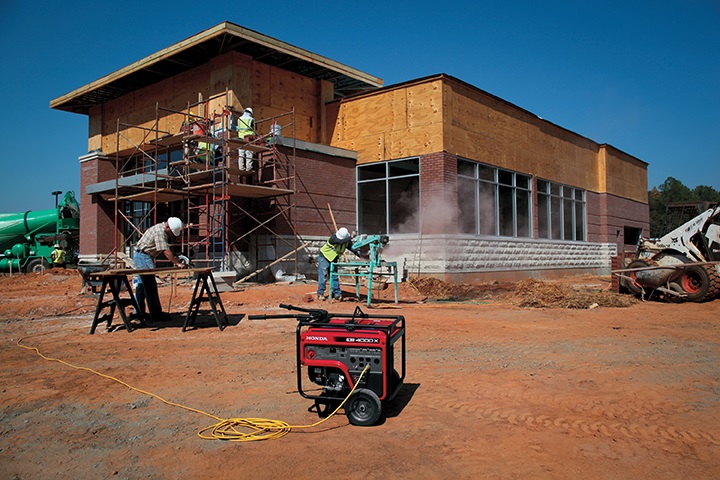
Honda 4,000W EB4000 portable generator with commercial IGX engine http://powerequipment.honda.com
About The Author

GRIFFIN, a construction journalist from Oklahoma City, can be reached at [email protected].