Artificial intelligence (A.I.), broadband deployment and growing reliance on teledata are fueling opportunities for telecommunications work.
Deloitte.com estimated telecommunications market capitalization in the United States through Jan. 6, 2025, at $0.7 trillion, and overall global capitalization at $2.6 trillion. Deloitte also projected telecommunications infrastructure in the country to grow 30% through 2030.
Need for skilled workers
“There’s absolutely increasing demand for telecommunications trained technicians,” said Matt Paules, director of construction and maintenance at the IBEW, Washington, D.C. “ There’s an unprecedented boom, along with a need for electricians overall. We have an average of 1,100 to 1,400 calls going unanswered every month.”
Approximately 23,000 inside and outside telecommunications technicians will be needed per year through 2034, according to data from the Bureau of Labor Statistics.
Describing those labor needs as “staggering,” Paules said, “A lot is being driven by A.I. and the construction of data centers [and] chip manufacturers, but also the need for more power. The tsunami of work is on top of us now!”
When it comes to building teledata and telecommunications infrastructure, quality matters more than ever, he said.
Finding technicians
While some subcontract with telecommunications contractors, others, such as New River Electrical Corp., Cloverdale, Va., decided that having telecommunications technicians on staff offers an advantage.
New River Electrical also takes advantage of training through vendors, the Electrical Training Alliance (eTA) and the Fiber Optic Association.
“Telecommunication scopes of work generate approximately $40 million a year in revenue and it’s really important work for the advancement of our country,” said Ike Poe, president and CEO of New River. “We are a $1 billion or so a year company, so $40 million may seem relatively small at the moment, but we see significant growth potential.”
Of New River’s 2,300-member workforce, approximately 150 work in the company’s telecommunications division.
“It’s becoming a more significant division of our company. As we expand our national footprint, we see more opportunities expanding in this area,” Poe said.
For most of its 72 years as a company, New River performed as a regional operation in Appalachia, the Mid-Atlantic and lower Midwest. But two years ago, the company embarked on a national growth plan and has opened operations in Ontario, Calif., and Goodyear, Ariz. New River also is growing significantly in Florida and Texas.
“For line contractors, the key word is infrastructure,” Poe said. “Infrastructure is our business, it’s how we make a living. Telecommunications infrastructure development has been hyperactive within our regional footprints and will serve as one of many growth catalysts for us as we expand nationally.”
Pathway to apprenticeships
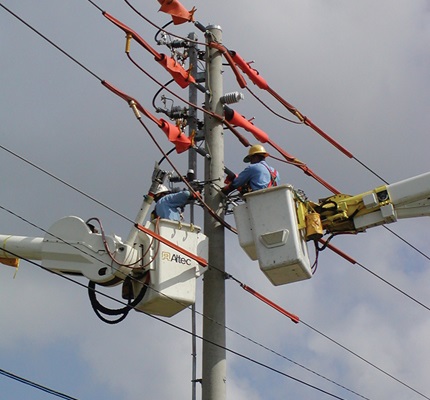
While some aspects of telecommunications work are the same for inside and outside, there are special training and safety considerations for working aloft, operating heavy equipment, digging, boring and locating utility lines when working outside.
Those considerations end up making telecommunications technician training a pathway to lineworker apprenticeship.
“The important thing is to first get the people employed [and] get them going,” he said. “We basically introduce them to the industry.”
Dennis Hunter, executive director of American Line Builders Apprenticeship and Training (ALBAT), is aware of the demand for telecommunications technicians. He graduated as a journeyman substation technician from IBEW 17 in Michigan, where he helped start a telecommunications program recently approved by the state.
“When I was at Local 17, we were pushing for a telecommunications apprenticeship,” he said. “Our contractors got together to put together a fee structure that would pay for it at 2% toward training trusts.”
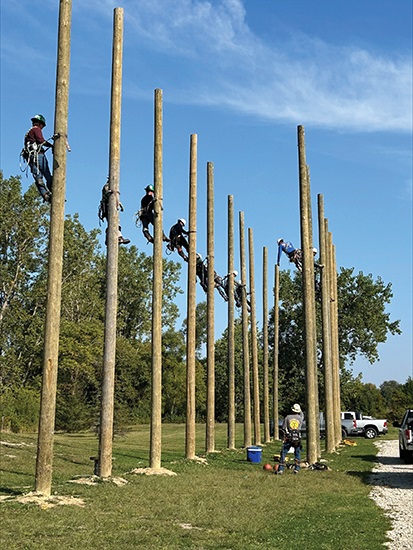
Having recently cleared an acre of forest specifically for telecommunications training on the ALBAT campus in Medway, Ohio, Hunter anticipates that approval of a national certification program will enable ALBAT to offer all IBEW locals in its eight-state jurisdiction with telecommunications training compliant with pending new national standards.
“We know the work is coming,” he said. “We need to prepare for it. There is a massive push to get this workforce trained. We want to make sure we’re ready, that we have the trained workers. The larger infrastructure is growing. What’s going to keep driving that need is what A.I. is pushing and what the population is consuming. Tele-data is a facet in this.”
Training is going national
Three years ago, the eTA established a committee to develop a new telecommunications training line program, relying on inside telecommunications curriculum created by Jim Simpson, eTA’s director of installer-technician and residential programs.
“[There has] been plenty of good work out there and increasing interest on the part of the outside sector, wanting to install and do splicing,” Simpson said. “But there was not any program at the national level for IBEW dedicated to training for running fiber in the transmission and distribution setting.”
For the most part, inside JATCs trained apprentices according to the needs of their area, signing them up for existing eTA classes a la carte, Simpson said.
Growing the skilled labor
At one time, eTA had considered nationwide adoption of the telecommunications program developed by Alaska’s IBEW-1547 training center, which covers inside and outside wire training.
“But that was a four-year program that covered a lot of outside work,” said Virgil Melton, eTA’s director of the outside line program. “We decided to work on developing a two-year national line program minus some of the stuff in the line apprentice program, like working energized. The main advantage is getting more skilled workers on to job sites more quickly.”
The proposed program would include 4,000 hours of classroom instruction and on-the-job training as well as certification by the Fiber Optic Association. It will cover construction safety, working aloft, utility line locating, pulling fiber, fiber repair, splicing, insulation and testing.
“Most of the telecommunications work in the transmission and distribution setting has to do with fiber,” Melton said. “Utilities are relying on it more heavily for monitoring substations and transmission towers to prevent and address outages.”
Fiber’s presence will continue to grow in oil and gas infrastructure, streetlighting systems, data centers and broadband deployment. As of mid-December 2025, 37 of the 56 states and territories had received approval from the National Telecommunications and Information Administration for final broadband deployment proposals.
A win for the industry
“We will target high school students,” Melton said. “And we try to get into high school programs with community colleges that offer interim credentials. These programs enable eTA to provide a good portion of training for many students before they graduate high school.”
Average pay for a telecommunications technician is $64,000 a year, i.e., $30 an hour. For high school graduates not wanting decades of college debt, the career choice offers financial independence and opens doors to advancement in the electrical trade. It’s also a good option for those not ready to commit to 7,000-hour apprenticeships.
“For years we’ve pulled fiber in, and dead-ended it on the pole,” Melton said. “Then everybody else would come in and do all the splicing. Now, we’ll be in a position where we can do the job from start to finish.”
Dennis Hunter
About The Author
.jpg?sfvrsn=a64b988b_1)
DeGrane is a Chicago-based freelance writer. She has covered electrical contracting, renewable energy, senior living and other industries with articles published in the Chicago Tribune, New York Times and trade publications. Reach her at [email protected].