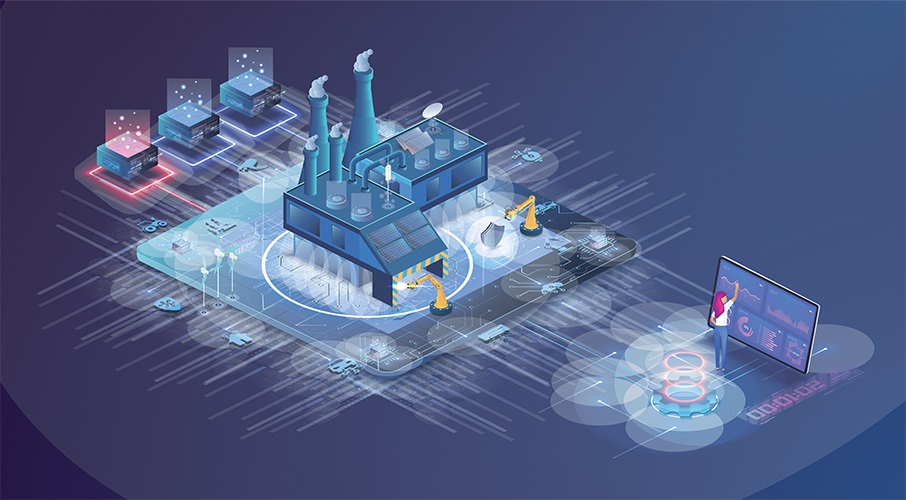
Often described as the fourth industrial revolution, Industry 4.0 challenges a singular role for electrical contractors. The internet of things (IoT), artificial intelligence (A.I.) and big data analytics will automate the factory floor better through communication between machines, improved operational systems and worker interaction. Smart manufacturing is expanding the EC’s roles from power installers to creative problem-solvers.
The beginnings of Industry 4.0 are found in the early use of A.I. that allowed plant managers to retrofit machinery with devices that read and analyzed equipment operation. These devices and software decreased repair and downtime through predictive maintenance and real-time operational performance. Industry 4.0 is another leap tied to strategic use of IoT devices and their data collection. Tools such as digital twins, better use of A.I. and its advances, and edge computing deliver a fully digitized and automated plant floor where efficient productivity is a bottom-line asset.
Better harnessing of A.I.
Red Hat, an American multinational software company based in Raleigh, N.C., provides open-source software products for enterprises. Luis Arizmendi, principal specialist solution architect at the firm, sees A.I. having two roles in the industrial and smart manufacturing landscape. One is to enhance efficiency.
“When you look at efficiency, you find use-cases such as predictive maintenance and automated quality control,” Arizmendi said. “But there’s also process optimization, secure chain optimization, dynamic scheduling inside the factory, real-time production adjustments—all used in the service to reduce downtime and waste.”
Use in safety has provided A.I. with a second role, which could include what Arizmendi described as computer vision to “detect anomalies or to detect or prevent accidents.” Monitoring OSHA compliance on a factory floor (e.g., hard hat use) is one example.
“Smart factories have become more important and more permanent as reduced hardware costs have allowed for faster device scale-up that can run advanced services powered by A.I.,” he said. “A greater familiarity with A.I. through ChatGPT and similar tools has helped as well.”
Mike Bradford serves as strategic business development and marketing director for Dassault Systemes’ Boston Campus. He sees A.I. applied in many ways within Industry 4.0, including tools ECs can bring into their own businesses. Dassault Systemes is a French multinational software corporation that develops software for 3D product design, simulation, manufacturing and other 3D-related products.
“There are now A.I. embedded scheduling tools that dynamically update plans to keep production flow efficient,” Bradford said. “This scheduling intelligence can analyze root causes of past schedule deviations and proactively suggest more informed plans to avoid future issues and delays. This could be a real advantage for the electrical contractor in terms of project planning with A.I. recognizing what negatively affected past projects and make recommendations on how to better plan current and future work.”
Back on the shop floor, A.I. tools are advancing machine learning and making old systems feel new again, such as CNC machining programs now given in a 3D model.
“This kind of intelligence could allow electrical contractors to create an electrical layout of a new facility, much more quickly correcting issues of the past,” Bradford said.
Mastering data
Edge computing is one focus for Arizmendi. It too may become a common feature within smart manufacturing. His firm is working on what it calls edge A.I. to reduce machine latency for smoother operation.
“On the factory floor, you cannot send data or needed images to the cloud and expect a real-time response,” Arizmendi said. “Beyond latency, sending back the images from the factories to the cloud is super expensive because an image is quite large. There is a cost to moving data.”
Bradford has found that almost every manufacturer he talks to is using the industrial internet of things (IIoT) at some level. IIoT is the basis for smart manufacturing. Due to the enormous amount of data generated, edge computers offer processing and storage right where the data is being generated.
An IIoT ecosystem can do different things. Its interconnected sensors, instruments and other devices are networked with computers’ industrial applications, including manufacturing and energy management. That enables technologies that might include cybersecurity, cloud computing, edge computing, machine-to-machine communication, advanced robotics, 3D printing and a future of cognitive computing.
“People with many IoT devices end up with all this data but may be collecting the wrong data that’s of no value to them,” Bradford said. “It could be attributed to company indecision or ability to successfully isolate the data most useful for them.”
Bradford is, however, seeing better strategic data gathering. “Companies are more readily asking, ‘Which data do we really need? How do we use it? How does it help us?‘” Mastering big data will unlock the promise of Industry 4.0.
IIoT sensors are becoming smarter and more communicative with other services in a factory. That will make for a smoother operating factory floor and better data collection, too.
“Traditionally, a worker would respond to a sensor capturing, say, machine pressure,” Arizmendi said. “In a world of Industry 4.0, a more sophisticated read of that data could allow the machine itself to make decisions. That’s a goal, and we are not there yet. We do have a good foundation with all the IoT sensors and IoT devices already storing data just waiting to be used. In a sense, IoT is something both new and not. It’s a matter of acting on the data it provides.”
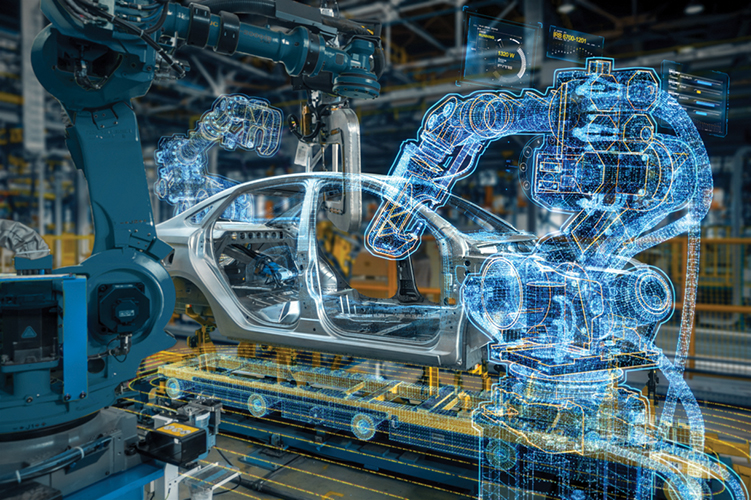
A digital/virtual twin could be of a new plant, assembly line, machining line or process.
Cybersecurity is an application
“One of the issues with IIoT devices in the past has been a risk of cyberattack,” Bradford said. “[The devices] can be susceptible. The challenge is how we manage all these different devices that can be accessed from the outside world. Here’s another opportunity for the electrical contractor who should be working with the IT team. Cybersecurity may involve added devices that can affect the power requirements.”
Another opportunity at the table for ECs is future planning.
“I think it would be useful for ECs to interact with the new plant strategy and sales forecasting teams,” Bradford said. “If plans include plant expansion, that’s good for the electrical contractor to know. That may affect what the contractor does with conduit and layout. The need for future equipment may be discussed. An EC can make life easier moving forward for a customer.”
The digital twin
Bradford described digital twinning as “a digital representation of a physical thing,” and it is used in industries such as healthcare and automotive. It plays a particularly important role in manufacturing.
“A digital twin can be used for things like simulating a new process or simulating use of a new piece of equipment on the shop floor. It can be used to integrate things for testing and monitoring. At Dassault Systemes, we call a digital twin, a virtual twin,” he said.
Sometimes twins are offered as a service.
“We can build the virtual twin for the owner, give the owner access and anyone that they appoint access via a webpage to see, adjust and do some simulations. About 30% of global manufacturing companies have either fully or partially implemented virtual or digital twins,” he said.
Bradford went on to explain that a digital/virtual twin could be of a new plant, assembly line, machining line, process or, in a whole different application, a new supply chain pathway. Twins simulate and support what an Industry 4.0 plant will look like.
“We have precise digital models of hundreds of pieces of shop floor equipment rendered in 3D,” Bradford said. “That can include transforming a company’s 2D drawing of a robotic assembly line into 3D. Now if something in the line is moved, we can quickly adjust within a virtual twin.”
For ECs, a digital twin simulation could take historical data in creating a more sustainable layout. Generative A.I. could retrain A.I. models, resulting in self-learning equipment.
“Generative A.I. holds promise in many other applications beyond the machine learning, such as in documentation and procedures and how you manage documentation,” Arizmendi said. “You could overlay a chatbot and create interaction with that documentation for the people in the factory.”
Arizmendi added that generative A.I. could be used to give advice while you’re performing a process. Though in an exploratory phase, generative A.I. portends an important advance.
“It’s useful to understand A.I. is composed of multiple subsets,” Arizmendi said. “There’s high-level A.I. [e.g., generative], then we have this subset of machine learning [saddle learning] that has been applied in predictive maintenance for some years but is improving through deep learning, a resource heavy subset of machine learning. Though not as widespread as other machine learning services, deep learning will become an important part of this new A.I. era.”
Smart factories
Bradford describes savvy electrical contractors as those who understand the effect Industry 4.0 and IoT have on electrical requirements.
“They understand digital twins and how to use them to effectively plan and execute, and they understand how A.I. can help them continuously improve how they do their job,” Bradford said.
Arizmendi encouraged ECs to be curious.
“Learn more about the technology that is behind innovative approaches, new progressions, changes to the way a customer may work, a factory may run, and how your company may work. A.I. is opening a lot of doors for manufacturing,” he said.
Dassault Systemes , stock.adobe.com / supakritleela
About The Author

GAVIN, Gavo Communications, is a LEED Green Associate providing marketing services for the energy, construction and urban planning industries. He can be reached at [email protected].