There are about 2.7 million people living in the city of Chicago. Add the suburbs to the north, south and west, and that population jumps to over 9 million. Those people are dependent on the Metropolitan Water Reclamation District (MWRD) of Greater Chicago for clean water, which originates from Lake Michigan to the east.
That is to say, they are dependent on programmable logic controllers (PLCs), motor control centers and other electrical infrastructure, though most don’t know the technological complexities. They only know that when they turn on a faucet, out comes clear, treated water.
That’s where education comes in for Allison Fore, public and intergovernmental affairs officer for the MWRD.
“PLCs are essential to the MWRD because they automate and regulate critical processes such as pumping, chemical dosing and treatment operations, ensuring efficiency, safety and reliability across our facilities,” Fore said.
“The MWRD typically uses industrial-grade PLCs from major manufacturers like Allen-Bradley, Siemens or Schneider Electric, with models ranging from compact units for smaller systems to modular platforms for large-scale plant operations,” she said. “Installation and maintenance often involve collaboration with electrical contractors and system integrators who provide expertise in setup, troubleshooting and upgrades.”
Like everywhere else, data is crucial in water and wastewater facility operation, and PLCs like the new SIMATIC S7-1200 G2 from Siemens, Alpharetta, Ga., are designed to that end. It features wireless access to diagnostic and device data through near-field communication, facilitating better monitoring, analysis and decisionmaking, which optimizes an operation and reduces downtime.
Cybersecurity concerns
Downtime is a killer, especially in an era of cyberattacks and other internet-based mischief that can extend that downtime. Ahmik Hindman, senior network and security solution consultant for Rockwell Automation, Milwaukee, is seeing even more emphasis than usual on security, because failure is not an option when it comes to public health.
“The biggest trend we see is water/wastewater facilities looking to better secure their systems,” according to Hindman, who is also an ISA/IEC 62443 cybersecurity expert. ISA/IEC 62443 is a standards series that outlines requirements and processes for implementing and maintaining electronically sound industrial automation and control systems.
“How do they do that while simultaneously allowing people access to the system?” he asked. “That can be a challenge to come in and support the equipment.”
He noted a Rockwell solution in this area, FactoryTalk Security, which is a role-based access control solution that provides granular access management for Rockwell software applications and Logix controllers. Its purpose is to reduce the risk of malicious or accidental internal threats by ensuring only authorized personnel have access to critical systems.
With centralized administration of user accounts and permissions, FactoryTalk simplifies security management across an entire water and wastewater plant. It handles authentication and authorization consistently for software and hardware assets—such as ControlLogix and CompactLogix controllers—ensuring a unified and secure environment.
Think a successful cybersecurity incident can’t happen in water and wastewater? Guess again. In January 2024, a water tank in tiny Muleshoe, Texas, northwest of Lubbock, overflowed for up to 45 minutes due to an offshore cyberattack.
Up in Chicago, Fore is well aware of the implications of a major cybersecurity incident and how PLCs play into that equation.
“Because PLCs are part of critical infrastructure, cybersecurity is a major concern, addressed through measures such as network segmentation, firewalls, access controls and adherence to standards like NIST [National Institute of Standards and Technology] and ISA/IEC 62443,” she said.
Here’s something else you might not expect: Hindman said the SANS Institute, North Bethesda, Md., estimates that the humble USB drive is involved in 20% of facility cyberattacks.
“[That is] driving the need for secure remote access, for contractors and on-site people,” he said. “Now you’re forcing cyber hygiene.”
Unique maintenance considerations
But what about the actual work carried out by internal personnel and outside electrical contractors at a water and wastewater facility? Consider the need for maintenance of a certain portion of a facility, for example—or a full upgrade.
“A big challenge is keeping the process running in the background,” Hindman said. “It’s not shut down, or, if it is, it’s a short time. If they go to federal funding, they have timelines associated. Anything that helps them stay on time is of huge interest.”
Skip McConkey, vice president of the water and wastewater division of Singleton Electric Co. Inc., Gaithersburg, Md., is well aware. He and his team headed up a six-year electrical upgrade project that concluded in 2023 at the Noman M. Cole Jr. Water Recycling Facility in Lorton, Va.
He said the challenge was taking all the electrical equipment down, piece by piece, but keeping the plant running, because if there are overflow issues, the U.S. Environmental Protection Agency will assess fines. Now add in challenges from the COVID-19 pandemic, and you’ll likely agree that this project was complicated.
“We made up sequencing plans of how we would use temporary equipment until we replaced old equipment with new,” said Mike Kern, Singleton Electric’s site superintendent for the project.
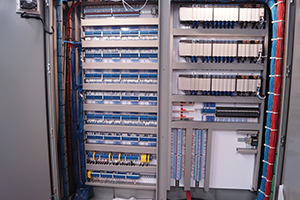
Singleton Electric installed new power distribution equipment
at the Noman M. Cole Jr. Water Recycling Facility
The project scope consisted of replacement or modification of 40 motor control centers and 18 distribution centers, with the work performed in 20 process and support buildings throughout the plant.
New power distribution equipment, all from Eaton, Beachwood, Ohio, included two 1,000-kVA/4,160V–480V outdoor transformers; one 1,200A/4,160V nine-section distribution center; five 800A/480V motor control centers; and four 1,200A/480V motor control centers.
Singleton Electric also headed up replacement, modification and expansion of process SCADA PLCs and standby power control systems. That included the addition of a redundant SCADA server, 19 ethernet switches and 28 control panels.
McConkey said the process was tedious.
“Shut down half a board, make the equipment replacements, and shut down the other half,” he offered as an example. “If you can get a new location for a motor control center, then you can bring that online and transfer the loads. It’s tough to do that.”
Bob Fairweather, president of Sherwood-Logan and Associates, a manufacturers’ representative for water and wastewater treatment equipment in Annapolis, Md., did on-site testing after Singleton Electric installed the equipment. Another firm did the actual systems integration work.
“We would design the panels and all the breakers and PLCs,” Fairweather said, adding the controllers were Allen-Bradley ControlLogix models. “We’d build them, and once we shipped them to the site, Singleton installed it and we would do a point-to-point field test.”
McConkey said that most PLC manufacturers will have their own type of cybersecurity protection. “But sometimes, the owner wants to turn that off and use their own IT,” he added.
Additionally, he said he is seeing more artificial intelligence enter his work, particularly from the clerical angle, such as reviewing contractors and writing letters, but “the field side is coming,” he said.
Fore is already seeing that in Chicago.
“While PLCs handle real-time control, artificial intelligence increasingly complements them by analyzing sensor data, predicting equipment maintenance needs, optimizing treatment processes and detecting anomalies, thereby enhancing operational resilience and efficiency,” she said.
But when it comes down to it for an electrical contractor, customer service, from the standpoint of being on time and on budget, are still crucial in the water and wastewater space, according to MyAn Bourdon, Rockwell Automation’s water and wastewater industry account manager.
“I work with a lot of general contractors and electrical contractors, and staying on time, more than ever,” is important, she said. “More focus [is] on lead time so projects can be done on time.”
stock.adobe.com / Kalyakan / singleton electric
About The Author

VOSS is a freelance writer based in the Chicago area and has worked extensively in the low- and high-voltage areas of the electrical industry. Contact him at [email protected].