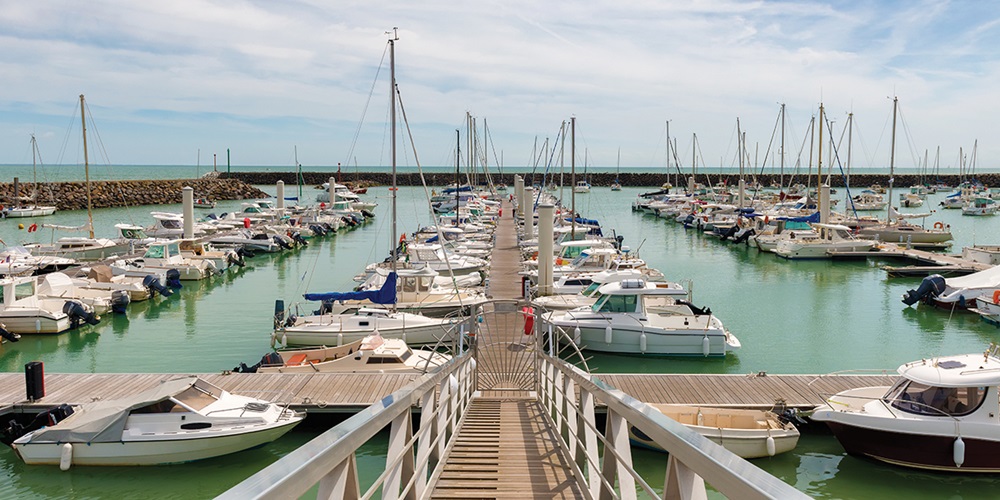
There has been a boatload (pun intended) of information on commercial marinas and boatyards, but very little, if any, that specifically addresses noncommercial marinas or docks. Understand one very basic fact: the danger of electricity in and around water does not differentiate between commercial and residential boat dock facilities.
Electrical danger is present in both, no matter who owns the facility or how the electrical power is installed. It remains a constant and critical issue. Electrical current in and around water is something that everyone needs to understand and deal with regularly.
Electrical function of the human body
We also need to be very careful to not subject ourselves to unwanted electrical currents from boats, power pedestals and other electrical sources when working on or near the water in lakes, rivers and oceans. The human body can be very conductive when in or around water. The human body is more conductive than fresh water; conversely, salt water is more conductive than the human body.
Knowing the basics of the body’s electrical functions may help us understand better what happens when boats and electricity combine with water and the human body. Many people don’t realize that the human body is electrical by nature, with electrical current generated in the brain and then connected throughout it by the spinal cord and peripheral nerves.
I should note that I am not in the medical field. However, my wife is a registered supervising psychiatric nurse, one of our daughters is the associate director RN at a hospital and our other daughter was an emergency room doctor for many years and now is a specialty medical doctor. None of their expertise has rubbed off on me, but here goes.
The nerves branching from the spinal cord form the peripheral nervous system that connects the muscles, organs and sensory receptors. The spinal cord is the major communication pathway between the brain and the rest of the body. Information travels along neurons as electrical impulses (action potentials). At the end of a neuron, the electrical signals trigger the release of chemicals called neurotransmitters into tiny gaps called synapses. Neurotransmitters are the chemical messengers that bind to receptors on the next target cell (like a muscle or gland), triggering a response.
Even small amounts of electrical current in the water can cause issues for a swimmer, possibly leading to paralysis, muscle spasms and drowning, even if the current is not strong enough to cause immediate electrocution. The resistance of the human body ranges from 100,000 ohms in dry conditions to 1,000 ohms in wet or sweaty conditions. Currents as low as 10–20 milliamps (mA) can cause paralysis and drowning. Currents of 50–100 mA through the heart can cause ventricular fibrillation.
Electric shock drowning
I was a member of National Electrical Code Panel 7 for two NEC cycles, where we dealt with many of the issues surrounding electric shock drowning (ESD), which occurs when electrical current in water causes muscle paralysis, resulting in drowning. Deaths caused by ESD can be in a swimming pool, boat dock or irrigation canal.
Most commercial boat docks are maintained well and follow all required safety issues, while a private residential boat dock may not be. Private boat docks can be associated with single-family, two-family and multifamily dwellings.
The electrical installation for any docking facility, private or public, requires various levels of ground-fault protection. If there is a feeder supplying power to the docking facility, a listed ground-fault protection of equipment (GFPE) rated not more than 100 mA must be provided for that feeder. This would apply to a feeder supplying a panelboard to the dock or the boat house.
Remember that a 100-mA device will not protect anyone from an electric shock, either in or out of the water. Any branch circuit supplying shore-power receptacles must also be provided with a listed GFPE device rated not more than 30 mA.
According to U.S. Coast Guard studies and industry standards, 30 mA represents an acceptable level to prevent a majority of ESD incidents while remaining practical enough to minimize unnecessary tripping. Finally, any outlets, such as for boat power, must have Class A protection using a listed GFCI device. This pertains to outlets with a maximum rating of 150V to ground and 60A, applicable to single- and three-phase installations.
Boating can be an incredible hobby, but ensure that your boat, dock and storage area are electrically safe at all times.
stock.adobe.com / ThomasLENNE
About The Author

ODE is a retired lead engineering instructor at Underwriters Laboratories and is owner of Southwest Electrical Training and Consulting. Contact him at 919.949.2576 and [email protected].