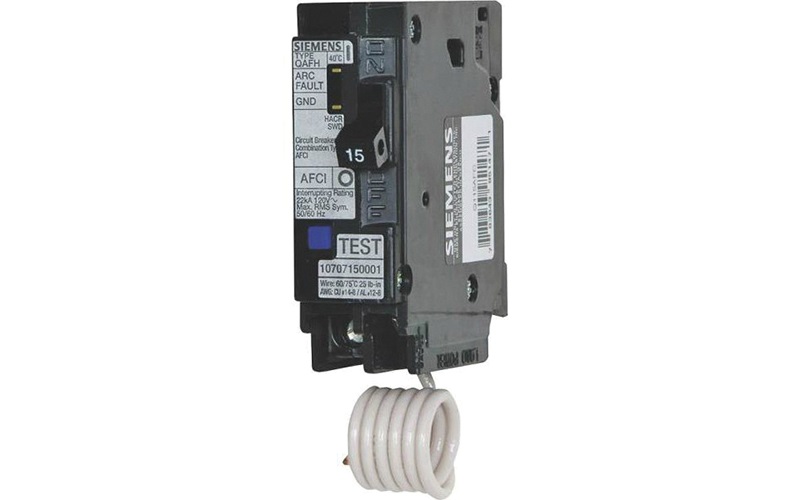
The national electrical code has been requiring arc-fault circuit interrupters (AFCIs) since the 1999 edition for dwelling unit circuits. That introduction provided a definition of AFCIs in 210.12(a) and a requirement in 210.12(b) for them to be installed in dwelling unit bedrooms.
The AFCI protection requirement for dwelling unit bedrooms in the 1999 NEC stated that all branch circuits that supplied 125V, single-phase, 15A or 20A receptacle outlets were to be protected by an AFCI. To ensure the electrical industry had time to react to this new protective device, the requirement became effective Jan. 1, 2002. Since the 1999 NEC was issued in September 1998, the delay of three years allowed enough time for the industry to gear up for the change.
Why AFCIs?
The definition of AFCIs has remained the same in all editions of the NEC since 1999. It states that an AFCI is “a device intended to provide protection from the effects of arc faults by recognizing characteristics unique to arcing and by functioning to de-energize the circuit when an arc fault is detected.”
UL 1699, Standard for Arc-Fault Circuit-Interrupters, was developed to specifically address test methods that created or simulated arcing conditions to determine a product’s ability to detect and interrupt arcing faults. AFCIs are tested to verify that arc detection is not inhibited by the presence of loads and circuit characteristics that mask the hazardous arcing condition. These devices are evaluated to determine resistance to unwanted tripping due to the presence of arcing that occurs in equipment under normal operating conditions or loading conditions that closely mimic an arcing fault, such as a solid-state electronic ballast or dimmed load.
Normal electrical equipment that might have symptoms similar to an arcing event were tested to ensure that the AFCIs only reacted to arcing faults that might pose or indicate a possible fire hazard. For example, a parallel arc fault might occur due to a staple that was driven too hard into NM cable, causing internal damage to the cable’s conductor insulation, with an arcing fault occurring between the ungrounded conductor and the grounded or grounding conductor. A series fault occurs when a flexible cord conductor is damaged internally and starts to burn apart, causing damaging heat and potentially a fire.
Initially, there were questions in the electrical industry as to why AFCIs were restricted to just bedroom circuits in dwelling units. When it was initially included in the 1999 edition, there wasn’t any real field history of this new technology, so restricting the protection to dwelling unit bedrooms provided a history in a limited area of the home. Bedrooms contained clothing, bed sheets and other easily ignitable materials as well as sleeping occupants who were likely unable to take immediate action in the event of a fire.
In the 2002 NEC, 210.12(B) was amended by removing the word “receptacles” so AFCI protection was required for all branch circuits that supplied 125V, single-phase, 15A or 20A receptacle outlets in dwelling unit bedrooms. The original AFCI devices were called branch/feeder AFCIs with the function of reacting to parallel faults, and they required an approximate minimum peak arcing current of 75A.
AFCI innovations
Then the combination-type AFCI was developed, which reacted with a peak as low as 5A. Following this, in the 2005 NEC, branch/feeder AFCIs could be used until Jan.1, 2008, at which time the new combination-type AFCI had to be installed. The purpose of AFCI devices is to provide for protection of the entire branch circuit.
AFCI protection has since grown to include almost all 120V, nominal, single-phase, 10A, 15A and 20A branch circuits supplying outlets or devices in the entire dwelling unit, as well as in dormitories, guest rooms and guest suites of hotels and motels, and sleeping areas in nursing homes, limited-care facilities, fire stations and other similar areas.
There were two exceptions in 210.12(B) of the 2023 NEC. Exception No. 1 stated that AFCI protection was not required for an individual branch circuit supplying a fire alarm system. Section 210.12(B), Exception No. 2 stated that AFCI protection was not required for an individual branch circuit supplying an outlet for arc welding equipment in a dwelling unit until Jan. 1, 2025.
After that date, AFCI protection would be required. In the 2026 NEC, this deadline was removed and AFCI protection is not required for outlets for welding equipment in dwelling units, garages and accessory buildings. This requirement was removed because arc welding creates high-frequency, high-energy arcs that would trip any AFCI device installed.
siemens
About The Author

ODE is a retired lead engineering instructor at Underwriters Laboratories and is owner of Southwest Electrical Training and Consulting. Contact him at 919.949.2576 and [email protected].