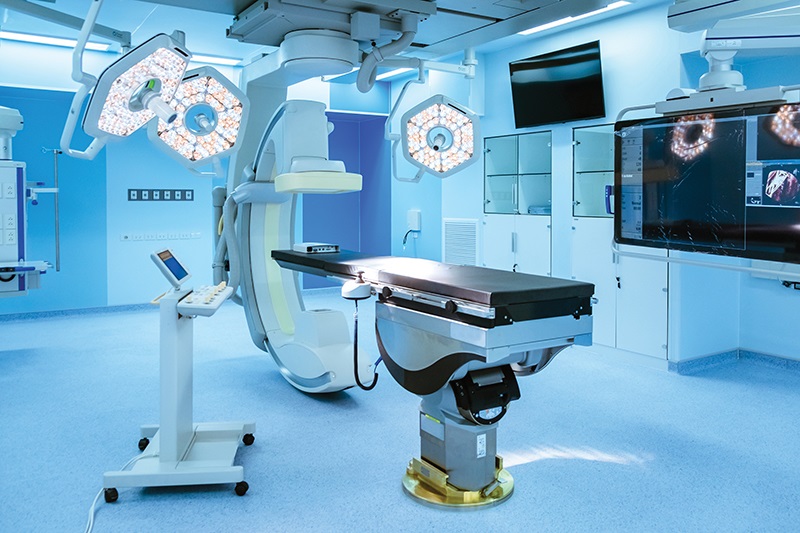
Power distribution systems in healthcare facilities often require multiple levels of panelboards. Specific grounding requirements apply to panelboards serving patient care vicinities.
Grounding requirements
Section 517.13 applies to equipment grounding conductors (EGCs) of branch circuits serving patient care spaces. As indicated in the definition of branch circuit, the requirement for two equipment grounding paths is not generally applicable to feeders. The general requirements for feeder EGCs are found in 215.6. This section requires feeders to provide an EGC where the feeder supplies branch circuits where EGCs are required. This requirement applies to all feeders regardless of occupancy.
Each feeder supplying branch circuits serving patient care spaces must include an EGC in accordance with the provisions of 250.134 for connection of branch circuit EGCs served by the feeder. Since chapters 1–4 of the NEC apply generally, any type of EGC included in Section 250.118 would meet this requirement. Most engineered designs exceed this minimum requirement by requiring a wire-type EGC installed with the feeders to supply these panelboards.
If a feeder in the critical branch is supplied from a grounded distribution system in a healthcare facility and is installed using a metal wiring method, the grounding of the switchboard, switchgear or panelboard is required to be assured by one of the methods in 517.19(E)(1), (2) or (3). This enhanced bonding requirement applies to all junction points (connection points at enclosures, junction and pull boxes, etc.) of the metal raceway, metal Type MC or mineral-insulated (Type MI) cable armor.
Enhancing the bonding requirements for feeder equipment grounding means helps to ensure effective operation of branch circuit and feeder overcurrent protective devices in ground-fault conditions. Because only one EGC is required to meet the minimum NEC requirements for feeders in healthcare facilities, enhanced and more restrictive and strengthened bonding is essential. This bonding at termination points can be accomplished by a grounding (bonding) bushing and a properly sized bonding jumper, threaded bosses or hubs, or other approved devices, such as bonding-type locknuts or bushings. See Section 250.96.
Multiple panelboard requirements
In addition to the feeder EGC rules in 215.6 and 517.19(E), there are bonding requirements for panelboards that provide branch circuits serving patient care vicinities. This is an effort to minimize potential differences among conductive equipment and parts serving the same patient care vicinity. The NEC requires the equipment grounding terminal bars of the normal and essential branch circuit panelboards serving the same individual patient care vicinity to be bonded together.
Section 517.14 requires these components be connected (bonded) together with an insulated copper conductor not smaller than 10 AWG. The insulated bonding conductor installed between the panelboard equipment grounding terminal bars must be continuous, except that it may be broken where it connects to the terminal bar in the panelboard. This applies to all situations in which two or more panelboards supply the same patient care vicinity and are served through separate transfer equipment on the emergency system.
The reason for this is that the normal branch circuits and the critical branch circuits serving the same individual patient care vicinity are generally supplied from different separately derived systems. This situation can introduce the possibility of potential differences between the branch circuit EGCs of the normal and essential systems. An exception was recently added following 517.14 that allows an alternate method to achieve the bonding of panelboards serving the same individual patient care vicinity. The exception relaxes the requirement for an insulated copper bonding conductor not smaller than 10 AWG to terminate on the EGC terminal bar installed within the panelboard cabinet or enclosure. Instead, and by exception, the insulated 10 AWG copper conductor is permitted to be terminated on a copper or aluminum busbar not less that ¼ inch thick by 2 inches wide and of sufficient length to accommodate all required conductors. The connections must be made using listed connections. This busbar termination equipment must be securely fastened to the structure and installed in an accessible location.
Bonding all equipment grounding terminal bars of all panelboards serving the same patient care vicinity helps minimize the possible potential differences. Note that the NEC requires this bonding conductor to be at least a 10 AWG copper conductor and insulated. It may be larger, depending on the design. For example, if the panelboards serving the same patient care vicinity were located a considerable distance apart, voltage drop concerns could be a problem. There is also a concern for protection of such bonding conductors from physical damage, which can be mitigated depending on how the bonding conductor is routed between panelboard enclosures.
stock.adobe.com / Pitchy
About The Author

Michael Johnston
NECA Executive Director of Codes and Standards (retired)JOHNSTON, who retired as NECA’s executive director of codes and standards in 2023, is a former member and chair of NEC CMP-5 and immediate past chair of the NEC Correlating Committee. Johnston continues to serve on the NFPA Standards Council and the UL Electrical Council. Reach him at [email protected].