Multifamily has been the ballast for residential construction when single-family has softened. After a successful run over the past couple of years, multifamily hit a rough patch in May, showing a 40% retraction, according to the U.S. Census Bureau. That is quite the headline, but there is more to the story.
The retraction in multifamily is a slowdown, not a sustained plummet. That’s according to Caitlin Sugrue-Walter, senior vice president and head of research and innovation at the National Multifamily Housing Council (NMHC), Washington, D.C. Beyond the Census Bureau figures, NMHC also looks at data provided by CoStar, Real Page Analytics and Yardi Matrix. They have all been showing a slowdown that started earlier than Census Bureau figures.
“The concerns right now are the fundamentals that make it difficult for developments to pencil out,” Sugrue-Walter said. “It takes about two years, if you are lucky, to get a development completed. We are dealing with some markets that are working through oversupply, as well. In a couple of years that will not be the case.”
Sugrue-Walter pointed to other important nuances in the overall data revealing the on-the-ground challenges for multifamily.
“There are a significant number of jurisdictions that are making it difficult to build,” she said. “For example, developers in Montgomery County, Md., and the city of Boston are nervous because of rent control discussions. Typically, when you see rent control being discussed, you see the permits drop off. In our quarterly survey of apartment development and construction, developers tell us costs are still high, though not rising like they did.”
NMHC members’ mixed use Class A multifamily projects are projects penciling out, she said, adding that, “the slowdown is magnified if mixed use represents an oversized portion of what’s being built.”
Danushka Nanayakkara-Skillington, assistant vice president for forecasting and analysis at the National Association of Home Builders (NAHB), Washington, D.C., finds it most useful to look at multifamily performance in three-month averages. Looking at April to May 2026, the contraction resulted in only 295,000 units being built. For May 2026, the three-month average was 431,000 units.
“In 2022–2023, multifamily numbers were so strong that a 2024 contraction was more of a correction,” she said. “Starts rose again in 2025. In 2026, we see a continued slowdown in single-family but continued strength in multifamily—over 400,000 units this year and next.”
Less urban development
NAHB’s Home Building Geography Index has been telling a story of residential migration. Various housing, including multifamily, is shifting away from urban centers.
“Go out from a major metro like D.C., Chicago or any large metro area, and you start seeing apartments after apartments. People are willing to commute,” she said. “Hybrid work schedules contribute to this expansion into less-populated areas. In addition, millennials have reached an age where they are having children, care about school districts and attending to aging parents.”
Still, Nanayakkara-Skillington does not see multifamily urban living being abandoned. News coverage has pointed to Gen Xers and other demographics still gravitating to urban centers as a place to reside. With the rise of existing building stock moving into multifamily conversions, there remains an appetite for urban dwelling.
Ken Simonson, chief economist for the Associated General Contractors of America (AGC), Arlington, Va., said, “With the pandemic, suddenly lots of people wanted to get away from somebody else, out of their own parents’ basement or out of downtown, out to other areas. Not everybody can afford single-family, and so multifamily had more than a moment. It had about three years of extreme growth. Now it is payback time.”
Simonson added that cities such as Austin and Nashville got so many new units all at once, it created a glut. Rents have been dropping. Developers hit by a huge jump in short-term interest rates are also seeing weak demand.
“That’s a deadly combination if you depend on rents to cover both construction costs and interest costs,” Simonson said. “I think any recovery will be spotty, both because interest rates are high and population growth is slow.”
While AGC members engage in nonresidential building, a portion of its members build complex, large multifamily projects.
“Denver is seeing a lot of construction. North Carolina as well. Places like Raleigh and Charlotte see a fair bit of construction,” Sugrue-Walter said. “CoStar did report a decrease in starts in the first quarter to 2026, most pronounced in the south.”
A regulatory headwind
A report from NAHB and NMHC outlined the heavy burden that regulations pose to multifamily housing. Written by Sugrue-Walter and Paul Emrath, NAHB’s vice president for survey and housing policy research, the report found government regulations (at federal, state and local levels) represent 40.6% of all multifamily development costs in the form of fees, standards and other requirements. In responses from multifamily developers, 47.9% said they avoid building with inclusionary zoning policies; 87.5% avoid jurisdictions with rent control laws; opposition adds 5.6% to costs and delays projects by 7.4 months; and neighborhood opposition affects 74.5% of developers. Such headwinds hinder development in high-need areas.
Sugrue-Walter sees zoning issues now bumping up against a stronger case of needed multifamily housing.
“That wasn’t the case before,” she said. “We released our Housing Affordability Toolkit that looks at how to get developments off the ground [and] make them financially feasible in this era of increasing difficulty.”
She mentioned a few ways to broaden multifamily. One example that is positive but in need of zoning help are accessory dwelling units (ADUs, sometimes called ancillary or additional dwelling units), which include backyard carriage houses and coach houses. In September 2025, the Chicago city council voted to expand its ADU ordinance beyond a pilot program, allowing for ADU access more broadly across Chicago. For that city, conversions are also part of the ordinance.
“In New Jersey, you’re seeing a lot of multifamily development because of some conclusions to the Mount Laurel decision,” Sugrue-Walter said.
In 2024, New Jersey Gov. Phil Murphy signed legislation codifying the state’s Mount Laurel doctrine. It mandates all cities and towns build their fair share of affordable housing. The new law streamlines the process.
“Florida’s Live Local Act also streamlines multifamily development projects, creating a more formalized process and avoiding the whims of local neighborhood dynamics,” Sugrue-Walter said.
Multifamily building-type diversity
Nanayakkara-Skillington sees a need for more housing diversity (see Figure 1) to keep multifamily growing.
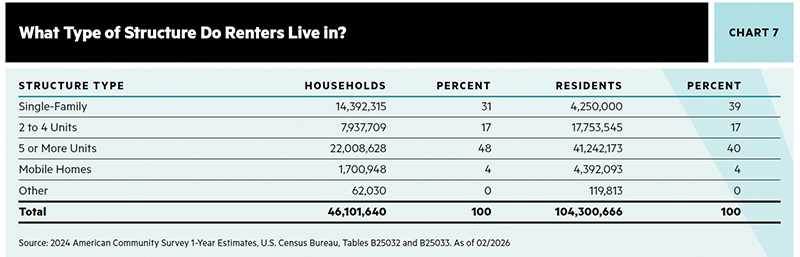
Figure 1
“There is a new type of multifamily. It is called co-living. It’s a shared housing arrangement. Tenants rent a private bedroom but share common areas like the kitchen and living room,” she said.
Co-living is a modern take on communal housing, with amenities including furnished rooms, utilities and social programming, with flexible leases. It is popular among young professionals and students in urban areas.
“I think the way we have thought about multifamily ... needs to change,” Nanayakkara-Skillington said. “The 55-plus communities used to be a thing. We need to revive them. At the end of the day, people value community, even in a multifamily setting.”
A glass half full or half empty?
“We are hitting historic levels of multifamily completions. What encourages me is, yes, there are some markets that are dealing with an oversupply, but they are working through it,” Sugrue-Walter said. “Any temporary oversupplies do not feel like a systemic issue. What keeps me up at night are two things. Consumers are dealing with increased costs, and so are the housing providers themselves. Electricity is not just going up for me and my single-family owned home. It is also going up for the housing provider.
“Secondly, regulations may be well intended, but they can make it difficult to operate properties and add consumer burdens. I do think the conversation about tariffs is over. Whatever the impact was, it has been baked in at this point. The financing costs are likely to stay where they are,” she said.
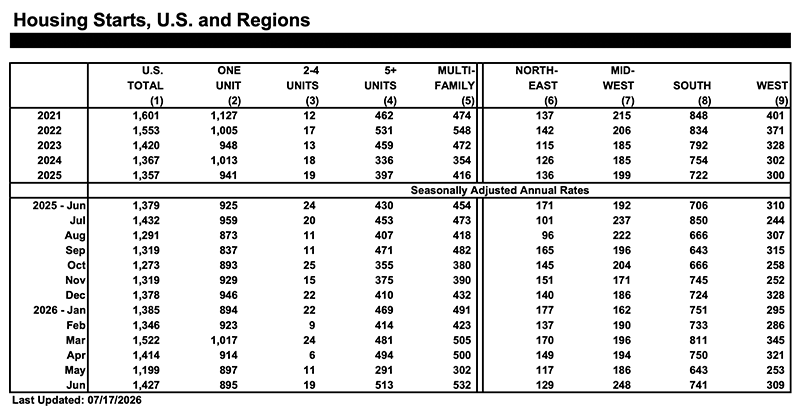
Figure 2
Simonson has another worry. He pointed to the rapid fluctuations in fuel costs and its many uses, including making concrete.
“To make concrete, you must use a lot of petroleum to dig up the rock and crush it. You must mix it, drive it to a job site and pump the limestone and cement out. Deliveries of equipment and materials and then hauling away dirt, debris and equipment—all of that is subject to fuel surcharges these days. I just cannot tell how long those will last. I do not see steady improvement [for multifamily] the rest of this year,” he said.
Simonson also pointed to the effects of current immigration policies on multifamily.
“The Census Bureau said last year that population through July 1 had grown half a percent,” he said. “That was half of the year before. The bureau attributed that to a big slowdown in net immigration and are predicting a further sharp slowdown this year, assuming births and deaths stayed constant, which they have been. This would imply population growth would fall to something like three-tenths of a percent.”
“Other measures have net immigration at a negative. And so, population growth may be zero and certainly negative in some border cities or other places. That is a longer-lasting headwind than fuel prices or interest rates,” Simonson said.
While financing for multifamily can be extremely complex, regulations can be challenging and zoning change is an uphill battle, Nanayakkara-Skillington said there is one indisputable fact that portends well for the future.
“There’s such a healthy demand for apartments, and that is a good thing. That is where the household formation is taking place. Part of that formation are 9 million young adults living with their parents who will eventually move out and into the rental market,” she said.
National Multifamily Housing Council, National Association of Home Builders
About The Author

GAVIN, Gavo Communications, is a LEED Green Associate providing marketing services for the energy, construction and urban planning industries. He can be reached at [email protected].