In last month’s article on imbalance, I was helping a customer find the cause of a tripping 15A AFCI breaker, indicating a possible arcing fault condition in a residence with a typical split-phase voltage configuration. This circuit fed overhead lights in four rooms, two receptacles in bedrooms that were very lightly loaded and the exhaust fan of the bathroom. Initially, it was difficult to determine a pattern or cause for the breaker trips. A possible suspect was the ceiling fan in the bathroom. But we couldn’t determine if the breaker tripped when the ceiling fan switch was turned off or sometime later in the night. The only data point was that in the morning, the lights on that circuit wouldn’t turn on.
In the last troubleshooting of a tripping AFCI breaker, it turned out to be faulty candelabra light bulbs in a ceiling fan that were producing an arc-like signature (see “It Ain’t Over,” ELECTRICAL CONTRACTOR, January 2024). In that case, we used a power quality monitor with high-speed waveform capture and recorded the transients to analyze the data. The breaker didn’t seem to be able to differentiate the very low current arcing signature with some voltage transients from a more serious potential problem. However, replacing the defective bulb(s) solved the issue.
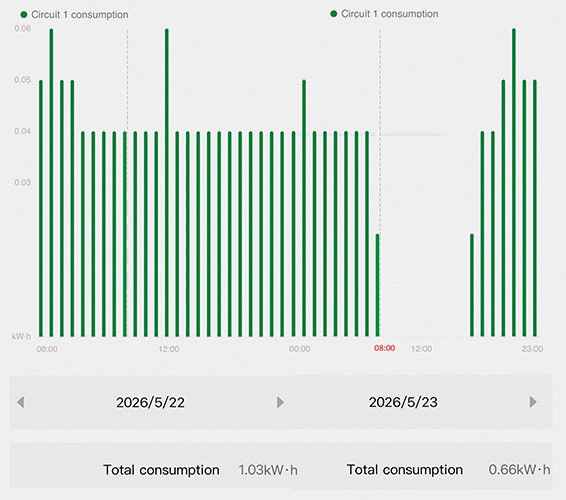
In this situation, a high-end PQ monitor was not available, so we used an inexpensive (under $100) power monitor instead. The single-phase monitoring system was connected at the breaker panel with the voltage leads connected to one voltage bus bar and the neutral, while the current probe was connected to the hot wire leading out from the breaker to the circuit in question. The instrument would provide bar graphs of the power consumption (or production) on a daily or monthly basis. The X axis (time) has a resolution of 1 hour, and the Y axis shows kilowatt-hours used—just a bit different from the 1-microsecond transient capture the more expensive monitor is capable of.
More monitoring
The monitoring lasted approximately one month. During this time, there were a half-dozen unexplained AFCI trips. Most occurred in the 7 a.m. to 9 a.m. window. The figure shows one such event. The trip most likely occurred around 8:40 a.m., or two-thirds of the way between 8 a.m. and 9 a.m., based on the energy consumption versus prior hours.
Loads within a facility, such as vacuum cleaners, treadmills, older high-wattage electronics and power tools, can cause false trips, also called “incompatible electronic noise.” This was why the bathroom exhaust fan was initially suspected, but the data didn’t correspond to its operation. It was unlikely that any load change in a residential neighborhood would create a voltage disturbance on the distribution lines to qualify as an arcing transient on a cloudless and low-wind morning.
There are two industrial facilities nearby—a lumberyard and a stone-cutting shop. The latter might possibly cause such a trip if workers were using an arc welder to repair equipment or something similar. But that wouldn’t explain why the AFCI tripped during the night. The delay time until power consumption resumed was the result of no one being home to reset the breaker.
The data over that month didn’t reveal any other patterns based on the amount of energy being consumed. The granularity in the time and kilowatt-hour data didn’t allow for much more analysis, though it did provide a time frame for when the trips occurred when the resident wasn’t available to determine such.
The maximum kilowatt-hours during any 1-hour period was 300 Wh, and there was no interruption during that time. An alternative explanation was needed since no load current nor external voltage event seemed likely.
A suspect emerges
A proposed class action alleges that a certain type of circuit breaker made by a well-known AFCI breaker manufacturer is defective because it is unable to distinguish between harmless and dangerous electrical arcs. The complaint alleges the manufacturer has failed to update its AFCIs to identify and ignore harmless arcing signatures caused by common appliances, especially as new appliances have been developed, and to accommodate electrical codes that have expanded the locations where homeowners are required to use AFCIs.
“AFCIs experiencing nuisance tripping must be replaced because the nuisance tripping renders the circuit unusable and prevents users or electricians from determining whether a breaker tripped due to a defect in the breaker or because of a dangerous arc,” according to the class action. So far, no false trips have occurred after replacing the AFCI breaker on this circuit in this residence.
Since 2020, the National Electrical Code requires AFCI protection for all 120V, single-phase, 15A and 20A branch circuits supplying outlets or devices in nearly all areas of dwelling units except bathrooms, garages and exterior or outdoor spaces. Hopefully, progress can be made before people start removing them as they did in the early development of smoke detectors for alarming too easily. We don’t want this to get more dangerous by circumventing proven best practices.
Richard P. Bingham
About The Author

BINGHAM, a contributing editor for power quality, can be reached at 908.499.5321.