Last month, I described how I was introduced to fiber optics at Bell Labs by the researchers inventing a lot of the technology needed to convert the phone network into fiber optics. At Bell Labs, I met the scientists and engineers developing the equipment to digitize phone lines, lasers needed for transmitters and various components needed for the cable plant such as cables, splices and connectors.
I was invited to Bell Labs to learn about the need for manufacturing and test equipment. I was convinced that the two technologies would revolutionize the phone system. In 1980, I started a company called the Fiber Optic Test Equipment Co., or FOTEC. This led to my direct involvement in much of the early development of fiber optics.
Training, training and more training
When we started FOTEC, our first commercial products were field instruments—a power meter and test source—allowing a tech to measure fiber loss and link performance. Meanwhile, AT&T was just beginning to manufacture 1,310-nm lasers and asked for help with building equipment for its production lines. Our first big order was for a custom manufacturing and test station for lasers for AT&T.
Our field test equipment business was also growing rapidly. Surprisingly enough, most of our sales were not to the telcos installing long-haul fiber as we expected; it was computer companies. Minicomputer companies such as Digital Equipment Corp. (DEC) and Wang Labs were developing their own fiber optic links to connect computers on local area networks (LANs) and to giant graphics terminals. IBM was building links to mainframe peripherals based on fiber. Already, copper cable was becoming obsolete for high-speed communications.
DEC ordered fiber optic test kits for its more than 800 field service techs. Those sales led to another opportunity. They asked us to train the techs on how to use the kits—or even better, train them on fiber optic installation in general. We created a set of slides for an overhead projector, bought some basic equipment and components to use for training, and began teaching them fiber optic installation and testing.
That was 1982 and only a couple of years after our first product sales. By that time, we had been meeting with other companies in the field at conferences and trade shows that were making fiber optic components including cable, connectors, splicing machines and other hardware. We were purchasing some of that for our own use or reselling to our customers. From them, we learned the basic techniques of fiber optic installation, which we used in our training courses.
We also discussed with them how necessary it was to train people. There were few fiber optic techs outside the telcos and lots of demand for them. New techs needed training. Realizing that we were all already doing training and that it could be much more effective if we joined together and trained in our specialties, a group of us began “taking the show on the road.”
I estimate this group trained almost 10,000 techs in the 1980s. We were so successful that one of our trainers, Dan Silver of 3M, suggested we start offering a big fiber optic training conference. Since I had been the organizer of most of our earlier sessions, he suggested I should run them.
A star is born
With this, Fiber U was born. We’d take over a hotel or convention center and dozens of our fiber optic supplier partners would set up training labs for students in a ballroom, like hands-on sessions in a big trade show booth. We’d set up another ballroom as a classroom for lessons. Imagine a giant class for morning lectures and dozens of breakouts in the afternoon for hands-on labs.
Fiber U was a real success. We did dozens of Fiber U Conferences. Our big annual conference moved around the United States. We did Fiber U at many other conferences and trade shows. We even did Fiber U worldwide.
Our roster of instructors grew. We had instructors from a dozen manufacturers such as 3M and Siecor (Corning’s cabling venture with Siemens), two college professors, the head trainer for the Air Force and the director of fiber optic standards for the Navy. Quite a group.
One day at lunch, the instructors decided fiber optics was ready to have its own professional association and a recognized certification for fiber optic techs. Thus, the Fiber Optic Association was born. That’s another story.
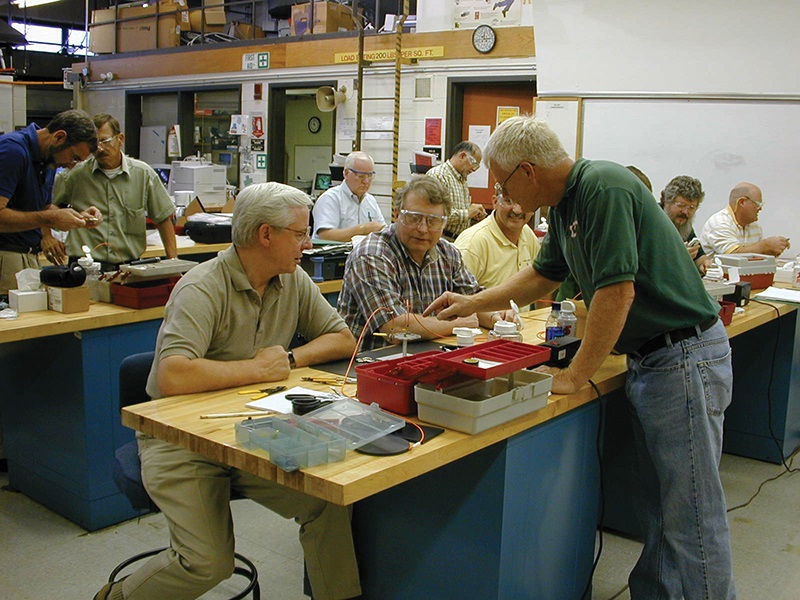
Header image: FOA co-founder John Highhouse shows how to effectively teach fiber optics during a train-the-trainer course.
jim hayes
About The Author

HAYES is a VDV writer and educator and the president of the Fiber Optic Association. Find him at www.JimHayes.com.