Is a lock required?
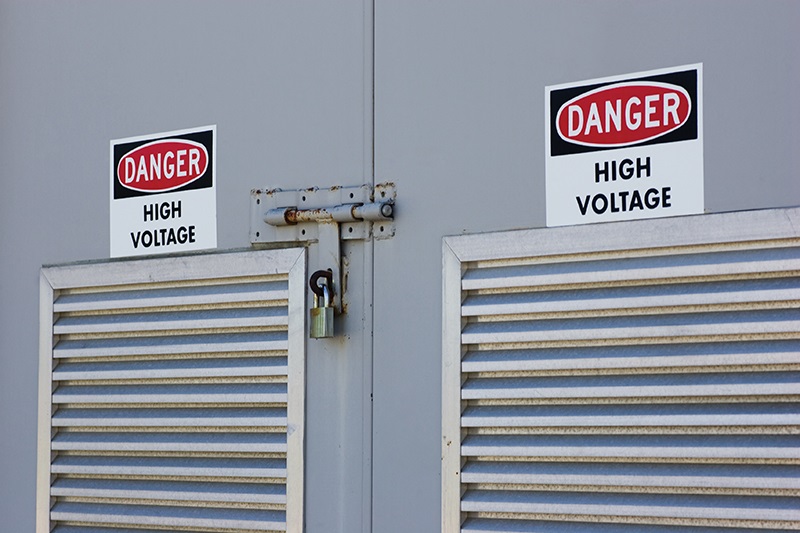
A construction manager is pushing back on the need to provide a lock to keep people out of a transformer vault that contains three single transformers, stepping down from 4,160V to 208/120V. Does the NEC address the issue of a lock?
Yes, a lock is required. See Part III of Article 110, which addresses installations over 1,000V. Section 110.31(A)(4) requires all doors for electrical vaults be equipped with locks, and the doors must be kept locked, with access allowed only to qualified people. Personnel doors associated with an electrical vault must open at least 90 degrees in the direction of egress and be equipped with listed panic hardware or listed fire exit hardware. This requirement is all-inclusive for electrical vaults, and, unlike 110.33(A)(3), is not based on a distance from the nearest edge of the working space.
Main lug only (MLO) permitted?
In a commercial (retail) occupancy, our design has a customer-owned 2,000-kVA transformer located outdoors that supplies an indoor switchboard. There is an outdoor 15-kV service (fused disconnect) and the transformer is supplied by a 15-kV feeder. There are parallel underground secondary conductors, which turn up directly into a switchboard. The secondary conductors terminate MLO and supply not more than six circuit breakers. The inspector is claiming this is a violation. However, the transformer is permitted to supply up to six circuit breakers as per Table 450.3(A)—a note in 240.21 sends me there. Can you help?
As designed, this installation is in violation of the NEC. There are multiple NEC requirements involved, and each applies independently. A disconnecting means for the transformer is required in accordance with 450.14 and must be located either in sight of the transformer or in a remote location. The service disconnecting means in this case serves as the required disconnect. If the 15-kV disconnect is not within sight from the transformer, it must be lockable open in accordance with Section 110.25, and its location must be field-marked on the transformer. Transformer overcurrent protection is required in accordance with Table 450.3(A).
Based on your question, I assume this is not a supervised location and the fused primary overcurrent protection is at 300% of the primary current values. In this case, secondary overcurrent protection is required, and Table Note 2 permits not more than six circuit breakers or six sets of fuses grouped in one location. Where more than one overcurrent protective device (OCPD) is used (as permitted for transformer secondary overcurrent protection only), the total of all the device ratings cannot exceed 250% of rated secondary current. This permissive rule does not stand alone—the requirements of 240.21(C) must be met. In this installation, Section 240.21(C)(4) for outside secondary conductors applies. This requires the secondary conductors terminate at a single disconnecting means, which could be a single circuit breaker or a single set of fuses. In this case, the required disconnecting means must be inside, nearest the conductors’ point of entrance. See the permissive requirements in 225.30(B), which permits not more than six feeders provided they originate in the same panelboard, switchboard or other distribution equipment, and each feeder terminates in a single disconnecting means, with all six grouped in the same location.
The parent text in 240.21(C) permits a set of conductors feeding a single load, or each set of conductors feeding separate loads. The permission to provide up to six overcurrent OCPDs for protection of the transformer in Table 450.3(A) does not negate the single disconnecting means requirement in 240.21(C)(4). Six sets of secondary conductors each terminating in an OCPD would be permitted.
Supporting conductors in a vertical raceway
Notes on our drawings require support for conductors in risers. The risers are all 500-kcmil copper conductors. How many floors can we go before we need support? What methods of support are permitted?
See Section 300.19(A) for spacing interval requirements to support conductors in vertical raceways. Table 300.19(A) requires copper conductors that are sized 350–500 kcmil to be supported (at a minimum) every 50 feet. See 300.19(C), which permits methods including, but not limited to, clamping devices constructed of or employing insulating wedges inserted in the ends of the raceways. This requirement is based on the distance of a vertical riser in feet, not the number of floors.
Off means off
One of my apprenticeship instructors told us to never trust the off position on a motion sensor. He claimed that when he was an apprentice, he received a shock when replacing a lighting fixture supplied by a motion sensor that was in the off position. Is there voltage available when in the off position?
No, see Part II of Article 404, which addresses switch construction. Section 404.20(B) requires all/any switching devices with a marked “off position” to completely disconnect all ungrounded conductors to the load it controls. This requirement was added to the NEC and product standards more than 20 years ago to address the problem with some older motion sensor device designs.
Backfill requirements
Does the Code require fine crushed stone for all installations of conduit and UF cable in a trench?
No, there is not a blanket requirement mandating fine crushed stone in all cases. See Section 300.5(F). Only where it is necessary to prevent physical damage to the wiring method installed underground, granular or selected material, suitable running boards, suitable sleeves or other approved means are required. In each case, the installer and AHJ must look at the removed soil for large rocks, paving materials, cinders, large or sharply angular substances that would drive the need for removal of such material or physical protection.
Connection to the grounded conductor?
Supply chain issues made it difficult to get small metering centers for service replacements in an apartment complex. The utility company and engineer designed individual apartment meter installations that are on the load side of the service disconnects. The meter enclosures have the grounded (neutral) bonded to the enclosure. That is not permitted on the load side of the service disconnect, right?
There are provisions in the NEC that would permit this installation. The general requirement in Section 250.24(B) prohibits a grounded conductor from being connected to normally non-current-carrying metal parts of equipment, to equipment grounding conductor(s) or be reconnected to ground on the load side of the service disconnecting means. The informational note following this requirement sends the Code user to Section 250.142 for use of the grounded circuit conductor for grounding equipment. See Exception No. 2 to Section 250.142(B), which permits meter enclosures to be connected to the grounded circuit conductor on the load side of the service disconnect if no ground-fault protection of equipment is installed, the meter enclosures are located immediately adjacent to the service disconnecting means and the size of the grounded circuit conductor is not smaller than the size specified in Table 250.122 for EGCs.
Future expansion capability mandated?
Does the Code require spare conduits be installed? An owners’ representative is requiring spare raceways from every panelboard to the ceiling space above. Can you please comment?
The NEC contains minimum safety-driven installation requirements. See Section 90.2. It is not intended as a design specification or an instruction manual for untrained people. Section 90.2(B) clearly states that an NEC-compliant design results in an installation essentially free from hazard but not necessarily efficient, convenient or adequate for good service or future expansion of electrical use. Section 90.8(A) does address future expansion and convenience. Designs that include spare raceways and other provisions for future expansion are a good idea but are not an NEC requirement.
stock.adobe.com / Kevin Woodrow
About The Author

DOLLARD is retired safety coordinator for IBEW Local 98 in Philadelphia. He is a past member of the UL Electrical Council, NEC Correlating Committee, NEC CMP-10, CMP-13, CMP-15, NFPA 90A/B and NFPA 855. Jim continues to serve on NFPA 70E as a Special Expert. Reach him at [email protected].