Changing cultural norms and increased state legalization of marijuana are adding layers of complexity when it comes to providing safe and drug-free workplaces.
Heavy marijuana use can impair and degrade cognition and motor skills. In rare instances, it can cause temporary psychosis.
The federal government still regards marijuana as the most widely used illicit substance in the United States, but at least 40 state governments have legalized its use for medical or recreational purposes, or both, and more states are likely to do so.
‘Adult’ recreational use
Recreational marijuana is legal in many states for adults 21 or older in nonwork, private settings, but it’s also popular among youth.
An estimated 61.9 million people aged 12 or older used marijuana in 2022, according to a National Survey on Drug Use and Health. The survey also said use frequency is rising among people younger than 21.
This is important to note for trade groups recruiting 18- to 21-year-olds for preapprentice programs and potential apprenticeships. Past-month use among people 18 or older increased from 6.3% in 2008 to 15.9% in 2022.
The Centers for Disease Control and Prevention warns that frequent marijuana use negatively affects developing brains until age 25. Effects include difficulty with problem-solving, memory and learning; reduced coordination; difficulty maintaining attention; mental health challenges; and impaired driving ability and reaction time.
Research published by the American Psychological Association also suggests marijuana use can inhibit education attainment and career success.
Even so, across the United States, legalization of marijuana continues to gain acceptance while increasing state GDPs and tax revenues. In 2025, sales of medical and recreational marijuana in Illinois hit $1.96 billion, nearly a tenth of state agricultural crop revenues. Sales also generated 2025 state tax revenues of $438 million.
Worker protections and marijuana
The most common prescription request for medical marijuana use is chronic pain, a complaint shared by many in the construction trades, according to a National Health Interview Survey, published by the National Institutes of Health. And most medical marijuana users are prime working age, between 25 and 60.
The Americans with Disabilities Act does not protect medical marijuana users from employment discrimination or testing, but some IBEW locals oppose testing.
“Just like alcohol or barbiturates, individuals cannot use these products in the workplace, and we continue to provide a drug-free workplace,” said Mark Thomas, manager at the Electrical Contractors Association of City of Chicago (ECA).
However, Thomas said, “Here in Illinois, based on an attorney’s advice and contractors’ sentiments, we followed the norm here in Cook County and agreed to take THC [tetrahydrocannabinol, the main psychoactive compound in marijuana] out of random drug testing. If we had a definitive test that could substantiate the level of impairment, that would be a different story.”
That’s where enforcement of a drug-free workplace can get a bit hazy.
“For now, NECA’s 118 chapters must all follow category 1 [illicit substance] language for marijuana related to drug testing,“ said Jef Fagan, NECA chief operating officer.
That language must follow federal, state and local laws, but those often conflict. Language must also commit to testing, treatment and protection of privacy.
“The chapters must bargain with locals and draw up contract agreements with provisions unique to state and local laws,” Fagan said. “In every case, it’s a drug-free workplace. Safety is everyone’s responsibility.”
But “drug-free” can seem elusive when marijuana impairment is difficult to prove.
“If you come to work drunk, I can send you for a [breathalyzer] test,” Fagan said. “With marijuana use, other than seeing that you are impaired, there is no test to tell me how high you are. This clouds legal liability for employers and employees.”
Blood, urine and saliva tests can confirm use, even levels of THC, but not actual impairment.
Some states equate 5 nanograms in the blood and 10 nanograms in the urine and saliva to impairment while driving, but those quantities may not actually be enough to cause impairment for some people.
Cook County, Ill., accounts for the highest concentration of marijuana dispensaries in the state—98 as of July 2025, according to the Illinois Annual Cannabis Report. In Chicago, THC-infused hemp drinks are available at the United Center, a large public venue, which is normally a realm where most states restrict THC consumption.
Though the bulk of THC clears the body in two to four hours, it can also build up with heavy and frequent use. “THC persistence” can, but does not necessarily, correlate to impairment.
“It doesn’t make it any easier that there are THC-laden drinks, gummies and lotions with THC content,” Fagan said. “But we’re still obligated to provide a drug-free workplace.”
To do that, ECA Chicago and IBEW 134 agree to confront “reasonable suspicion” and post-accident/incident with testing for THC, which can be requested by ECA members. And to fulfill customer-specific requirements, such as with federal contracts, ECA Chicago can require THC testing.
“We have individuals who go through training to assess,” Thomas said.
Documented descriptive testimony is provided by foremen and, in some cases, other eyewitnesses.
Some NECA chapters, IBEWs and LMCCs elsewhere, like PowerForward DuPage in DuPage County, Ill., still test for THC randomly and otherwise.
“We have federal contracts with Argonne and Fermi National Labs, which still consider marijuana an illicit substance just like the Department of Justice,” said Peter Cattaneo, supervising electrician for Cattaneo Electric Co., Darien, Ill. “They require drug-free work zones, so THC is still on the list of what we test for.”
Several Illinois NECA chapters and IBEW locals participate in a Drug-Free Reciprocal Coalition agreement, which ensures they will work together in a drug-free workplace. Although, in certain instances some signatories may not test for THC, the common denominator is that all satisfy their local’s drug-free program.
With confirmation of drug use after a safety-related incident, local members must comply with a member assistance program (MAP), which works in tandem with an employee assistance program. Depending on the substance, they may spend time in a hospital or other location to allow for detox, supervision and education.
While testing and inquiries related to marijuana use can stall out due to difficulty proving impairment, there’s no reason to give up on providing a safe workplace, Fagan said.
As a bedrock for employment obligations related to cannabis use, he points to the NECA/IBEW Joint Resolution, which acknowledges that NECA and IBEW must confront the problem of substance abuse and support the formulation of local substance abuse programs throughout the electrical industry.
“MAP is trying to care for the individual, which is the important thing,” Thomas said.
Many LMCC agreements include random drug testing minimums of 25% of an employer’s workforce, but some like PowerForward DuPage have higher percentages.
And while testing can discourage use, it also can introduce liability issues.
“If a worker tests positive for drug use, a big concern is that an insurance company may not cover a related claim,” Cattaneo said.
On the other hand, Fagan said, “Risk exposure for employers also increases with willful failure to test job applicants.”
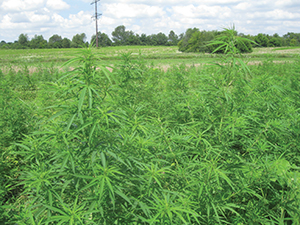
Cannabis growing in a field in Illinois
Driving while impaired
Impairment in offices and work site settings can be spotted by co-workers, but impairment on the road, where employees drive service vehicles and heavy equipment, can be harder to detect.
The Department of Transportation still considers medical marijuana and recreational use unacceptable for CDL license holders.
A 2015 study conducted by the National Institute on Drug Abuse, the National Highway Traffic Safety Administration, the Office of National Drug Control Policy and the Department of Transportation substantiated slow reaction times, problems with maintaining attention and lane position, as well as decreased target recognition and diminished ability to plan routes. Later studies using driving simulators produced similar findings.
A sign of the times, the National Transportation Safety Administration regularly broadcasts public service announcements intended to discourage people from driving while high.
Injury and crash rates increased in California, Nevada, Oregon and Washington in the months following relaxation of state marijuana laws, according to a 2021 study conducted by researchers at the Highway Loss Data Institute.
Other studies suggest that more people with detectable levels of THC in their blood have been involved in fatal accidents since legalization, according to the Insurance Information Institute.
All states prohibit driving while impaired, but confirming marijuana impairment faces hurdles in some states.
Illinois-area hospitals have refused to draw blood samples and delayed requests from police for testing individuals suspected of driving while impaired, according to statements supplied by Illinois State Police for the State of Illinois 2025 Annual Cannabis Report compiled by the state’s Cannabis Regulation Oversight Office. Those testing delays often exceeded the two-hour limit for gathering evidentiary blood samples.
Reclassification
Reclassification of marijuana under the Controlled Substances Act from a Schedule I, highly addictive substance, to a Schedule III, low potential for addiction substance, could bring better product quality control with oversight from the Food and Drug Administration, as well as the ability to fund health-related research.
However, safety challenges could arise for industries where human performance is critical, according to Jennifer Homendy, chair of the National Transportation Safety Board, in a letter to Anne Milgram, administrator of the Drug Enforcement Agency, urging a national conversation on reclassification.
Homendy expressed concerns that marijuana testing of air traffic controllers, pilots, commercial vehicle operators, locomotive engineers, subway train operators and other safety-sensitive employees might no longer occur because Health and Human Services-certified labs only test for Schedule I and II substances.
Whether or not testing continues for these sectors, it’s worth noting that “human performance critical” sectors are reluctant to give it up.
stock.adobe.com/YARphotographer | stock.adobe.com/Santirani
About The Author
.jpg?sfvrsn=a64b988b_1)
DeGrane is a Chicago-based freelance writer. She has covered electrical contracting, renewable energy, senior living and other industries with articles published in the Chicago Tribune, New York Times and trade publications. Reach her at [email protected].