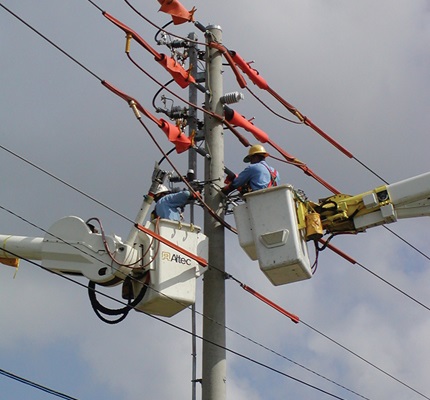
A host employer is required to provide the necessary information to its contractors prior to any job commencing when working under OSHA’s 29 CFR 1910.269 (Occupational Safety and Health Standard for Electric Power Generation, Transmission, Distribution) or 20 CFR 1926 (Safety and Health Regulations for Construction). This information helps protect the contractor’s workers from any potential hazards. Depending on the job, contractors may fall under either standard.
Regardless of whether or not you are the host or contractor, the main key to success is developing an effective communication process that informs both parties as to what is taking place to ensure the job is completed economically and safely while complying with OSHA and company policy.
In “Keeping Everyone in the Loop” (SAFETY LEADER, May 2021), I discussed what OSHA specifically requires in the Information Transfer section of the 1910.269 standard. This article discusses why you need to go beyond those directives to ensure your job is completed safely.
Examining 1910.269 on information transfer
Let’s examine one OSHA statement in the Information Transfer section of 1910.269: “Effective communication and coordination among such employers means that, before coming on site, contractors and their workers are aware of special characteristics of the host’s installations that are related to the safety of the work to be performed.” What exactly does that mean?
OSHA gives the host the flexibility to provide the information in any way it deems appropriate to ensure the contractor understands. For example, the host may use a tagging system (tags plus) rather than locks and tags. It is imperative for the host to explain its procedures to the contractor and provide examples of how using the tags plus program eliminates the need for locks.
The contractor needs to be aware that the locks are not required or even practical in some work areas. If someone does not have the necessary experience to do the job using those methods, then the host has a decision to make—train the contractor on their procedures, or look elsewhere.
Communication rules the day
This is a perfect example of why communication (information transfer) is essential to ensuring a safe work environment. The RFP for this job may require knowledge in lockout/tagout (LOTO) procedures compliant with OSHA regulations, but until you have that communication on the specific types of procedures necessary in completing the job, the contractor wouldn’t be aware that they would be using tags plus rather than LOTO.
While all electric utilities have a common element (electricity), all utilities are not built the same or even exist as they were originally built. That is why when the OSHA standard was developed, the utility industry, with the assistance of the contractor community and labor organizations, asked that the standard be written in performance language rather than the typical specification language that spelled out each step of compliance.
While the similarity of “electricity” remains, all methods of compliance vary between utilities. That is why effective communication from host to contractor and back is essential to maintain a safe work environment.
Today, the industry looks very different than when the original standard came out in 1994 and the revision in 2014. Many utilities no longer generate electricity, opting to just provide transmission and distribution services and leaving the generating to another entity that services their territory. This may be an affiliated entity within the overall umbrella of the utility, or it may be a independent operator. But the days of a vertical utility are long gone—thus reinforcing the importance of communication.
The governing standard puts many responsibilities on the host and contractor/subcontractor, but the bottom line is that communication is key. Giving as much information pertaining to the job as possible is essential for it to be completed in a safe and acceptable manner while establishing a positive relationship between parties.
About The Author

KELLY, president of Kelly Consulting & Mediation Services, has worked with utility industry leaders on safety, labor relations and human resources for more than 30 years. Reach him at 540-686-0118 or [email protected].