Many types of disturbances may happen without being detected by a PQ instrument. Detection of short-duration rms voltage variations, whether sags, swells or interruptions, require a backup power system that is active all the time and can react within a cycle or two. Sustained interruptions, often called outages, are usually the most obvious to customers and often don’t require a PQ instrument to detect them.
After a customer loses all the food in their refrigerator after a sustained voltage interruption, they try to prevent that from happening again. There are plenty of advertisements for backup generators, either fueled by gasoline or natural gas. Before spending $1,000–$10,000, it is prudent to determine how much protection one is getting for that expense.
A number of factors affect the probability of the voltage being interrupted for seconds, minutes or hours. Let’s start with where the residence or facility is located. Most cities have extensive interconnected underground electrical distribution systems. They protect the wiring from fallen trees or heavy ice on the lines, common causes of circuit interruptions. The response time for getting a crew and equipment to repair the problem is relatively short, though the time may be longer given the underground working conditions. In contrast, rural communities can have interruptions that last for days because crews must cover larger areas and address potentially widespread damage.
Nonmajor events
Electric utilities report their service quality into two main categories: with or without major events. Weather-related outages from hurricanes, thunderstorms and blizzards are considered major events as compared to interference from vegetation near power lines and atypical utility operations.
The extensive blackout of 2003 in the Northeast began with a transmission line drooping because of high heat and load currents and contacting a tree. According to the Energy Information Administration’s 2024 Reliability Metrics for the U.S. distribution system, the last 10 years experienced only 2 hours of interruption unrelated to a major event. Major events added an average of double that amount, ranging from an additional 2–9 hours of interruptions in a given year.
States such as Maine and Vermont also tend to have more interruptions, with Hawaii being the highest at double the average. The smaller generating capacity and less-extensive interconnections contribute to Hawaii’s situation. In contrast, states such as South Dakota, Maryland, Illinois and Massachusetts experienced, on average, less than one power interruption last year.
Most utilities report their performance to a Board of Public Utilities in their annual reports. Three key reliability metrics—the System Average Interruption Duration Index (SAIDI), System Average Interruption Frequency Index (SAIFI) and Customer Average Interruption Index (CAIDI)—are typically used to compare performance to prior years and other utilities in the region.
For example, in New Jersey, there are two major electric utilities, PSE&G and JCP&L (part of First Energy). In 2023, New Jersey’s SAIDI was 108.3 minutes per year of interruptions, its SAIFI was 0.881 interruptions per year and its CAIDI was 123 minutes. These numbers include major events.
But significant differences exist in performance and restoration times. PSE&G covers more of the densely populated section of New Jersey within an hour’s drive from New York, while JCP&L has more of the rural areas. This is reflected in JCP&L having triple the miles of power lines and its SAIFI index being nearly triple. Likewise, CAIDI for JCP&L is double that of PSE&G. PSE&G reports an annual SAIDI ranging between 34 and 55 minutes of sustained power interruptions per customer when excluding major storm events.
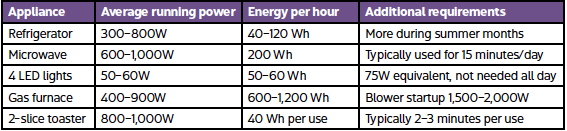
The next factor to consider is the minimal power needed to continue operating essential equipment. The data for average power (in watts) and the energy (in watt-hours) as well as any instantaneous power data allows comparison to the ratings of the backup power source. In a residence, critical appliances include the refrigerator, some sort of cooking appliance and possibly heat during the winter. See the table, which assumes modern or Energy Star appliances.
There are small gasoline generators and newer “portable power stations” in the 2- to 3-kilowatt range that can be run indoors without need for refueling (some have optional solar panels for recharging the batteries). Powering through a typical two-hour interruption from a nonmajor event with a 2,500W backup generator may allow life to continue with minimal disruptions. The refrigerator could be run with the lights on continually, except when cooking appliances are used. One might question the need for cooking or heating with such a short power interruption. Power for IT equipment such as routers, modems and phone chargers is about the equivalent of the 4 LED lights. For a $500–$1000 investment, this seems like a reasonable amount of protection for the nonmajor events.
The major events—well, that’s a story for another time.
About The Author

BINGHAM, a contributing editor for power quality, can be reached at 908.499.5321.