Less than two years ago, virtual reality (VR) meant gaming for budding electricians. Today, it is being used for electrical training. When treated as a supplement in the classroom, the simulated world is a new tool for learning the complexities of an electrician’s job.
The Electrical Training Alliance (ETA) sees value in VR. Based in Bowie, Md., the ETA is a joint training program between NECA and the International Brotherhood of Electrical Workers (IBEW). It has been developing VR for two years. Marty Riesberg, director, describes VR as an “add-on” to its training offerings. With more than 21 years of curriculum development under his belt, Riesberg sees a selective use for virtual training.
Serious business
If VR feels like it doesn’t belong in the world of training, remember the old driving education programs. After the book portion, lectures and films, many new drivers moved to a driving simulator. Even commercial pilots learn how to fly jets in simulators. The VR experience for electricians-in-training is like those simulators.
“It shouldn’t feel like a game,” Riesberg said. “And so, we are building our VR training with the help of staff from a NECA contractor. That has included taking a BIM model and building VR interaction within it. We are also getting feedback from the students and the instructors on what they like or do not like in this virtual training.”
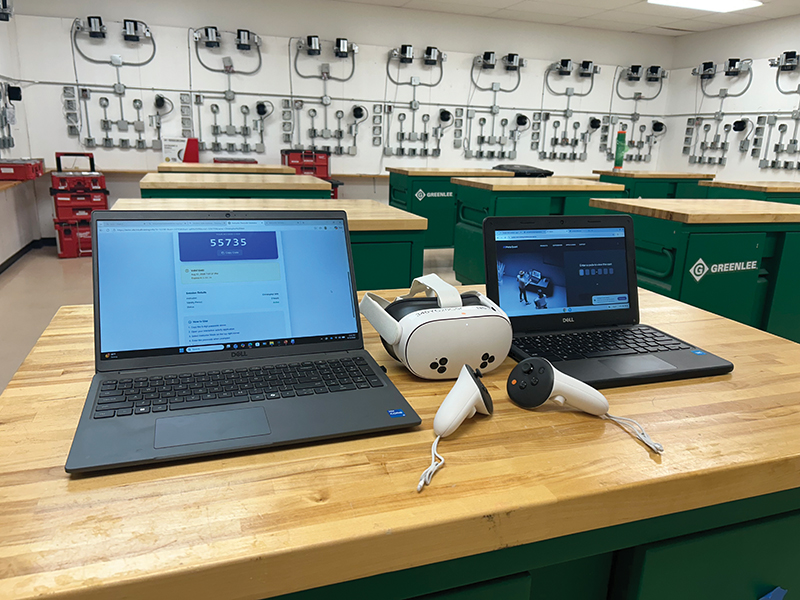
The laptop image on the left shows a screen and access code that ties a
student’s activity in the VR headset to the JATC’s learning management
system for historical record of the interaction, shown in the right laptop screen.
Broad applications and better rendering
Christopher Witt, assistant training director for Austin Electrical JATC, is also an instructor and IBEW 520 journeyman inside wireman electrician. His JATC has embraced VR.
“The ETA developed a transformer module that covers everything from step up, step downs and different wiring configurations,” he said. “We leaned heavily into that module. Now ETA is coming out with blueprint modeling where you walk the floors, walk the buildings. You identify where you are on the blueprints, as well as items and little tasks at hand. We should soon see a VR conduit training module. We also have used VR branch circuitry and general wiring training modules.”
The Austin JATC also considers VR from other vendors serving electrical and other tradespeople. Witt added that instructors get up to speed with VR and the modules through train-the-trainer classes. BIM companies have asked for input from the contracting community to help improve the visualization of electrical components. The outreach has helped, but the ETA has led in adding definition to virtual electrical components.
“Though components don’t look like a photograph, they look close enough, so trade workers know exactly what they are looking at,” Riesberg said.
Witt is pleased with how imagery has improved. “Electrical components have gotten a lot more realistic within the last two years. When our students put their VR headsets on, they are blown away,” he said.
Handling realism
With better rendering, however, comes more pixels. More pixels means a larger program and processing needs. Riesberg quickly ran into a challenge.
“We had a three-story office BIM model. It was available for our use. We wanted to incorporate VR into BIM. Using Meta, our app was headset-ready, but we were told our model was too big. Within the BIM model there were 300 office chairs. Each chair was rendered to be photorealistic. All this detail was taking up too much bandwidth. This can happen with lighting products too, [such as] 2x4 troffers supplied by a major lighting manufacturer rendered photorealistically,” he said.
Photorealistic rendering can make a program become so large that a normal computer might have trouble running it.
For Riesberg, the solution was to dial down some of the photorealism in its VR training, reaching what he called a “sweet spot.” “What makes it [the VR experience] feel real is having everything to scale and accurate in the virtual space. You condense the look of certain things so you can still recognize it, but it does not have to look like a photograph either. That makes the size of the program manageable,” he said.
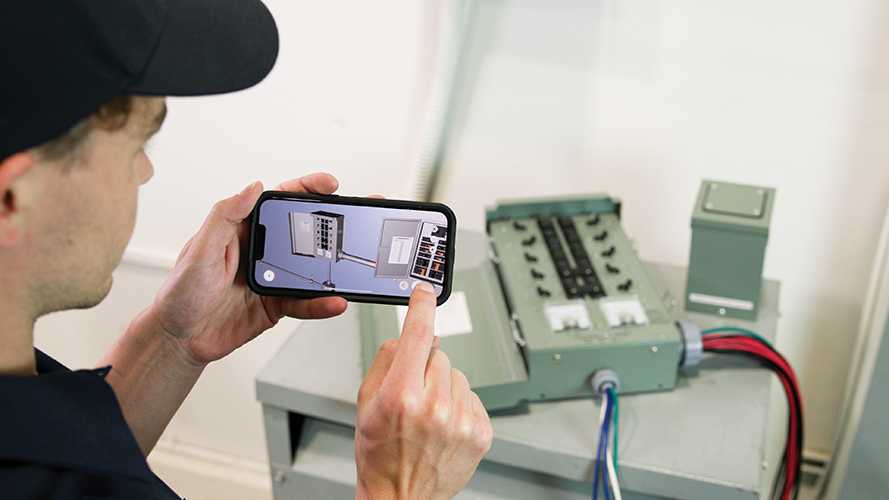
The BILT extended reality app on a smartphone is used to follow
interactive 3D instructions while working on electrical equipment.
The VR industry is also paying attention to this issue. Nate Henderson is chairman and CEO of BILT Inc., Grapevine, Texas. His firm converts customer CAD drawings into interactive, cloud-based 3D.
“You see Nvidia beginning to partner with Apple and other entities to tackle the problem of exceptionally large virtual environments featuring many rendered assets. The challenge is how to feed the user only what they need. You are seeing a lot of innovation in that space,” Henderson said.
He explained that some emerging approaches allow a user to move toward targeted equipment in the VR environment, allowing it to come into focus as other objects recede and lose detail.
VR is in session
The classroom looks a little different for instructors when VR is in session. Instead of a captive audience attuned to the instructor, students are wearing headsets to work through an electrical challenge. That, however, does not sideline the instructor.
“Each student has a headset, but also a Chromebook,” Riesberg said. “Whatever they are doing in the VR is also cast to the Chromebook [showing what the student is seeing with the headset]. That way the instructor can oversee the students, giving instruction, sometimes correction, and so forth. We also realized fourth-year apprentices could step in to guide first-year apprentices when needed.”
Witt also uses Chromebooks in the Austin JATC training.
“I am a big fan of casting. This allows the instructor to give immediate feedback to the student,” he said. “For example, is the student wiring something correctly? If not, what step was missed? You explain what damage would ensue on-site. We work through the proper wiring. It is now unlikely that student will make the same mistake in the field. VR makes the training process more efficient and lean.”
Riesberg shared that one of the first VR programs the ETA developed featured a 75-kVA dry-type transformer. Others followed.
“Before VR, apprentices might draw diagrams all day long in the training center. Once they were in front of an actual transformer, they would get this glazed look because the diagram did not look like the physical piece of equipment," he said.
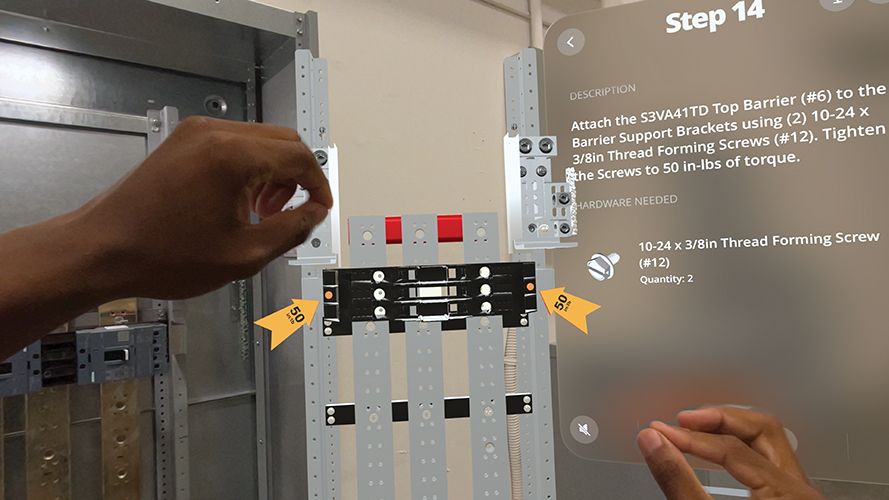
First-person immersive 3D view showing instructions for an electrical panel
Now with a transformer VR program, a student puts on the headset and has the transformer right in front of them. This is what it looks like, here are the voltage expectations and the wiring. There is no disconnect when they get on-site from what they learned and experienced in the VR. As the students have learned to draw transformers, including diagrams to learn how the transformer works, there is a link from that lesson to the VR module. So old school learning does not go away.”
In classroom quizzes, screenshots of important areas covered in a VR module are represented, helping students with recall.
“We’re looking down the road at augmenting normal things electricians do in a VR way,” Riesberg said. “For instance, to wire lights and switches, you’re clicking to cut a wire.”
Safety modules may be on the horizon. “We’re considering one right now and looking for the right spot to do it, essentially hazard identification (OSHA 10),” Riesberg said. “Why couldn’t we take realistic photos or a model of a job site allowing students to identify the hazards before crews get to the job?”
To date, ETA has VR training modules for transformers, print (blueprint) reading, wind turbine power and photovoltaics. Residential electrical work is being considered.
“We were able to get some 360 photos from the National Institute of Science and Technologies [NIST] of a residential net-zero house. NIST let us go in there with a 360 camera and take an album of photos. That could be the basis for a residential module,” Riesberg said.
The residential module could be in XR (extended reality), which is an umbrella term for augmented reality (AR), mixed reality and VR. Henderson said that an XR experience allows users to virtually go into a room that needs to be wired or learn how to run a piece of equipment. Users can fully experience the space: walk around, rotate something or conduct an operation safely.
“When an apprentice stands in front of the piece of equipment, he or she will already know where the danger areas are,” Henderson said. “They will know how it works. Once on-site, they can then touch the actual object, feel temperature, pressure, etc.”
XR influences learning
“When you bring the right XR environment into a training situation, the student’s level of confidence and willingness to try it is massive,” Henderson said. “Some platforms are hands-free where you can look at an object and zoom in, zoom out, rotate around an object. These help us write memory or information into our brain.”
“There’s cognitive retention and cognitive overload. So, in the real world when you put someone in front of a task, the brain is thinking, considering the weight of an object, its size, the temperature in the room, the noise level in the room and safety,” he said. “When immersed in a virtual world, you remove distraction when learning the task at hand or understanding a concept.”
Henderson argues cognitive retention is better when using XR. “Now you do not have cognitive overload, retention is extremely high, confidence is high. Once a student touches a physical transformer they explored through XR, they are ready to go. The training is so much faster. You have saved money with fewer mistakes on site.”
Riesberg and Witt agree. XR’s future in training applications will only expand and join the job site, too.
BILT / stock.adobe.com/KanawatTH, stock.adobe.com/DIgilife, Austin Texas JATC
About The Author

GAVIN, Gavo Communications, is a LEED Green Associate providing marketing services for the energy, construction and urban planning industries. He can be reached at [email protected].