Today’s most progressive safety programs include an assessment of high energy that can result in a serious injury or fatality (SIF). Many industries, including the electric utility industry, include high energy control assessments (HECA) on their work sites. Understanding HECA will help electrical contractors prevent SIFs and address the requirements of a growing number of host employers.
HECA are science-based measurements of performance that determine how well frontline workers are protected against SIFs. These energy-based observations (EBOs) are collected during site visits and conducted by trained professionals while work is underway.
Most EBOs implement a three-step process for assessing performance, including the identification of high energy sources, the presence of controls and reporting results.
High energy sources
Safety professionals in the electric utility industry use specific criteria to determine the presence of high energy as defined in their HECA model. In this model, a hazard that exceeds 500 ft.-lbs. of energy, if contacted by a worker, is most likely to result in a SIF. These high-energy hazards are communicated to workers through tools such as icons and energy wheels. For example, an uncontrolled fall from a height of 4 feet or greater has the potential to result in a SIF.
Presence of controls
The control of hazards, especially those that can result in SIFs, are most often addressed in OSHA regulations. The HECA model has created a higher standard required for control called direct controls, which are safeguards specifically targeted to the high energy source. They effectively mitigate exposure when installed, verified and used properly, even when someone makes a mistake. In some cases, direct controls are not available, so alternate ones must be used. The alternate controls should also exceed OSHA requirements and bring them as close as possible to a direct control.
Reporting the results
HECA uses a simple equation to score the observation’s results. It determines the proportion of high-energy hazards that had a corresponding direct control in place at the time of observation. Specifically:
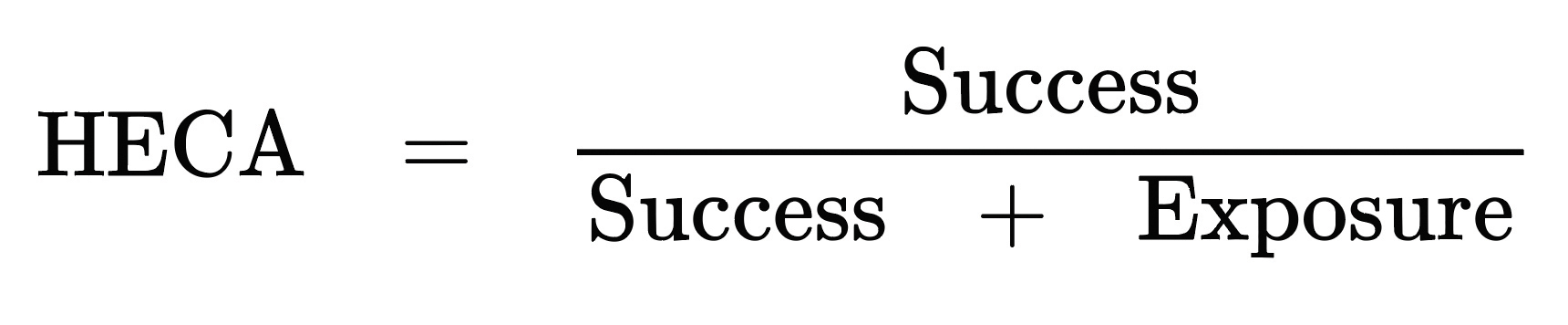
In this equation, “success” is the total number of high-energy hazards with a corresponding direct control and “exposure” is the number of high-energy hazards without a direct control.
Understanding the specific classification used for SIFs and the details used in preforming HECA is a major commitment for any organization. However, understanding where high energy is present on your job sites and ensuring it is effectively controlled is essential, regardless of the organization’s size. In addition, understanding HECA will assist in addressing the expectations of host employers conducting energy-based observations on job sites across industries.
There are advantages to HECA, because they incorporate the science of energy-based safety with human and organizational performance. They acknowledge that people make mistakes and controls must be effective even when someone does. HECA also supports recurring and regular learning from successes and exposures. Additionally, it enables employers to measure and learn from normal work in real-time by continuously monitoring job sites and employee performance.
HECA can help organizations shift focus from lower-severity incidents to environments more capable of being life-threatening or life-altering, vastly reducing SIFs. If used and applied consistently across the industry, HECA have the potential to help establish shared learning and benchmarking.
Although they have the capability of being a transformative new metric, HECA are mainly used as a tool to reduce SIFs. As with any metric, data can be directly or indirectly incentivized. This can lead to underreporting, misreporting, case management and other forms of data manipulation. For HECA to be most effective, the process should be used for continuous safety monitoring, learning and strategic allotment of resources.
Other potential pitfalls of relying on HECA data for benchmarking include overestimating scores, duplicate observations, invalid or inconsistent scores, factoring in low-energy events, inconsistent data collection, convenience sampling and organizational imposed quotas. There are some ways around these obstacles, but it goes back to the challenge of consistency across organizations and the industry for it to be a truly effective benchmarking tool. The pros far exceed the cons when it comes to using HECA to reduce SIFs.
Tools are available on the eSafetyLine subscription site, including SIF prevention videos, safety talks and content, and HECA solutions for developing and implementing effective and compliant company safety programs and site-specific plans.
STOCK.ADOBE.COM/ Summer Paradive
About The Author

O’CONNOR is safety and regulatory affairs manager for Intec, a safety consulting, training and publishing firm. Reach him at [email protected].