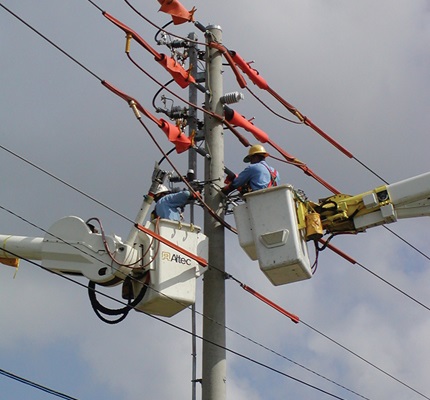
Whether you are doing electrical utility work under OSHA general industry standards (1910) or construction standards (1926), grounding plays an important part in keeping employees safe. Over the years, some of the worst accidents the industry has experienced have been the result of poor or nonexistent grounding practices.
This short overview will explain the basic requirements of grounding and give you direction on where to find more detail.
What’s in the standards?
Federal regulations for grounding for the protection of employees in our specific industry can be found in general industry standard 29 CFR 1910.269(n) or in construction standard 29 CFR 1926.962. The language in the application sections is almost identical following OSHA’s 2014 effort to “harmonize” the 1910.269 and 1926 Subpart V, although 1926 leaves out the word “generation” since Subpart V deals with transmission and distribution work only.
Both standards require the employer to ensure that the lines and equipment worked on are de-energized under the provisions of specific sections of each standard—Paragraph (m), De-energizing lines and equipment for employee protection, in 1910.269, and Section 962 in 1926. OSHA suggests that the best way to do this is to establish an equipotential zone (EPZ) at the location to be worked on. OSHA defines an EPZ as, “Temporary protective grounds shall be placed at such locations and arranged in such a manner that the employer can demonstrate will prevent each employee from being exposed to hazardous differences in electric potential.”
In establishing this requirement, OSHA set off mass confusion in the electrical industry. Folks who were trained to think, “If it’s not grounded, it’s not dead,” traditionally used single-point or bracket grounding to meet the safety requirements of the standard. With the onset of EPZ, there was a new method to learn. OSHA has always tried to protect the employee from exposure to hazardous differences in electric potential, and from my perspective, this new initiative was targeted at bringing work practices up to date with new information.
Let’s look at some of the requirements:
Protective grounding equipment: Para (n)4 in 1910.269 and 1926.962(d)(1) and (2) indicate that the equipment shall be capable of conducting the maximum fault current that could flow at the point of grounding for the time necessary for the fault to clear.
Testing: Para (n)(5) in 1910.269 and 1926.962(e) require that employees test the lines and equipment and verify the absence of nominal voltage before an employee can install any ground on those lines and equipment. This section does not apply when there is a presence of previously installed grounds.
Connecting and removing grounds: Para (n)(6)(i) and (ii) in 1910.269 and 1926.962(f)(1) and (2) require practicing the “first on, last off” process when connecting and removing grounds. This means that the employee attaches the ground end connection first and then, using a live line tool, connects the grounding device to the other end of the line or equipment. When removing grounds, this process is reversed, always having the employee use a live line tool when removing ground from the line or equipment.
Note: At 600V or less the employer may permit the employee to use insulating equipment, provided the employer ensures that the line or equipment is not energized, or that the employees are protected from hazards that may develop if the line or equipment is energized. This applies to the connecting and disconnecting of grounds.
Taking care of equipment
These are just small portions of what is necessary when conducting grounding practices. You should also be mindful of the importance of doing a regular inspection of your grounding equipment and checking for any device deterioration or degradation. Remember, equipment and proper procedures are there to protect you in case of an unforeseen incident. You need to take care of the equipment so it can take care of you.
For the complete standard language and requirements, go to www.osha.gov/laws-regs. These standards were promulgated by OSHA, with the assistance and support of the electric utility industry. They represent the best known methods of working practices and procedures to ensure employee safety.
Header image: Getty Images / Veronika OliinykAbout The Author

KELLY, president of Kelly Consulting & Mediation Services, has worked with utility industry leaders on safety, labor relations and human resources for more than 30 years. Reach him at 540-686-0118 or [email protected].