Power undergrounding replaces the power pole with buried conduit. Once used selectively, its adoption is now expanding, spurred by calls to harden the grid. Utilities and the communities they serve want to remediate power losses from fires and storms while providing an aesthetic alternative to transmission lines strung across the landscape. what was once a new world for lineworkers is becoming more familiar.
Most of the U.S. power grid is aboveground, with 5.5 million miles of distribution lines and more than 180 million power poles. Power undergrounding, however, is practiced to some degree or another in many states. In its “Infrastructure Funding Progress Update Winter 2025,” the U.S. Department of Energy (DOE) reports that undergrounding has had gains, however small—from 18% in 2009 to roughly 20% in 2023.
Utilities today are doing the math, weighing the costs of repeated outages and damage due to fires and storms and the need to span across rough terrain against the cost of undergrounding power lines. Jersey Central Power & Light (JCP&L), a subsidiary of FirstEnergy Corp., is relocating and upgrading power lines in portions of its New Jersey service territory to enhance electric service. Transmission undergrounding was one part of the utility’s solution for the limited-area 2024 $1.75 million project.
“Moving power lines underground is not a one-size-fits-all solution, especially due to the higher costs,” said Doug Mokoid, FirstEnergy’s president, New Jersey. “In situations like this, relocating the lines and burying a short segment enhances the benefits for our customers in a practical, cost-responsible manner.”
Approximately 1,500 feet of the new line was installed underground as a workaround for dense trees and difficult terrain along a portion of a corridor in Somerset County.
Long a proponent of having a mix of underground power as part of its transmission network, other JCP&L companies such as Penelec are replacing portions of underground electric cable, transformers and other equipment due to aging. Underground wires are now protected from the corrosive effects of soil and water by PVC conduit.
Scott Wyman, former president of FirstEnergy’s Pennsylvania operations, said, “Underground cables, housed in conduit, are easier for line crews to repair, which can shorten the duration of service interruptions.”
Not just New Jersey
About 45% of Florida Power & Light’s (FPL) distribution system is underground, and about 90% of its new distribution lines are underground. The utility has two programs. One is the Storm Secure Underground Program (SSUP). Under SSUP, the municipality works with neighborhoods and communities interested in power undergrounding. In 2024, 90 miles of neighborhood power lines were undergrounded in Northwest Florida. By late 2025, FPL completed 170 undergrounding projects in Brevard County alone, serving approximately 4,000 customers.
On the other side of the country, the California Public Utilities Commission (CPUC) approved a long-term power line undergrounding program in 2024, which allows major Californian utilities to propose 10-year plans designed to harden the state’s electric grid against wildfire risks while driving down costs through economies of scale. The winter fires that devastated Los Angeles in 2025 were a reminder that even more undergrounding is needed.
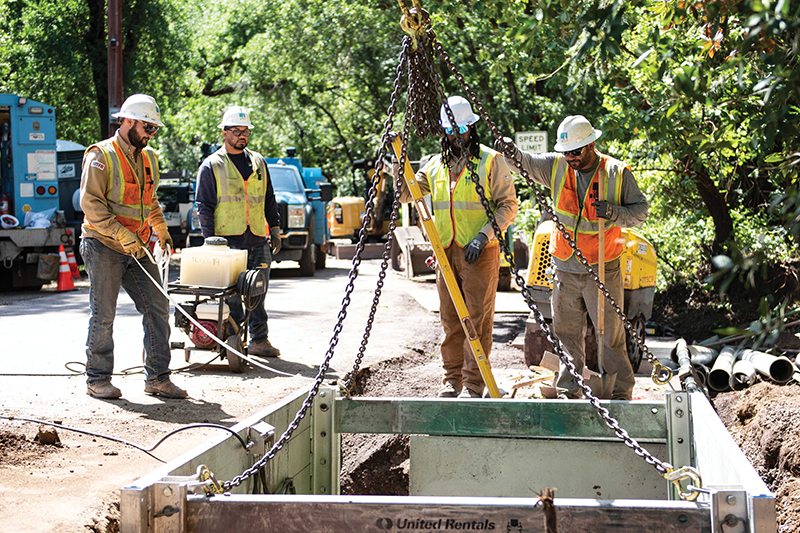
In its efforts to reduce fire risk in a heavily wooded roadway, PG&E workers construct a wide trench that will hold conduit and other equipment for power undergrounding.
Back in 2021, Pacific Gas & Electric Co. (PG&E) set a goal to move 10,000 miles of power lines underground, estimating that this could reduce the risk of wildfire ignition by 98%. As of December 2025, PG&E had constructed and energized more than 1,200 miles of underground power lines, and expects to bury a total of 1,600 miles of power lines by the end of this year. Power line burial will target the portions of the company’s service area with the highest wildfire risk and will focus on distribution lines, which the company said has a higher wildfire risk than transmission lines. For transmission lines, the company is implementing methods other than undergrounding to reduce wildfire risk and safety outages.
Many of PG&E’s undergrounding efforts use fiberglass conduit, which, is tolerant of high temperatures, according to a 2019 report from Champion Fiberglass, Spring, Texas.
California isn’t new to undergrounding, though. It has been on the radar since at least the late 1960s. Vanessa Bryan is PG&E’s senior manager of underground customer experience, which focuses on converting existing overhead lines to underground. According to Bryan, there has been an undergrounding requirement for new housing developments since 1967. She attributes the renewed focus on underground power in her state as a reflection of the growing wildfire risk.
“You’re also improving reliability with undergrounding when we think about limiting outages due to weather events, including winter storms,” Bryan said. “It [undergrounding] is also a cost-cutting measure. There is the cost to vegetation management such as tree trimming and tree removal. We must maintain a big clearance around the transmission line and maintain it consistently. There is a fair amount of inspection on an annual basis at minimum, then trimming and/or removing either dead, dying or diseased trees to maintain that clearance. We anticipate saving about $746 million in reduced maintenance costs and tree trimming as we meet our undergrounding goals.”
When undergrounding, she explained, transformers are taken off the pole. They usually remain pad-mounted and are not completely subsurface.
“We’ve got different sized underground vaults, if you will, which is where the conduit and wires are located. Junctions typically happen in that box. That is where switches are also installed. So, there is a fair amount of equipment beyond conduit and wire that is being placed underground.”
Bryan’s program was launched in 2021. “The year our program began was also the year the utility announced its plans to underground 10,000 miles of power lines,” she said. “We’ve got about 25,000 miles of primary distribution lines in our service territory.”
Considering costs
Power line burial is expensive. According to the CPUC, undergrounding the state’s existing overhead distribution infrastructure can range from $350 to $1,150 per foot, or $1.85 million to $6.072 million per mile. Some can be installed through trenching. Others might require drilling through rock.
“One of the costs associated with undergrounding are the dig costs,” Bryan said. “You typically transport the off-haul [soil removed to create a trench]. You potentially must bore to create a trench wide enough and deep enough to underground power transmission. One project can take 18 to 24 months, cradle to grave, including design. Then there is the restoration of land where power poles once stood if this is a conversion project.”
Efforts to bring costs down may expand power undergrounding for the U.S. grid.
“We started out with an average cost per mile of about $4 million in 2021,” Bryan said. “By 2023, we were able to drop that to $3 million. We are on track to achieve a goal of about $2.8 million per mile by 2026. Certainly, bundling work helps. Our work plans spell out how much risk we need to reduce to confirm the cost. Funds need approval from our regulator to be able to recover those funds. With help from the DOE, we need to keep working on cost-effective undergrounding technologies.”
Faster and cheaper
The DOE’s Grid Overhaul with Proactive, High-speed Undergrounding for Reliability, Resilience, and Security (GOPHURRS) program brings together public and private entities to explore “innovative approaches to burying power infrastructure underground.” It was created in early 2023. Operating within DOE’s Advanced Research Projects Agency-Energy (ARPA-E) program, GOPHURRS is focused on ways to simplify the construction of underground medium-voltage (5–46 kV) power distribution grids in urban and suburban areas. Automation, damage prevention and error elimination are key tenets to reduce costs, increase speed and improve safety.
According to Robert Mellors, program director for GOPHURRS, “With distribution lines, one option is to dig a trench, put the conduit lines in and then fill in the trench. Another option might require directional boring or horizontal drilling, depending on the underground environment. You usually have a fairly good idea of what is in the area, but a lot of times there are underground pipes that may not be mapped and other obstacles completely missed. Our goal is to make this hard drilling faster and better identify and flag obstacles in the way.”
One method is to add sensors to a drill bit to avoid hitting obstacles, a technology often used in oil and gas drilling.
“We are also trying to do a combined model with sensors on the drill bit and ground-penetrating radar on the surface,” he said. “Changing drilling methods while drilling could be transformative, as well.”
To that point, he shared how Case Western Reserve University has built multiple prototypes of its earthworm-inspired digging tool. The robotic tool consists of a sleeve of expanding and contracting materials that digs underground like an earthworm while laying conduit as it goes. It could make the installation of underground distribution power lines in busy urban and suburban environments both cheaper and quicker.
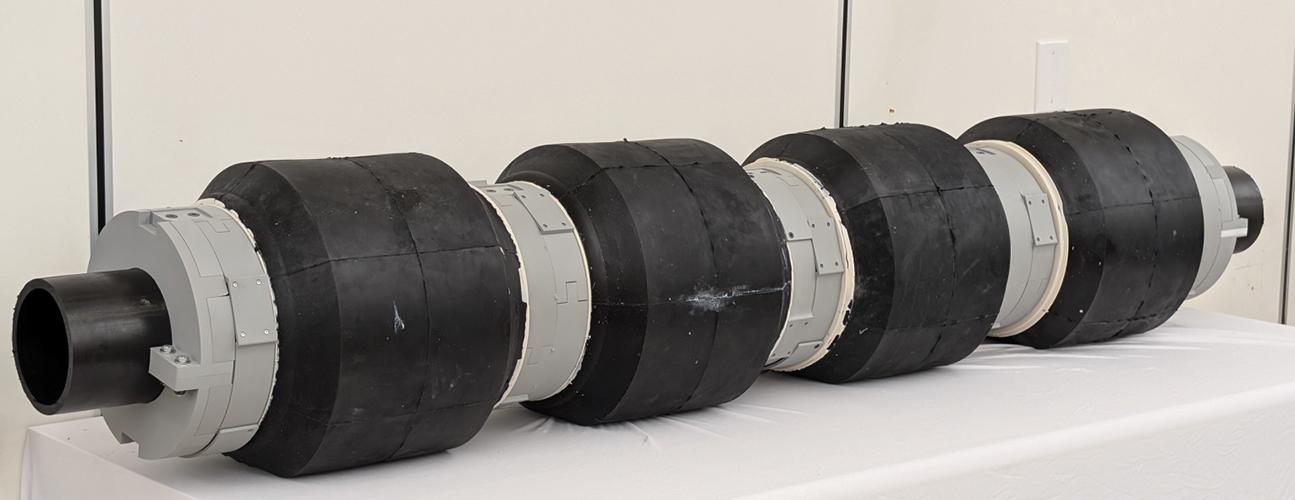
Case Western Reserve University’s self-propelled robotic sleeve features a braided mesh exterior that allows it to mimic an earthworm’s movement to advance through soil when laying transmission lines.
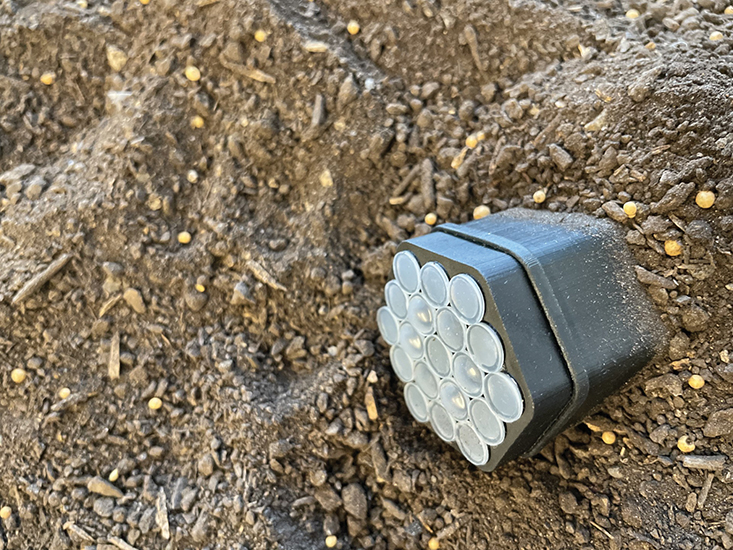
Cornell University researchers and GOPHURRS are working on a piston drilling system. Shown here is a component that uses combustion energy to drive a flexible soil fracturing head.
Automated joint installation technologies are also being investigated that perform error-free and accurate splicing operations to eliminate human error in the installation process. There are now 12 projects underway through GOPHURRS.
“Commercialization is baked in from the beginning,” said Peder Maarbjerg, assistant director for external coordination at ARPA-E.
He explained that while there are technical milestones, participants must also submit a business plan that identifies the target customer in the case that the research and development of the tool pans out.
“Knowing your customer helps in the tool design,” he said.
PG&E as a utility has also been finding ways to lower its cost.
“We’re utilizing new technologies to manage the off-haul and backfill and how to manage hard rock,” Bryan said. “From a design standard perspective, we look at the lengths of cable that we pull before there is another box. We have already adjusted trench depth and trench width, so then there is less dirt that you have to off-haul.”
Civil work accounts for 75%–90% of the total cost of undergrounding. Driving down those costs is the way to better the scales in underground power adoption and bring much improved reliability and resilience to the grid. ARPA-E would like to reduce the cost of undergrounding lines by at least 50%. GOPHURRS and the utilities themselves are working with that goal well in mind.
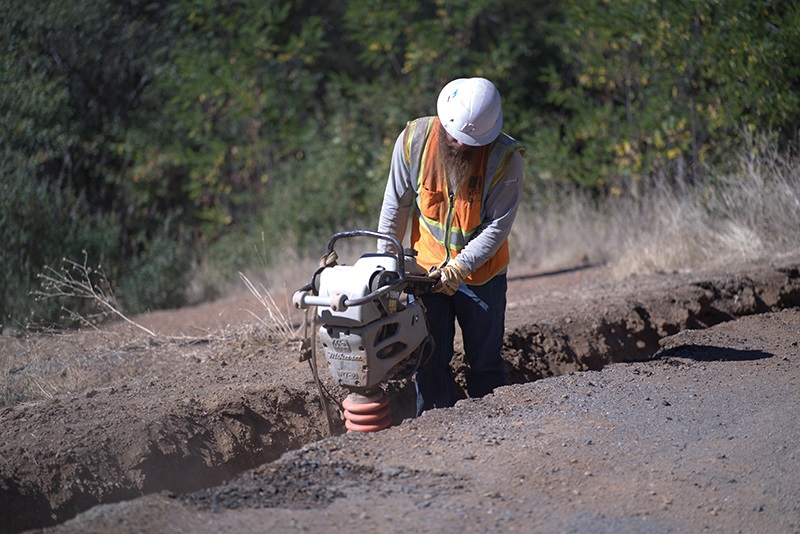
Header image: A PG&E crewman compacts soil to create a narrow trench for underground power.
Pacific Gas & Electric Co. / GOPHURRS
About The Author

GAVIN, Gavo Communications, is a LEED Green Associate providing marketing services for the energy, construction and urban planning industries. He can be reached at [email protected].
.tmb-art-li-th.png?Culture=en&sfvrsn=9278ce2b_1)