In the business of safety, human performance plays a critical role. When we get it right, employees are engaged and driven to implement the safety requirements associated with their tasks because of past encouragement and reinforcement from leaders, peers and subordinates. Employees recall being encouraged and recognized, and they are driven to repeat desired behavior.
When applying the requirements in NFPA 70E and any other code or standard, recalling key definitions is critical to getting it right. Every journeyman, apprentice, foreman, project manager and company owner should be able to recite the definitions of “risk” and “risk assessment.” These definitions apply to all hazards we encounter on the job and in our private lives.
Know the definitions
When electrical workers are asked to define risk, their response is likely to refer to their financial investments. Risk is a combination of the likelihood of an injury occurring or damage to health and the severity of an injury or damage to health resulting from a hazard. Simplified, when applied to a task, risk is the likelihood of injury and its severity.
For example, using a utility knife to open boxes comes with a likelihood of injury. The potential severity of injury would not likely include death, but a cut requiring stitches and a recordable injury are possible. A higher level of risk would include journeymen performing justified energized work on 480/277V equipment; there is a likelihood of occurrence and the potential severity is greater than a few stitches.
It is imperative that employees be able to recall the definition of risk assessment. There are three steps in a risk assessment. First, employees must identify existing and predictable hazards, whether they are related to electrical work, a fall or another hazard. Second, the employee determines if the task they are to perform brings a likelihood of occurrence from the identified hazard. Where there is a likelihood of injury, the third step requires that additional protective measures be applied.
Performing a risk assessment
We all perform risk assessments every day, but complacency results in flawed assessments. For example, an individual is driving at highway speed and receives a text message. They reach for their phone and take their eyes off the road. A risk assessment is performed without conscious thought. The individual knows distracted driving is a hazard, but when they consider the likelihood of occurrence (striking another vehicle or pedestrian), they do so subconsciously, determining there is no likelihood of occurrence because they do it often.
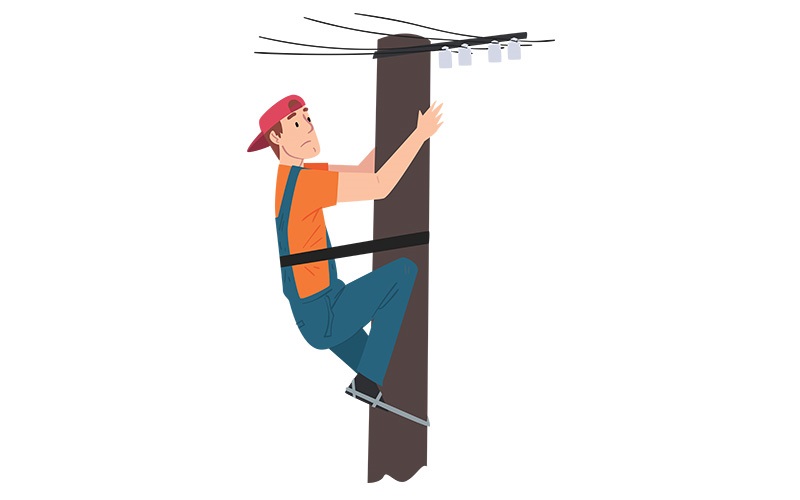
A similar mindset exists with a wireman that approaches a leading edge without fall protection or removes covers to expose energized conductors and circuit parts to work. They did a risk assessment. The problem is that they determined there is no likelihood because they are experienced.
This is a behavior that can be overcome through training and the memory recall of what an accurate risk assessment involves. We must ensure that all employees can recall and apply the three steps of a risk assessment.
NFPA 70E qualified person training includes how to determine the likelihood of occurrence. Table 130.5(C) provides the standard user with a method to determine the likelihood of occurrence with respect to tasks performed on energized electrical equipment. This removes the potential for subjective likelihood determination based on individual experience. It is important to read, understand and apply the table notes (mandatory) that follow Table 130.5(C). This requires that a risk assessment must determine the likelihood of occurrence as provided in the table, and we must consider the potential severity. The notes also clarify that the likelihood table does not cover every possible condition or situation, nor does it address severity of injury or damage to health.
Likelihood and severity must always be considered independently. For example, when the task is to open or close a circuit breaker, and a normal operating condition exists (see 110.2(B) Exception No. 1) according to Table 130.5(C), a likelihood of occurrence does not exist. Therefore, a three-pole 100A molded-case circuit breaker at 208/120V on the 10th floor of a high-rise building that meets the requirements for a normal operating condition can be operated without additional protective measures.
Now in the same building, consider normal operation of a 2,000A LVPCB, which is the service disconnecting means at 480/277V. While each circuit breaker here is in a normal operating condition, the potential severity associated in this example must drive the employee to additional protective measures. The hierarchy of risk control methods [110.3(H)(3)] must be considered for additional protective measures.
stock.adobe.com / topvectors
About The Author

DOLLARD is retired safety coordinator for IBEW Local 98 in Philadelphia. He is a past member of the UL Electrical Council, NEC Correlating Committee, NEC CMP-10, CMP-13, CMP-15, NFPA 90A/B and NFPA 855. Jim continues to serve on NFPA 70E as a Special Expert. Reach him at [email protected].