
The growth of data centers and construction of new hospitals, the transition to renewable forms of energy and the need to upgrade the grid are all generating more work. New customers are seeking out skilled labor. At the same time, baby boomers are retiring, which is heightening demand for electricians and technicians. Utah is a prime example of where this is happening.
Unprecedented growth
With more than 3.5 million residents, Utah’s population has increased by more than 50,000 residents since July 1, 2023, according to Utah Business. That includes a slight dip in growth since 2020, but calls for skilled labor keep coming. Utah Electrical Training Alliance, which trains inside wiremen and telecommunications technicians, is blazing new trails to increase recruitment.
The training center’s enrollment peaked at 800, an all-time high earlier this year, and total local union enrollment has increased by 20% since 2020.
“We’ve been fortunate with our local and posted record man-hours in recent years,” said Brian Vermouth, training director for the Utah Electrical Training Alliance. “In the last five years or so, we’ve had an airport remodel, an arena remodel and several data centers. There’s been consistent growth in the area and people moving here.”
New approaches
New approaches are needed for attracting new talent. One huge step for the Utah ETA was shortening the curriculum from five to four years.
“Now, a lot of locals are starting to do this,” Vermouth said. “With Electrical Training Alliance overseeing changing our curriculum for the last five years, six months ago, we had our largest graduating class ever—165 journeymen and telecommunications technicians. They are the first cohort of our four-year program.”
Some of that first group started out as five-year apprentices, however. To speed their progress along, the JATC added one week to their curriculum so they could complete 750 hours of classroom work in four years.
To get a Utah electrician’s license, requirements include four years of schooling, and the new apprentices were still required to complete 8,000 hours of work in the field.
“As far as realizing we needed people, contractors often reached out to me,” Vermouth said. “We had open calls for apprentices with experience as well.”
For the more experienced group, Utah ETA streamlined the application process. Electricians with more than 4,000 hours of experience qualified for direct entry into the apprenticeship program.
“Our local had a sign-on bonus for journeymen: $1,500 for journeyman, and $500 for whoever referred them,” Vermouth said.
As with most employers these days, applications must now be completed online, Vermouth said.
Posting homework lessons online also moves things along more quickly. Beyond that, the training center recently spent $60,000 on touchscreen technology.
“When I first started here, some people would have issues accessing materials online” Vermouth said. “Now that’s not the case at all. We’ve definitely made the transition to a tech-oriented group. I’m seeing all of our homework, which used to be in a notebook, done online.”
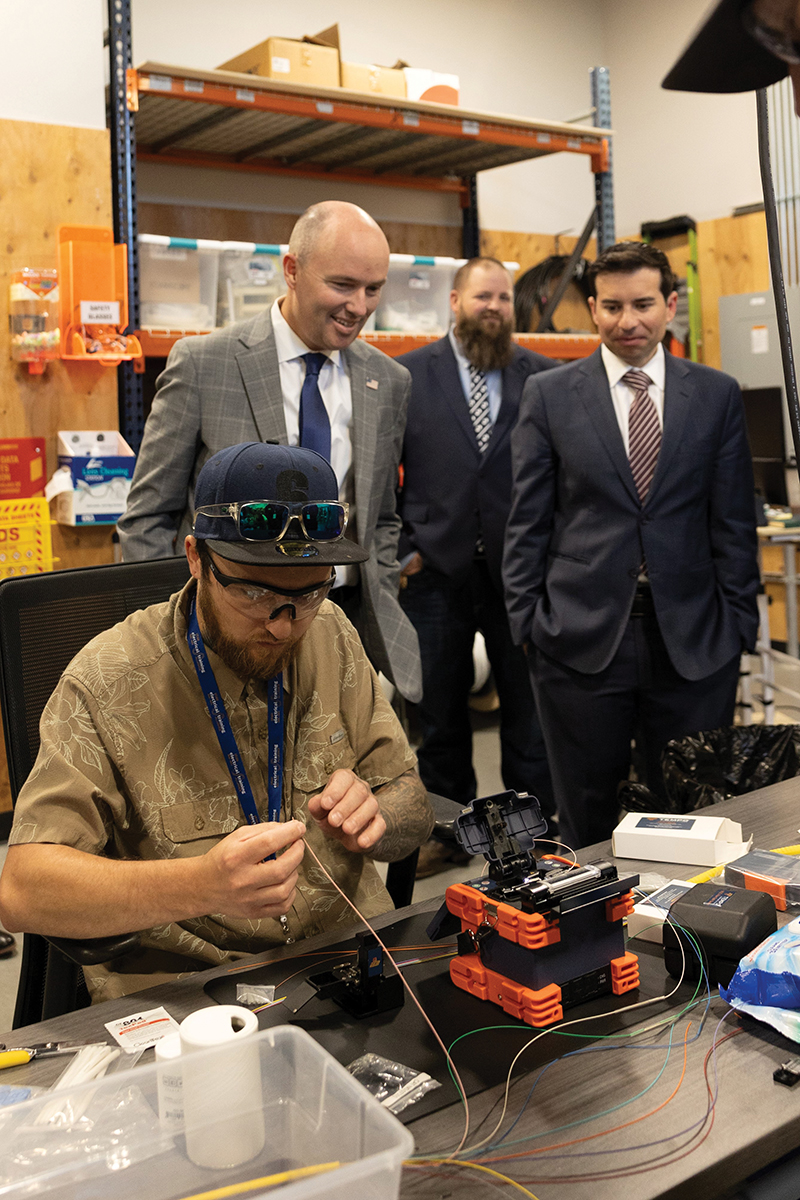
First-year Utah ETA apprentice Chet Vanausdal demonstrates cable splicing for Utah Gov. Spencer Cox,
former IBEW president Codey Lindsay and Deputy Secretary of Labor Keith Sonderling.
Broadening recruitment
The ideal age for apprentices to absorb the training and settle into long-term careers is around 26, Vermouth said, “but we have some as young as 18 and one who’s 54. For some younger people this is hard, because this is a full-time job along with schooling and homework. We find sometimes that takes a level of maturity to take this on.”
Current applicants are coming from all walks of life.
“We see people with college degrees who have found that their career pathway paid less than a second- or third-year apprentice would earn. We see high school graduates, and it’s their first job. We’re seeing vets,” he said.
Right now, enrollees are predominantly younger and inexperienced.
“We’ve partnered with members of the Utah High School Counselors Association by attending conferences, sending emails to members and putting on a spring open house for seniors,” Vermouth said. “With that, we’ve had a lot of success.”
IBEW 354 also notes an influx of Hispanic apprentices to more accurately reflect the demographics of the region.
“We’re not seeing a lot of other groups,” Vermouth said. “But that’s because we are not exactly a hotbed for diversity.”
“We’re also seeing more women,” he said.
Utah ETA’s enrollment is 10% female, with 60 female inside wiremen and 10 telecommunications technicians. Overall enrollment includes 665 inside wire apprentices and 65 telecom techs.
Utah ETA works with Utah Women in the Trades, which sponsors pre-apprentice workshops. These cover first aid, math for construction and an introduction to sample work tasks offering a sense of working in the field.
The pre-apprenticeship program opened the door for Kimberly Ivie, a 36-year-old first-year telecommunications apprentice. Coming into the Utah ETA program, she had already worked in construction as a roofer. She also had weathered some of the tough challenges faced by many in the construction industry.
She found out about Utah Women in the Trades through a fellow client in a drug treatment program.
“Her case manager told her about the pre-apprentice program,” Ivie said. “When I heard about this, I thought it might give me a chance to dabble and explore a new direction.”
The three-month pre-apprenticeship program included six hours of instruction, two days per week. It also enabled Ivie to secure an apprenticeship slot with the Utah ETA.
“There’s so much advancement going on here [in Utah] with A.I. and data. I thought this would be a good way to advance,” Ivie said. “I love it!”
Ivie has nearly completed her first year of online training and workbook exercises through Ogden Weaver Technical College. She attends hands-on instruction at Utah ETA. And her on-the-job training is with Cache Valley Electric Co., Logan, Utah.
“When I first started, the foreman was really welcoming,” Ivie said. “He takes his time to teach us what he knows, and he asks us what we want to know.”
Ivie appreciates getting paid as she learns, and she’s ambitious.
“My goal is to be a journeyman, then a foreman and go up through the ranks,” she said.
Ivie also has reached out to fellow apprentices and others in the industry who struggle. Her volunteer efforts have impressed Utah Gov. Spencer Cox and Deputy Secretary of Labor Keith Sonderling, both of whom visited the JATC and participated in a panel discussion with apprentices last May.
The timing of the visit could not have been better. Utah ETA’s 29,000-square-foot building, built in 2019, was remodeled to convert three labs into a multipurpose room, enabling the building to accommodate up to 160 people at one time.
Along with other apprentices, Ivie was invited to meet with the dignitaries.
“This [apprenticeship] opportunity completely changed my life,” she told those gathered for the roundtable discussion.
Finding a place for Gen Z
Generation Z seems comfortable taking an active role in preserving unions and standing up for themselves.
“They’re also very interactive with the community and willing to volunteer,” Vermouth said.
Like Utah ETA, the IBEW 134-NECA Technical Institute (IN-Tech) in Alsip, Ill., is a trailblazer in supporting younger generations with technology. With recruitment strategies that include an annual STEM competition for Chicago-area high schools, IN-Tech notes an overabundance of apprentice applicants.
IN-Tech apprentices recently participated in beta testing of a free web-based conduit-bending calculator developed by the Steel Tube Institute (STI) to serve the next generation of electricians.
“Gen Z is choosing skilled trades over traditional degrees at increasing rates, drawn to stability and real-world skills,” according to STI’s press release about the app. “But they expect digital tools, just like in every other part of life. Trade schools still teach by hand, but job sites don’t. Students trained without tech are often left scrambling once they graduate. STI’s app bridges that gap.”
The app covers every major bend type—offsets, saddles and concentric. The app also provides bend marks, shrink and other critical calculations in seconds. Its documented formulas enhance instruction as well.
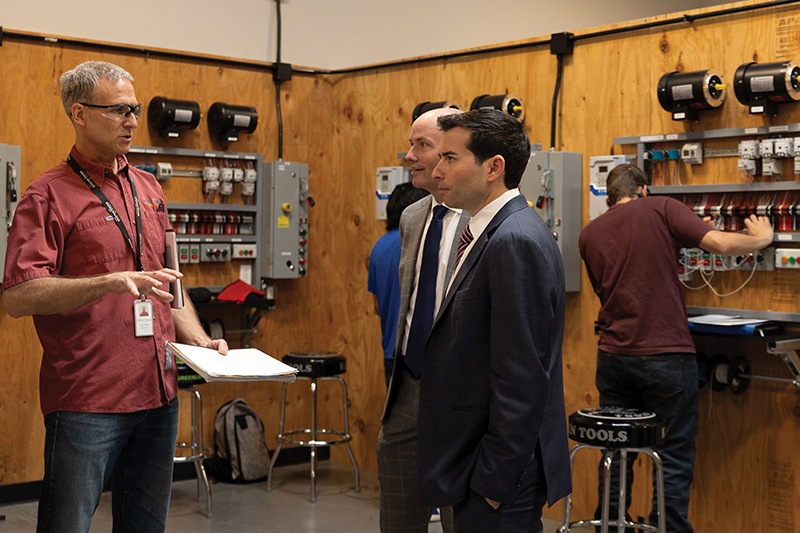
Utah ETA instructor Josh Denys tells Utah Gov. Spencer Cox and Deputy Secretary
of Labor Keith Sonderling about Utah ETA’s motor control lab.
The plus of 60-plus
Despite the growing need to replace journeymen who retire, there’s a lot to be said for seasoned journeymen who continue to work. Besides retaining institutional knowledge, the 60-plus age group has the lowest level of absenteeism of any age category, according to an ETA white paper on the causes of absenteeism.
Bill Sullivan, utility training manager at Aldridge Electric, Libertyville, Ill., is a prime example. Having retired as a manager in underground and utility pole safety for ComEd in 2015, he joined Aldridge that same year.
“The only time I’ve called in sick in the last 10 years was when I caught COVID, and then it was mandatory—you had to take off,” Sullivan said.
As far as retirement is concerned, “my wife says I’ll know when the time will come,” he said.
Because Sullivan enjoys his work, that could mean working part-time, he said.
Utah Electrical Training Alliance | stock.adobe.com / VStudio
About The Author
.jpg?sfvrsn=a64b988b_1)
DeGrane is a Chicago-based freelance writer. She has covered electrical contracting, renewable energy, senior living and other industries with articles published in the Chicago Tribune, New York Times and trade publications. Reach her at [email protected].