When a Person stops breathing, suffers uncontrolled bleeding or goes into cardiac arrest, first aid and CPR play critical roles in preventing permanent injury or death.
OSHA regulations
OSHA 29 CRF 1910.269 B suggests that employers provide medical services and first aid when employees are performing work on, or associated with, exposed lines or equipment energized at 50V or more. It is also recommended that two or more people with first aid training be present at the work site, and that “each employee exposed to electric shock can be reached within 4 minutes by a trained person.”
This means that emergency medical services, with access to CPR, must be within 4 minutes’ reach. However, this timeframe is not a realistic expectation for contractors working at remote locations or in high-rises still under construction.
“In some cases, they may be working in a swamp, 30 minutes away from any road,” said Luke Tyler, assistant director of training and curriculum at Southeastern Line Constructors Apprenticeship & Training (SELCAT), Newnan, Ga. This is why it’s crucial to have apprentices and journeymen trained in first aid and CPR.
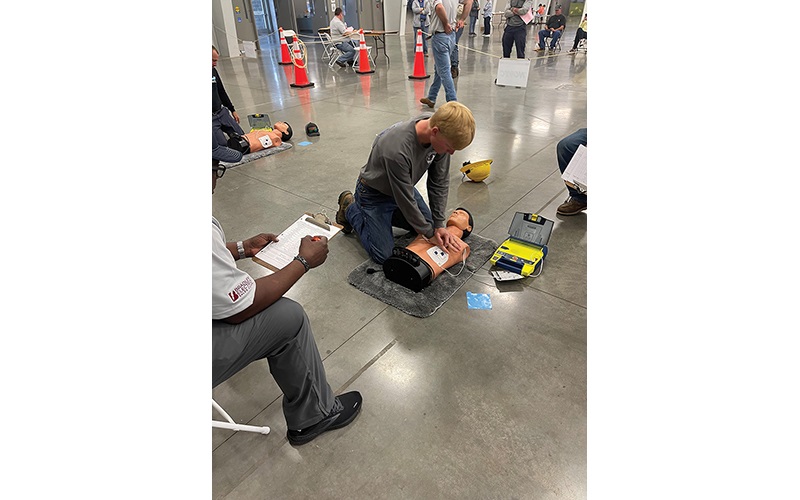
Thanks to train-the-trainer programming provided to SELCAT instructors by Coyne First Aid Inc., Sellersville, Pa., SELCAT instructors are able to provide hands-on first aid and CPR training to 100 apprentices a year.
Keeping skills current
To keep apprentices and journeymen current, SELCAT trainers also provide refresher training in CPR annually and in first aid every two years.
“You never know when you will have to rely on this training; that’s why we want it ingrained in muscle memory with training and retraining,” Tyler said.
Another reason for keeping current is that safety procedures in recent years have led to better outcomes, said Melissa Coyne, third-generation president of Coyne First Aid.
The International Liaison Committee on Resuscitation’s 2020 guidelines now suggest the recommended depth for CPR chest compressions is 2 to 2.4 inches at a rate of 100 to 120 per minute. Prior to 2015, Coyne said, the recommended depth of compression was 1.5 inches.
Another positive change in practice is performing the compressions before mouth-to-mouth resuscitation.
“That’s because people tend to hesitate with performing mouth to mouth,” Coyne said. “But once they get started in the CPR process, they don’t hesitate. They feel a sense of commitment to continue.”
Coyne also noted the need to consider contributing causes and possible complications when performing first aid and CPR.
In the construction industry, transportation accidents and falls remain primary causes of fatalities, but opioid overdoses, poor mental health and workplace violence are also gaining ground.
Existing medical conditions such as diabetes, asthma and food allergies also must be given consideration when administering first aid and when developing work site safety plans, Coyne said.
“Employees need to be encouraged to speak up to HR about existing conditions to ensure their own safety,” Coyne said. “That way, for example, if they are prone to serious allergic reactions, there’s an EpiPen available if they need it.”
Coyne points out that first aid and CPR efforts should only be intended to address immediate concerns until emergency medical first responders can take over.
Laying the groundwork for faster emergency response is also the employer’s responsibility.
“It’s important to inform first responders of your location and provide a copy of your safety plan before construction begins,” Coyne said. “This can save precious time when job sites have no posted addresses or require special access to service elevators or underground spaces.”
Coyne First Aid courses cover OSHA requirements that address suspension trauma, as well as electrical, confined space hazards and pole safety. Coyne First Aid’s train-the-trainer training is available in all 50 states. The company also provides video streaming, tracks learning progress, maintains qualification records and provides reminders for upcoming renewal dates.
Header image caption: SmartMan Manikins, such as this one, provide feedback regarding chest compression timing and depth. They have enabled first-year apprentices and others at the Electrical Industry Training Center, Long Island City, N.Y., to quickly become agents of workplace safety, said James Orban, administrator of apprentice training.
Coyne First Aid
About The Author
.jpg?sfvrsn=a64b988b_1)
DeGrane is a Chicago-based freelance writer. She has covered electrical contracting, renewable energy, senior living and other industries with articles published in the Chicago Tribune, New York Times and trade publications. Reach her at [email protected].