Making safety even safer is a continuous goal. Prevention through Design (PtD) is a risk assessment methodology and standard that has helped on the manufacturing and shop floor, construction site and many other locations touching medical, agriculture and beyond. PtD is largely unknown to engineers, safety directors and company managers. Maybe it has been hiding in plain sight.
PtD was formally introduced by the National Institute for Occupational Safety and Health (NIOSH) in 2007. In brief, NIOSH describes it as a process that “can prevent and reduce occupational injuries, illnesses and fatalities by designing out or minimizing hazards and risks.” NIOSH’s PtD initiative is broad-based, addressing facilities, work methods and operations, processes, equipment, tools, products, new technologies and the organization of work.
Bruce Main is president of Design Safety Engineering Inc., a consultancy based in Ann Arbor, Mich., that works collaboratively with manufacturers and others in the risk-assessment process and improving safety through design. He is a member of several national and international industry committees focused on risk assessment and safety of machinery, including ANSI B11.0 and ISO 12100, and ANSI Z244.1.
“The idea of PtD really comes back to an inherently safe design, designing a system that will be inherently safe so nobody can get hurt,” Main said.
His firm largely looks at PtD through the lens of equipment and machinery.
“PtD is error-proofing, discovering what else can we do,” Main said. “For instance, when looking at engineering controls, a safety solution might involve putting in guarding and fencing and interlock systems. You might apply PtD in more administrative controls like lockout/tagout, personal protective equipment [PPE] and so forth. We have done quite a bit of work in training engineers on the concepts of the hazard control hierarchy and the structure of PtD.”
In describing PtD thinking when applied to a construction application, Main described a few scenarios. “To eliminate a fall hazard, perhaps a fixed staircase could be used rather than a ladder,” he said. “On a construction site, deploy an off-road scissor lift that is stable on various terrain that moves not just vertically, but can articulate, offering on-site flexibility and minimize fall risks.”
The risk assessment process
Often visualized as an inverted pyramid, PtD can be applied in a hierarchy of controls where actions are prioritized as most to least effective, as shown in the figure on the next page. The most effective action is elimination (physically remove the hazard), followed by substitution (replace the hazard), engineering controls (isolating people from the hazard), administrative controls (change the way people work) and PPE (protect the worker).
Main shared the example of a robot cell used in a painting process and the use of machinery lockout. “If you shut it [the robot cell] down, the paint is going to coagulate and cause problems,” he said. “What if we separate those circuits so the robot is on one circuit [and] the pump on another? Now you can keep the pump circulating the paint while you work on the robot. That’s PtD. We still must use the control of hazardous energy and lockout/tagout, which is an administrative control, but, by separating those circuits, we are changing how the task is done and minimizing line disruption.”
An “in plain sight” PtD improvement for electrical contractors and others has been lowering voltage (25V or less) for controls used in equipment processes and machinery.
“My recommendation for electrical contractors and the construction community at large is to adopt PtD into their risk assessment procedures,” Main said.
The concepts of PtD aren’t new.
“Fred Manuele was a senior pillar of safety who wrote a paper that became the basis for the PtD standard,” Main said. “He formed a committee that crafted the first PtD standard first published in 2011 [ASSP Z590.3 Prevention through Design Standard, reaffirmed in 2016]. I was vice chair of that committee.”
The standard provides guidance on including PtD concepts within an occupational safety and health management system. In 1995, Manuele steered a 10-year National Safety Council (NSC) initiative called the Institute for Safety Through Design, which led to a co-authored textbook of the same name. Manuele received the inaugural Prevention through Design Award in 2021, presented by NSC, NIOSH and the American Society of Safety Professionals (ASSP). Main received the same award in 2024.
Recognizing PtD in action
In manufacturing equipment, thoughtful design considerations can often be the result of applying PtD. Consider the digitization of switchgear, which enables operators and service personnel to read switchgear operation or performance on a smartphone or tablet and lessens exposure to electrical hazards. The equipment itself might be simplified by removing tasks that once required an operator.
For 43 years, Mike Taubitz served in various capacities at General Motors. It was where he introduced PtD concepts before the name was coined. For the past 15 years, he has consulted under the Lean Journey LLC banner as its principal consultant and founder.
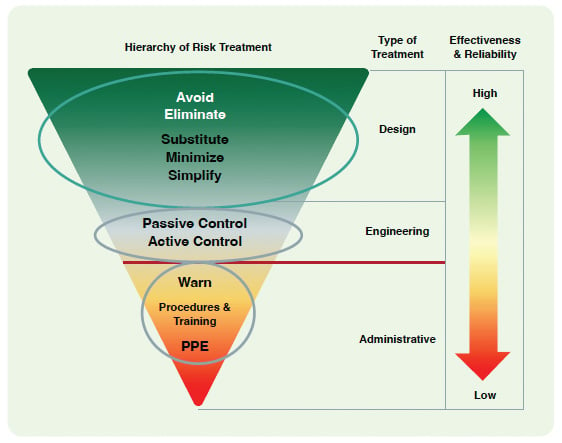
Prevention through Design employs a hierarchy of risks and how they will be
addressed. Pictured as an inverted triangle, actions are gauged in a sequential
ranking from highly effective to less effective. All PtD work should begin in
the design phase to be successful.
In his time with GM, one position Taubitz held was process engineer. “When I bought a machine and I didn’t like the noise enclosure or the guarding was too much or too little, I conducted what was a risk assessment and documented our actions,” he said. “That led to us creating a design specification in which successful vendors complied with specified noise attenuation—an example of a manufacturer applying prevention through design before a risk assessment-based formula was formalized by NIOSH in 2007.”
Easing into PtD
Taubitz referenced key standards to help guide users interested in adopting PtD.
“ANSI B11.TR8—2022, Guide to Inspection of Risk Reduction Measures, is a great starting point for developing a PtD safety specification,” he said. “It provides guidance on inspection and describes how to initiate an inspection process using familiar continuous improvement methodology. ANSI/ASSP Z590.3-2021 deals with avoiding, eliminating, reducing or controlling occupational safety and health hazards and risks during design and redesign processes. ANSI B11.0—2023, Safety of Machinery, is an excellent adjunct to ANSI/ASSP Z590.3—2021. It offers specific guidance for employing PtD on new machines, equipment and processes.”
When drafting a PtD “specification” within a firm, Taubitz finds it essential to engage stakeholders in an open, balanced consensus process. Stakeholders should include upper management, purchasing managers, project managers, project engineers, product design engineers, safety, operations, quality, facilities and maintenance personnel.
“Focus on stuff that can kill you,” he said. “That’s a clear aim and a great place to start. Input on worker problems and issues is an opportunity for better design. Also, keep your specifications simple. Leave more detailed technical specifications for other experts (e.g., mechanical design, wiring/controls, use of chemicals, machine layout).”
Leaders of tomorrow
PtD is taught at the University of Central Missouri. Georgi Popov serves as professor and program coordinator of the B.S. in environmental, safety and risk management, which is part of the Occupational Risk and Safety Sciences Department. Since 2009, he has served as chair of the ANSI/ASSP Z590.3 Prevention through Design committee. He is vice chair of the newly formed ANSI/ASSP Z310 Risk Management Standards Committee.
“You conduct risk assessments, identify risk priorities, and, if a risk is deemed too great or unacceptable for the company, apply that hierarchy of risk treatment,” Popov said. “We also have foundations for design and redesign. Set up the risk criteria, the risk assessment process and risk treatment and manage that throughout the whole life cycle of a system. That’s how you achieve safety, health, environment and quality at a lower cost.”
Popov added that electricians might apply the NFPA 70E qualitative risk matrix, which he calls “the simplest risk matrix you’ll ever find.”
Popov said that as PtD has evolved, the process has users look at low-likelihood, high-severity incidents and accidents.
“High-energy could be high-risk or, depending on the circumstance, a medium risk. You’ll need to reduce that risk. In our Prevention through Design course, we call it the ‘hierarchy of risk treatment,’ which is also aligned with the international ISO risk management standard. Working PtD into your safety program begins with leadership direction and communication, then adds the risk criteria methodology.”
Popov added that you can apply the hierarchy of risk treatment to anything, including management practices.
“Many textbooks still teach that engineering control is the highest level of control, and that’s not the case these days,” he said.
In educating the safety leaders of tomorrow, Popov said, “The best thing you can hear from your alumni is, ‘I’m in the safety profession because of you. I got my first job because of this concept [of] PtD.’ They may pique a safety manager’s interest in PtD, who in turn sells this approach up the management ladder.
“Students as new hires can show how easy PtD is to use and how it can reduce an organization’s costs by reducing risk. Saving money will resonate with upper management. It’s worth repeating that PtD helps an organization identify risks, its costs and how the risk can be avoided, eliminated or reduced by implementing higher levels of risk treatment, but it must be done early in the design phase.”
Popov gave this advice: “In times of downsizing, safety professionals and departments are at risk. They aren’t considered moneymakers. But if they are the ones saving the company money (reducing injuries, keeping insurance rates down), the viewpoint is flipped. I estimate 10% of the job descriptions I see now contain PtD specifically. Another 50% to 60% have some kind of language around risk reduction and risk treatment. They might not call it PtD, but they’re still using some of the methodologies and concepts.”
STOCK.ADOBE.COM / ONEPHOTO, ANSI/ASSP Z590.3-2021 and University of Central Missouri, Occupational Risk and Safety Sciences Department
About The Author

GAVIN, Gavo Communications, is a LEED Green Associate providing marketing services for the energy, construction and urban planning industries. He can be reached at [email protected].