Driven by an aging electric grid that increasingly suffers from power outages and other disruptive issues, utilities nationwide have been proactively implementing new products and practices that help minimize outages, enhance system resiliency and strengthen customer relationships.
One full-service utility contractor is helping utilities embrace the use of an early fault detection system developed by Australian manufacturer IND Technology (INDT). The system starts with sensors that predict electrical faults in high-voltage power systems, thereby reducing outages and preventing wildfires. Infrasource, a Quanta Services company based in King of Prussia, Pa., was recently contracted by a Pennsylvania utility company to install 2,000 INDT units within its most vulnerable stretches of electrical territory beginning in 2024. Since then, the utility has successfully reduced outages, improved reliability and demonstrated its commitment to customers and crews.
An innovative solution
Infrasource works for multiple publicly owned utilities in Pennsylvania and performs everything from electrical and gas services to renewable projects throughout the Northeast.
Nicholas Christof, operations manager, Northeast at the time of interview, has more than 15 years of experience in the utility construction industry and joined Infrasource four years ago.
“We’re passionate about identifying robust new technology and integrating it into boots-on-the-ground applications to make our job easier and safer and to deliver improved outcomes to utilities and their customers,” he said.
As a result, the Infrasource team was all in when the opportunity arose to install INDT’s units for their utility client in Pennsylvania.
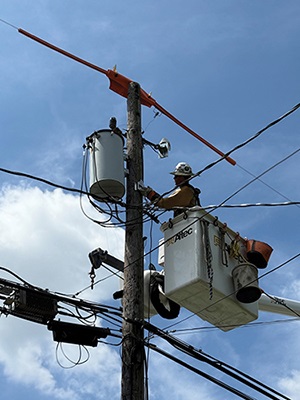
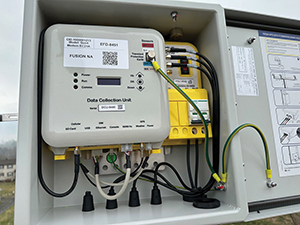
“INDT’s early fault detection sensors get installed on a utility pole or crossarm, where they then pair up with the network and identify and measure anything from excessive vegetation growth, conductors that are worn or have broken strands, deteriorating crossarms and insulators, and any other encumbrances that can pose a threat to the integrity of the system,” said Michael Simmonds, operations manager at Infrasource.
Offering early insight to potential hazards, “these sensors reduce customer outages while also avoiding the need for an employee to physically come out and survey the situation, which helps mitigate a safety risk.”
Once connected to a secondary service, Simmonds explained, the sensors use radio frequency to pinpoint and monitor outage-producing conditions within a 30-foot radius and relay that information to the power company’s system operations, which can dispatch a crew immediately or forecast when a repair will be needed to prevent an outage.
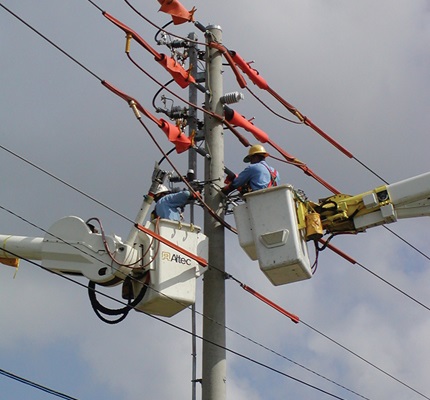
“This project required collaboration between field personnel, the utility’s engineering team and the Australian device manufacturer to ensure that the final result conformed with the power company’s specifications, and our linemen received daily work orders to perform an average of three complete device installs per day,” Simmonds said of the scope of Infrasource’s responsibilities.
“Once the sensors are installed and use radio frequency to communicate with each other, they display a constant sine wave unless that path is disrupted by an anomaly on the line, which the software monitors,” Christof said.
The technology, which was first introduced to the market more than a decade ago, has since been deployed by a growing number of utilities.
“By providing instantaneous monitoring of specific sections of line, the sensors provide much faster and more constant response than a person going out to assess the situation,” he said.
With the utility providing the sensors and Infrasource taking care of the labor, equipment and tooling, Infrasource’s crew members began their installation in mid-2024.
“Our utility client is a very technologically forward-thinking company that likes to try new products, and, through this project, they became the first utility in the United States to introduce the INDT technology at scale on their system for the purposes of mitigating outages and improving control and reliability,” Christof said. “Our specific assignment was to install 2,000 sensors across the property to address an area that serves about 2 million customers, and we placed them by following an installation map that was designed in tandem with the landscape.”
A cadre of challenges
While the sensors were deployed system-wide, “vegetation tends to be the No. 1 outage-producer, so the utility prioritized areas with a lot of tall vegetation and other sections of line where they’ve had repeated problems,” Simmonds said. “Installation time depended on the unique conditions and amount of space available in each location, but each sensor took about four hours to install. We typically ran two crews of four people each across the job’s six regions, so we had a total of 48 crew members installing the sensors.”
On the job, Infrasource’s lineworkers had some discretion as to where the units would be installed based on the condition of the poles, but spacing from the conductor required precise alignment to guarantee the units’ optimal performance. Units needed to be placed within a tight tolerance zone on single-phase applications, which required working carefully and installing extra rubber goods. On three-phase applications, they had to field engineer where the secondary service would be fed from after evaluating the condition of the adjacent poles.
While the sensors arrived assembled, Infrasource lineworkers engaged in some prefab activity by wiring them for a power supply and communication cable, relying on iPads to track materials, manage schedules, log work hours and provide real-time software updates to the early fault detection devices. Crew members also activated various traffic control patterns to secure a safe work zone.
Though the INDT devices proved relatively easy to install once in the hands of trained and qualified journeymen, Simmonds and Christof confirmed that their team was still confronted by certain challenges.
“Traditional hazards are always present when you’re working with high/primary voltages,” Simmonds said. “There was also a technical aspect to ensuring that the devices’ antennas were pointing in the right direction, like a mini cell tower.”
Weather issues on the two-year-long project luckily weren’t a concern, as the team refrained from scheduling installations at night or during inclement weather, but interactions with residents of the various neighborhoods they worked in were sometimes a different matter.
“Some homeowners were curious about what we were doing there, especially if we needed to be on their property to complete an installation, and could get angry,” Simmonds said. “Others were convinced that the sensor devices we were installing were cameras and were worried that their privacy was being violated. But once we explained that we were installing a device designed to reduce and prevent outages, they saw the benefit and were pretty understanding.”
A step forward for the industry
Since completing all 2,000 installations this spring, the Infrasource team couldn’t be prouder of their crew’s hard work or the stellar results they delivered to their client and its customers.
“The utility confirmed that the devices work well and are actively preventing outages and making their system more reliable,” Christof said. “As for our team, we hit every metric required of us by our client, even as they kept adding more work to our docket based on the sensors’ strong performance, and we were happy to work with INDT’s software engineers to help troubleshoot any situations that arose along the way.”
“The utility wanted to deploy this technology at scale—not just as a trial for select customers, but across all customers in an entire area, from mountainous regions to rural settings and cities—to assess its true effectiveness in real-time, and it proved to be a solid and cost-effective product that makes sense for utilities to consider,” Simmonds said. “If a utility’s goal is to improve reliability, this device will help achieve that.”
Simmonds added that the project was also a productive activity for Infrasource crew members to engage in alongside their other jobs.
“These installations were a good complement to our existing workload,” Simmonds said. “Some employees can get a little burned out doing the same thing over and over, like setting poles all day or doing other redundant tasks, so having these early fault detection installations to fall back on helped add variety to their workday and contributed to the success of this project, which we’re proud to say we completed on time and with no accidents or injuries.”
Simmonds and Christof are both impressed with the sensor technology and believe that it holds great promise for the utility industry going forward.
“INDT’s early fault detection devices reduce outage times for customers and also make for a safer work environment for our crews,” Simmonds said. “Line contractors always need to be operating in a safe setting and an investment in this monitoring device is a way for utilities to show both their customers and work crews that they prioritize safety and reliability.”
“I love to see the real-world application of new technologies driving improvement in the field, and this sensor device is an easy upgrade to get behind because it works and we believe in it,” Christof agreed. “Our client was the first utility to deploy this technology at scale, and we’re so honored that they put their trust in us to execute this project for them with technology that hasn’t been used before. We’re also proud to have worked directly with the manufacturer and to see that they made refinements to their system based on our feedback and field data. Other utilities and contractors have since reached out to us about our experience with the technology as well, and we’ve been happy to share what we know to help the industry move forward.”
Ultimately, he concluded, “use of this sensor technology is a great way for utilities to improve their operations and bolster relationships with both their customers and crew members.”
Infrasource
About The Author

BLOOM is a 25-year veteran of the lighting and electrical products industry. Reach her at [email protected].