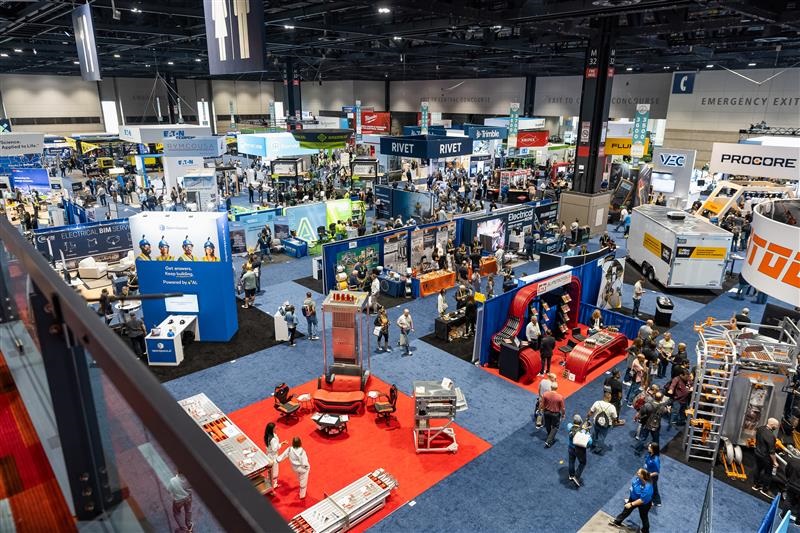
If you were not able to make it to NECA 2025 Chicago this year, I noticed two main themes. Artificial intelligence (A.I.), of course, was at the top of discussions in classes and on the show floor. Second would be automation solutions, either software or tools.
A few of the tools that really stood out were the iToolco B2 Rapid-Fire bender, the Krippa bender and the Milwaukee Tool M18 Fuel branch conduit bender. These are three very different machines tackling the same problem: how to bend conduit faster, more accurately and with fewer hands. Together, they highlight a growing shift in the trade where smart automation is about improving workflows so the electrical contractor can do more with less. As improving workflows and automating processes becomes a baseline strategy, and productivity becomes a critical metric, these tools are examples of the evolving electrical construction project.
The Krippa bender, for example, is bringing automated conduit bending to the prefab shop by solving three key issues: variability, spring-back and speed. Typical hand benders can introduce inconsistencies due to operator fatigue and manual pressure, often resulting in angles that can drift ±2 degrees from the intended angle. Krippa’s hydraulic system reduces that to within ±0.5 degrees, enabling higher QA/QC pass rates across identical assemblies. Its motorized assist also compensates for spring-back with consistent overbend correction, eliminating guesswork. Plane control—a critical component for saddle and offset bends—is dramatically improved, as the bender maintains steady torque and alignment without the need to physically “muscle” the conduit mid-bend. Most notably, time trials show that Krippa can complete a ¾-inch EMT 90- degree stub-up in roughly 4 seconds versus 9–10 seconds with a hand bender—a 2–3 times productivity gain. That equates to a savings of 1 minute per 15 bends. For high-volume prefab shops, that time savings scales fast. The ultimate result is faster bends, fewer errors, less rework and a smoother path to constructable prefabrication.
The iToolco B2 Rapid-Fire bender with the touchscreen option is designed for prefab shops and on-site work, and it handles ½-inch to 2-inch EMT, IMC and Rigid conduit with a single shoe. It does this through iToolco’s split-slip technology that auto-detects conduit type. A hydraulic load bar securely locks conduit into position at the push of a button, eliminating the struggle of manual alignment. Its B2 Detents system allows users to preset spring-back compensation for each conduit type and toggle between standard angles without recalibration. The touchscreen puts one-touch bends at the electrician’s fingertips. It can store and recall several bends with the push of a button, which eliminates having to scroll or retype bends when adjusting angles. Having the options of either corded or cordless, the Rapid-Fire bender gives the electrical contractor a conduit-bending solution at a lower price point, while still providing speed and accuracy.
Milwaukee Tool’s M18 Fuel branch conduit bender is an even smaller footprint than the iToolco bender. The M18 Fuel branch conduit bender is a cordless option used for bending up to 1-inch EMT and ¾-inch RMC conduit. Focusing on branch conduit, it brings automation to the field. This bender is cordless and uses the standard Milwaukee M18 batteries. It allows electricians to bend conduit directly at the point of installation, reducing the need for back-and-forth trips to a bending station. One of the features is its auto-zero technology, which automatically senses the zero-degree starting point on every bend, improving consistency and minimizing setup time. This bender is powered by a brushless motor, and it can perform up to approximately 110 bends on ¾-inch EMT per charge. This bender is a great example of a broader trend in the industry toward portable, battery-powered automation aimed at improving job site process and reducing labor fatigue.
Automation took center stage at NECA 2025 Chicago, where the industry spotlight shifted toward tools and technologies designed to streamline manual tasks and address ongoing labor shortages. These three examples are just a few of an ever-growing automation solution that is on the forefront of innovation. With electricians being in high demand for their installation skill set, they can spend more time installing and coordinating with other trades, instead of manually bending conduit.
About The Author

CHRISTMAN specializes in innovation and construction technology from an electrical contractors point of view. He is passionate about elevating the industry. He can be reached at [email protected].